TikTok scraping has become one of the most influential data platforms on the internet. What was once viewed primarily as a short-form entertainment app is now a massive ecosystem for trend discovery, product marketing, AI training, influencer analytics, and consumer behavior research. Brands monitor viral hashtags to predict product demand, agencies track creator engagement to optimize campaigns, and AI companies collect large-scale public content data to improve recommendation systems and language models.
As TikTok continues to expand globally, the value of TikTok data has increased significantly. Businesses are no longer scraping TikTok only for follower counts or basic video metrics. Modern scraping operations collect detailed engagement data, comment sentiment, regional trend signals, advertising creatives, audience interaction patterns, and product performance indicators from TikTok Shop.
At the same time, TikTok’s anti-bot infrastructure has become far more advanced. Traditional scraping setups that relied on datacenter proxies and simple scripts are no longer reliable. TikTok now combines browser fingerprinting, TLS detection, session analysis, behavioral monitoring, and IP reputation scoring to identify suspicious traffic with much higher accuracy than in previous years.
Because of this, successful TikTok scraping in 2026 requires a combination of high-quality residential proxies, browser automation, session management, and human-like browsing behavior.

Why TikTok Data Is So Valuable
TikTok has become one of the fastest-moving trend ecosystems online. Viral products, music, memes, and marketing campaigns can emerge and spread globally within hours. This makes TikTok an extremely valuable source of real-time consumer data.
For eCommerce sellers, TikTok scraping helps identify trending products before they become saturated. Dropshipping teams often monitor TikTok Shop engagement metrics, video performance, and creator campaigns to discover winning products early.
Marketing agencies use TikTok data to analyze competitor advertising strategies, influencer partnerships, audience engagement rates, and posting frequency. This allows brands to adjust campaigns based on real-time market behavior rather than relying on delayed analytics.
AI companies also increasingly rely on TikTok datasets for recommendation models, sentiment analysis, video categorization, and behavioral analysis systems. Public TikTok metadata provides large-scale structured data that can be useful for machine learning pipelines.
Why TikTok Scraping Became More Difficult
Scraping TikTok in 2026 is very different from scraping traditional websites. TikTok’s infrastructure is designed to detect automated traffic at multiple layers simultaneously.
The platform no longer relies only on rate limiting or IP blocking. Modern anti-bot systems evaluate browser fingerprints, TLS signatures, request timing, session consistency, cookie behavior, device attributes, and interaction patterns to determine whether traffic appears human.
Even if a scraper uses good proxies, poor browser fingerprints or unrealistic browsing behavior can still trigger detection systems. Many scraping failures today happen because the infrastructure looks artificial rather than because the scraping logic itself is incorrect.
Common TikTok scraping errors now include CAPTCHA challenges, temporary IP bans, login verification requests, session invalidation, and incomplete content loading. In large-scale scraping environments, these problems quickly reduce scraping efficiency if the infrastructure is not optimized correctly.

The Role of Residential Proxies in TikTok Scraping
Residential proxies have become one of the most important components of TikTok scraping infrastructure. Unlike datacenter proxies, residential IPs are assigned by internet service providers and appear as legitimate user connections.
This significantly improves trust scores and reduces the likelihood of triggering TikTok’s anti-bot systems.
For TikTok scraping, residential proxies are commonly used for:
- Large-scale trend collection
- Regional content analysis
- TikTok Shop monitoring
- Account management
- Ad intelligence collection
- Long-session browser automation
Rotating residential proxies are generally preferred for large scraping workloads because they distribute requests across many IP addresses. Static residential proxies, on the other hand, are more suitable for maintaining stable account sessions.
The table below shows the typical use cases for each proxy type.
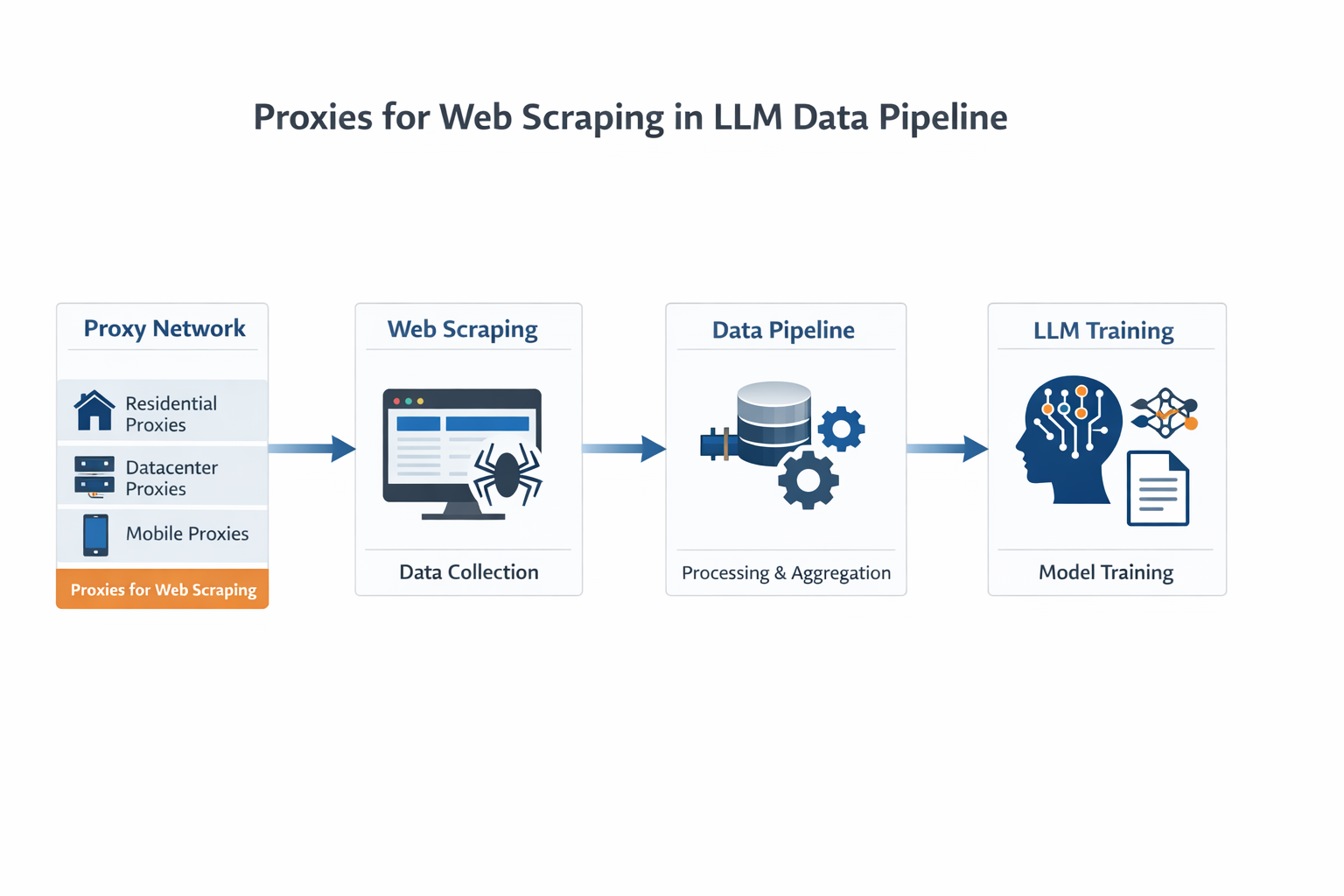
| Proxy Type | Primary Use Case |
|---|---|
| Rotating Residential Proxies | High-volume scraping and automation |
| Static Residential Proxies | Stable account sessions and browser management |
| Datacenter Proxies | Low-risk lightweight tasks |
| Mobile Proxies | Mobile app simulation and high-trust operations |
How TikTok Detects Scrapers
TikTok’s detection systems analyze much more than IP addresses. Browser identity has become equally important.
Modern browser fingerprinting techniques collect information such as screen resolution, installed fonts, WebGL rendering data, audio signatures, hardware characteristics, and browser behavior patterns. These signals help TikTok determine whether a session resembles a real user environment.
Behavioral analysis is another major factor. TikTok monitors scrolling speed, mouse movement, click timing, navigation flow, and session duration. Automated interactions that move too quickly or follow repetitive patterns can increase detection risk significantly.
TLS fingerprinting has also become increasingly important in recent years. Many automation tools generate network signatures that differ from real browsers, making them easier to identify. Advanced anti-bot systems compare these signatures against legitimate browser traffic patterns to detect automation frameworks.
Because TikTok combines all of these signals together, modern scraping infrastructure must focus on realism rather than simple request volume.
Recommended Tools for TikTok Scraping
| Purpose | Tool |
|---|---|
| Browser Automation | Playwright |
| Fingerprint Browser | AdsPower / Dolphin Anty |
| CAPTCHA Solving | 2Captcha |
| Proxy Infrastructure | colaproxy |
Building a Modern TikTok Scraping Stack
A reliable TikTok scraping setup typically combines browser automation tools, residential proxy infrastructure, fingerprint management, and session persistence.
Playwright has become one of the most widely used browser automation frameworks because it provides better browser control and compatibility with modern anti-bot systems than many older automation tools.
The following example demonstrates a basic Playwright setup using a residential proxy:
from playwright.sync_api import sync_playwright

proxy = {
    "server": "http://proxy_host:proxy_port",
    "username": "proxy_user",
    "password": "proxy_password"
}

with sync_playwright() as p:
    browser = p.chromium.launch(
        headless=False,
        proxy=proxy
    )

    page = browser.new_page()
    page.goto("https://www.tiktok.com")

    print(page.title())

    browser.close()
While this example is relatively simple, production-level TikTok scraping systems usually include additional components such as browser fingerprint masking, session rotation, concurrency management, and CAPTCHA handling.
A typical scraping architecture may look like this:
| Component | Purpose |
|---|---|
| Residential Proxies | IP rotation and geo-targeting |
| Playwright or Puppeteer | Browser automation |
| Fingerprint Browser | Browser identity management |
| Session Storage | Cookie persistence |
| CAPTCHA Handling | Challenge bypassing |
| Queue System | Request scheduling |
Browser Automation vs API Scraping
Some developers attempt to scrape TikTok using direct API requests because API-based scraping is generally faster and consumes fewer resources. However, API scraping is also more likely to trigger detection systems due to its unnatural traffic patterns.
Browser-based scraping is slower and more resource-intensive, but it more closely resembles legitimate user behavior. This approach often provides better long-term stability when collecting dynamic TikTok content at scale.
In 2026, browser automation combined with residential proxies is typically the preferred approach for large TikTok scraping operations.
Geo-Targeting and Regional Data Collection
TikTok content differs heavily across regions. Trends that appear viral in the United States may not exist in Southeast Asia or Europe. For companies performing market analysis, geo-targeted scraping has become increasingly important.
Residential proxies allow scraping traffic to appear from specific countries and cities, making it possible to collect localized TikTok trends and search results.
This is especially valuable for:
- TikTok Shop analysis
- Localized influencer campaigns
- Regional trend prediction
- Market expansion research
- International advertising intelligence
Best Practices for Reducing Detection Risk
Successful TikTok scraping now depends more on infrastructure quality than raw scraping speed. Aggressive scraping patterns usually fail quickly under modern anti-bot systems.
The most reliable scraping setups focus on maintaining realistic browsing behavior. This includes introducing delays between actions, randomizing interaction timing, limiting concurrency, and preserving stable browser sessions.
Using high-quality residential proxies is also critical. Low-quality proxy pools often contain abused or flagged IP addresses, which increases block rates significantly.
It is also important to avoid excessive account activity. Rapid logins, sudden geographic changes, and high-frequency automation patterns can trigger account verification systems even when good proxies are used.
Choosing the Right Proxy Provider for TikTok Scraping
Not all proxy providers perform equally well for TikTok automation and scraping. Proxy quality directly affects block rates, session stability, and scraping efficiency.
When evaluating a proxy provider, businesses should focus on:
- Residential IP quality
- Geo-targeting support
- Session stability
- Rotation control
- IP pool size
- Network speed
- Compatibility with browser automation
ColaProxy provides residential proxy infrastructure designed for web scraping, automation, AI data collection, and social media operations. Its global residential IP network supports geo-targeted sessions and scalable scraping workflows suitable for TikTok data collection environments.
Final Thoughts
TikTok scraping in 2026 requires far more than simple scripts and cheap proxies. The platform’s anti-bot infrastructure has evolved into a highly sophisticated system capable of analyzing browser behavior, network fingerprints, IP reputation, and user interaction patterns simultaneously.
As a result, successful scraping operations now depend on building realistic browsing environments supported by high-quality residential proxies and reliable browser automation frameworks.
Businesses that invest in stable infrastructure, content-focused data strategies, and scalable automation systems will have a major advantage in trend analysis, competitor intelligence, AI model training, and TikTok Shop research as the platform continues to grow.