App Store Proxy infrastructure can help app intelligence teams collect and compare public app-market observations from different geographic network locations. For developers, publishers, ASO teams, and market researchers operating internationally, this creates a practical network layer for studying how app markets differ across regions without routing every research request through one fixed server IP.
The important word here is observation.
An app marketplace is not necessarily a single global catalog that looks identical everywhere. App availability, pricing, storefronts, localization, rankings, and commercial conditions can vary by country or region. Google Play, for example, allows developers to control country availability and set country-specific prices. Apple similarly operates regional App Store storefronts.
A proxy does not override these platform systems.
Changing an IP address alone does not guarantee that a platform will treat a session as belonging to another country. Account country, storefront configuration, device compatibility, language, cookies, application state, and other signals may also matter.
Instead, residential proxies solve a narrower but valuable problem: they allow a research system to control the network location from which compatible requests originate.
For regional app-market research, that makes IP location a measurable variable rather than an uncontrolled one.
This article examines seven practical ways residential proxy infrastructure can support regional app-market research.
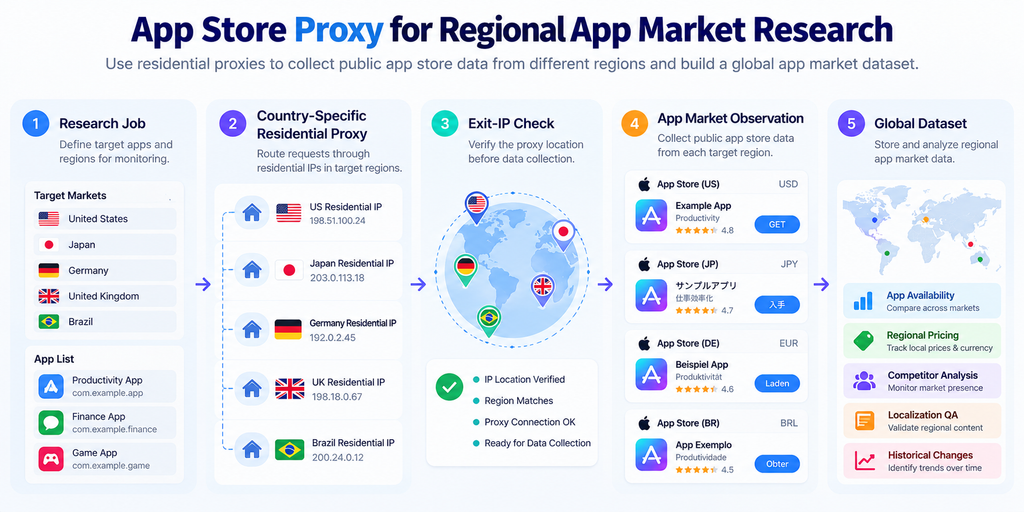
Why Regional App Research Needs More Than One Network Location
Imagine an app publisher based in the United States researching opportunities in the United States, Japan, Germany, Brazil, and the United Kingdom.
The team wants to understand which competing apps are visible, how public app pages are localized, which apps appear in selected market observations, and how public commercial information differs between markets.
If every automated research request originates from the same US data-center IP, the research system has only one network perspective.
A residential proxy layer allows the system to separate those jobs.
A US research job can use a US residential route, while Japanese and German research jobs can use appropriate network exits for their respective markets.
The resulting observation should preserve that context.
| Field | Example |
|---|---|
| Target market | Japan |
| Proxy region | Japan |
| Platform | App marketplace |
| App identifier | App being monitored |
| Observed price | Local observation |
| Currency | JPY |
| Language | Japanese |
| Availability observation | Available / not observed |
| Timestamp | Observation time |
The purpose of this structure is not to claim that the proxy alone created the observed result.
It allows researchers to say exactly where and under what network conditions the observation was collected.
That distinction makes cross-market data much more reliable.
1. Compare App Availability Across Regional Markets
One of the most useful App Store Proxy applications is regional availability research.
An application available in one country may not necessarily have the same distribution status everywhere. Developers can configure country or region availability, and commercial availability can also vary between markets.
For app intelligence companies, this creates a valuable dataset.
A monitoring system can maintain a list of relevant applications and periodically perform permitted public observations from several target regions.
Instead of storing only:
App available: Yes
the system should preserve:
App observed in Market A at Time B under Network Context C.
This is especially important when an app appears in one regional observation but not another.
A residential proxy allows the collection worker to use a network exit appropriate for the market being researched. If the application is monitoring 20 countries, those observations do not all have to originate from the same cloud-server IP.
However, the system should avoid concluding that IP location alone determines app availability.
For example, Google Play explains that country targeting can depend on the user’s registered Play country rather than simply the user’s current physical location. Apple also maintains an App Store storefront concept associated with the customer’s region.
Proxy observations should therefore be combined with other controlled test conditions when precise storefront validation is required.
This limitation does not make proxy routing useless. It makes the methodology more accurate.
2. Monitor Regional App Pricing Without Losing Context
Pricing is another area where regional app-market research becomes valuable.
Google Play allows developers to manage prices by country or region and can generate local prices using currencies, exchange rates, taxes in applicable markets, and locally relevant pricing patterns.
That means a global app pricing dataset should not treat one observed price as universal.
Suppose an intelligence platform monitors a group of paid productivity applications.
Instead of collecting:
App A — $9.99
the system can build a regional price observation:
App A — United States — USD — observed price — timestamp
and separately:
App A — Japan — JPY — observed price — timestamp
A residential proxy can provide the corresponding network route for each compatible observation.
The original values should be preserved before currency normalization.
This is important because converting every price into USD during collection destroys part of the source information.
A better architecture separates the two stages:
Regional Observation → Original Price and Currency → Normalization → Cross-Market Analysis
Researchers can then investigate whether an app follows roughly equivalent global pricing, uses differentiated regional pricing, or changes its pricing strategy over time.
The proxy is not being used to “find cheaper apps.”
Its purpose is to support a controlled network environment for regional market research.
3. Research Competitor Presence Across Countries
App publishers rarely compete against exactly the same market environment everywhere.
A finance app expanding into Japan may face a different competitive landscape from the one it encounters in the United States. A productivity tool popular in Europe may have much lower visibility in another market.
This makes regional competitor observation a useful application for residential proxies.
A research system can define a set of competitor apps and collect comparable public observations for each target market.
The same methodology should be repeated consistently.
For example, if the objective is to study a category, the system should keep the category definition, observation schedule, and relevant test conditions as stable as practical while changing the target regional network context.
Over time, the resulting dataset can show which competitors are repeatedly observed in each market and where competitive conditions appear to differ.
The important analytical structure becomes:
App × Market × Observation Time
rather than simply:
App
This sounds like a small distinction, but it changes what questions the dataset can answer.
A single global app record tells researchers what the app is.
A regional historical dataset helps researchers understand where and when its market presence was observed.
4. Validate App Store Localization from Different Regions
Localization involves much more than translating an app description.
International app publishers may need to validate public-facing elements such as titles, descriptions, screenshots, currencies, promotional text, and other region-specific presentation.
A regional proxy can form part of this quality-assurance workflow.
Suppose an app publisher updates its Japanese, German, and US storefront content.
The QA system can create three separate observation jobs and assign the appropriate network route to each one.
The resulting pages can then be checked against expected localization rules.
For example, the Japanese observation should not unexpectedly contain English copy where Japanese localization is expected. A German storefront observation should use the intended regional presentation. Commercial information should also be checked against the expected market configuration.
Residential proxy infrastructure is useful here because the QA team does not need to operate a physical testing server in every target country merely to obtain a different network exit.
But network location should not be confused with storefront identity.
If a platform also depends on account region or storefront settings, those variables need to be configured separately.
A professional localization test therefore treats the proxy as one layer of the environment rather than pretending that the proxy controls the entire marketplace.
5. Track Regional App Market Changes Over Time
The strongest app-market datasets are historical.
Collecting a regional app page once can answer a narrow question about that moment. Repeating comparable observations over months can reveal how the market is changing.
A monitoring system might observe selected competitors weekly or daily, depending on the research objective.
Instead of storing every page as an unrelated document, the system can normalize important fields and compare each new observation with the previous one.
Meaningful changes can then become events.
For example:
AVAILABILITY_CHANGED
PRICE_CHANGED
LOCALIZATION_CHANGED
METADATA_CHANGED
MARKET_OBSERVATION_CHANGED
Each event retains its regional context.
This creates a much more useful research model than simply scraping app pages at scale.
Imagine discovering that a competitor has become newly observable in several target markets, changed its regional pricing, and updated its localized storefront during the same month.
Individually, those observations may seem minor.
Together, they may indicate an international expansion strategy worth investigating.
Proxy infrastructure supports the regional collection layer, while historical comparison turns those observations into market intelligence.
6. Use Residential Proxy Sessions for Consistent Regional Research
Regional app research is not only about selecting a country.
The collection system also needs consistent network behavior.
Suppose one research job requires several related public observations for the same app.
If every request unexpectedly moves between unrelated geographic regions, the resulting dataset becomes difficult to interpret.
The proxy strategy should therefore follow the research unit.
Independent observations can use separate residential proxy sessions.
Related requests that should remain under the same network identity can use a sticky session where appropriate.
Most importantly, geographic configuration should remain consistent throughout a regional observation.
A Japan research job should not begin with a Japanese network exit and unexpectedly continue through another country.
For large monitoring systems, the scheduler can associate every job with a defined proxy profile:
Target Market → Proxy Region → Session Policy → Observation
This makes proxy behavior reproducible.
It also prevents one of the most common problems in multi-region datasets: mixing observations collected under different network conditions without recording the difference.
7. Build a Global App Intelligence Dataset with Regional Proxies
The previous six use cases become significantly more valuable when combined.
Instead of creating separate scripts for availability, pricing, competitors, and localization, an app intelligence platform can use one regional observation architecture.
Suppose the system monitors 2,000 apps across 15 target markets.
The scheduler determines which apps need to be observed and when.
Each job receives a target market.
The proxy layer provides the appropriate residential network route.
The worker verifies the route and performs the permitted public observation.
The result is normalized and stored with its market, network context, and timestamp.
The final dataset can support multiple forms of analysis without requiring the network layer to understand the business question.
A simplified architecture looks like this:
App List → Market Assignment → Residential Proxy → Regional Observation → Normalized Data → Historical Comparison → Market Intelligence
This separation matters.
The proxy provides network routing.
The collector records public information.
The database preserves historical observations.
The analytics system identifies meaningful differences.
When those responsibilities are mixed together, errors become difficult to diagnose. When they remain separate, the same infrastructure can support thousands of apps and many markets without losing the provenance of each observation.
Why Exit-IP Verification Matters
A regional research system should never assume that a proxy route is correct simply because the request did not fail.
Before accepting observations into the dataset, the worker can verify that the proxy gateway is reachable, authentication succeeds, and the observed exit IP is consistent with the intended geographic configuration.
If a Japan job receives an incorrect route, the correct response is not to continue collecting data and label it “Japan.”
The job should be retried or rejected according to the monitoring policy.
This creates a clean boundary between network failures and marketplace observations.
A proxy authentication error is a network failure.
A connection timeout may be a network or destination failure.
An app not being observed after a successful, correctly routed request is a marketplace observation under those test conditions.
Those outcomes should never be stored as the same result.
For app-market intelligence, data provenance is as important as collection volume.
Where ColaProxy Fits in Regional App Market Research
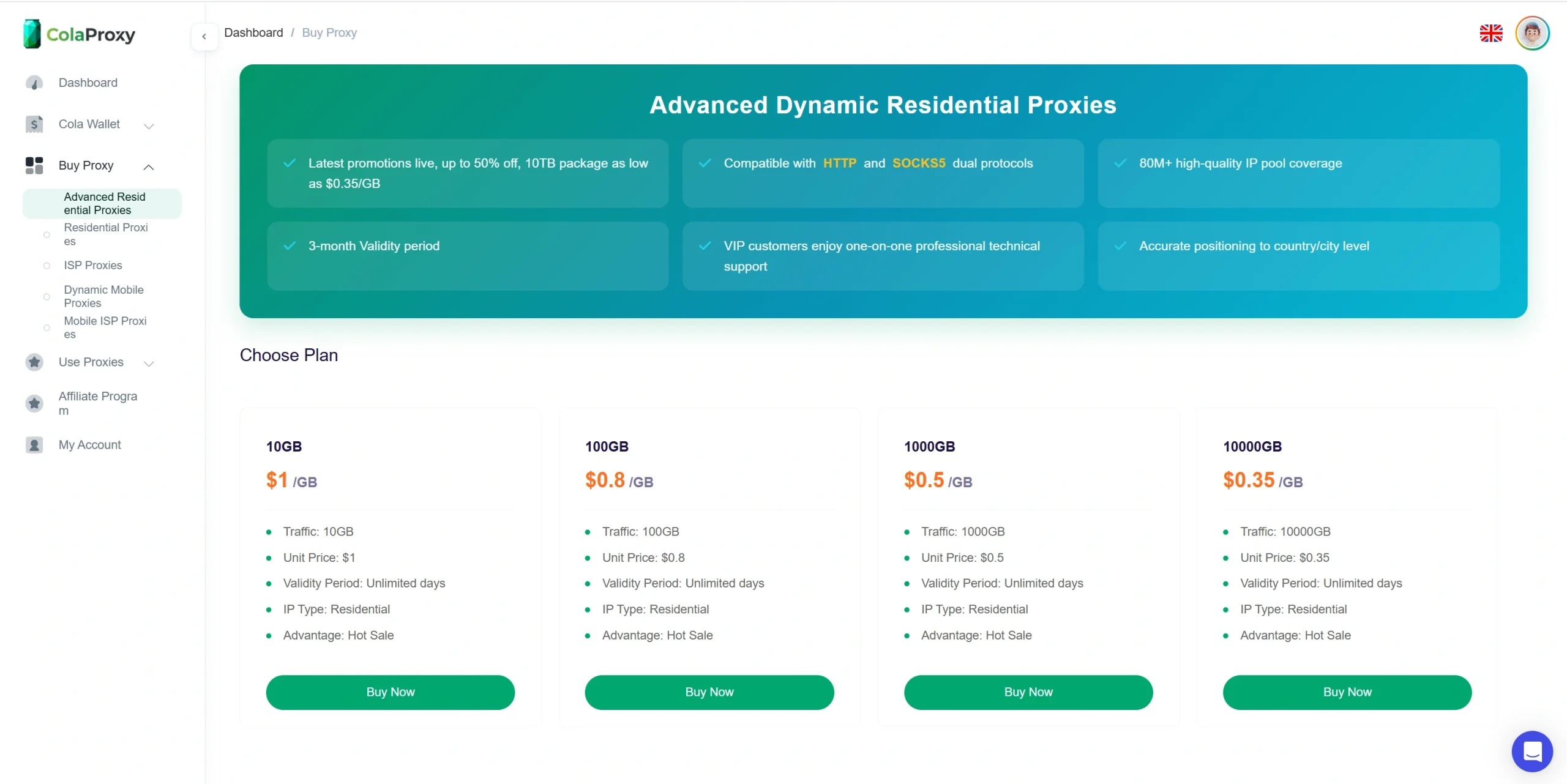
ColaProxy can provide the residential proxy network layer for compatible regional app-market research workflows.
A monitoring application can select the appropriate proxy configuration available in the ColaProxy dashboard, assign geographic routes to different research jobs, use sticky or rotating sessions according to the workflow, and verify the exit IP before accepting an observation.
The process can remain simple:
Choose Target Market → Configure Residential Proxy → Verify Exit IP → Collect Permitted Public Observation → Store Regional Context → Compare Historical Data
This architecture keeps the role of proxy infrastructure precise.
ColaProxy provides the network route.
It does not change an App Store account’s registered country, override Google Play country settings, force an application to become available in a market, or guarantee a particular storefront.
Those behaviors are controlled by the respective platforms and may depend on signals beyond IP location.
For researchers, however, controlling the network layer is still valuable because it removes one uncontrolled variable from cross-market observations.
App Store Proxy vs. Account Region: Understand the Difference
This distinction deserves particular attention because it prevents misleading research.
A residential proxy can change the network exit location of a compatible request.
It does not automatically change every regional signal associated with an app marketplace.
For example, Google Play states that certain country-targeting behavior is based on the user’s Play country rather than the user’s current location. Apple likewise exposes App Store storefront information associated with the customer’s region.
Therefore:
Proxy Region ≠ Account Country ≠ Storefront Region
Sometimes these variables may align.
Sometimes they may not.
A robust research system records or controls them separately wherever possible.
This also provides a more useful interpretation of proxy-based results.
Instead of claiming:
“This proxy shows exactly what every Japanese App Store user sees.”
a better conclusion is:
“This observation was collected through a Japanese residential network route under the defined test conditions.”
The second statement is both more accurate and more useful for reproducible research.
Building High-Quality Regional App Data
Collecting more pages does not automatically produce better app intelligence.
For cross-market analysis, consistency matters more.
Researchers should use the same app identifiers, comparable observation schedules, consistent geographic definitions, and clearly documented collection conditions.
Original observations should also be preserved before downstream transformations.
If a Japanese price is displayed in JPY, preserve the JPY value. If an app was not observed in a particular market, preserve that outcome rather than immediately assuming the application is unavailable.
Analytical conclusions should happen after collection.
This approach reduces the risk of turning uncertain observations into false facts.
It also makes the dataset more useful for future analysis because researchers can return to the original observation context.
Responsible App Market Research
Residential proxies should be used for legitimate, authorized research and testing.
Proxy infrastructure does not provide permission to access restricted information, bypass authentication requirements, or disregard platform rules.
Monitoring systems should respect applicable laws, platform terms, access controls, and reasonable request rates.
Efficient collection also improves data quality.
Instead of repeatedly retrieving unchanged information, systems can use sensible scheduling, deduplication, caching, and change detection to focus resources on meaningful observations.
The goal of a regional app intelligence system should not be maximum request volume.
It should be reliable, comparable observations across the markets that matter.
Conclusion
App Store Proxy infrastructure can provide an important network layer for regional app-market research.
Its value is not simply changing an IP address.
Residential proxies allow research systems to separate geographic workloads, create controlled regional network contexts, maintain consistent sessions, verify exit locations, and avoid tying an entire global dataset to one server IP.
Those capabilities can support app availability research, regional pricing analysis, competitor monitoring, localization QA, historical change detection, and larger global app-intelligence systems.
But IP geography should never be treated as the only regional signal.
Account country, App Store storefront, Google Play country, device compatibility, language, platform configuration, and other factors can influence what is available or displayed.
The strongest methodology therefore treats a residential proxy as one controlled network variable inside a broader regional research environment.
When every observation preserves its market, time, network context, and original values, proxy-enabled collection becomes more than app-page scraping.
It becomes a reproducible regional app-market dataset.
And for companies studying how mobile markets differ around the world, that dataset can be far more valuable than a single global view.
FAQ
What is an App Store Proxy?
An App Store Proxy generally refers to proxy infrastructure used by compatible research or monitoring applications to make permitted requests through different network locations when studying regional app markets.
Why use residential proxies for app-market research?
Residential proxies allow researchers to use network exit points in different geographic locations rather than routing every observation through one fixed office or data-center IP.
Can a proxy change my App Store country?
A proxy can change the network location of a compatible request, but it does not automatically change an account country, App Store storefront, Google Play country, or every other regional signal used by an app marketplace.
Can App Store proxies be used for regional price research?
They can provide the regional network layer for permitted observations. Researchers should preserve the original displayed currency and market context before performing currency conversion or cross-market comparisons.
Can a residential proxy guarantee that an app is available in a particular country?
No. App availability can depend on developer distribution settings, account or storefront region, device compatibility, platform rules, and other factors beyond IP location.
Should app-market monitoring use rotating or sticky proxies?
Independent observations may use rotating residential sessions, while related requests may benefit from sticky sessions. Geographic consistency should take priority when comparing regional markets.
Why should an app intelligence system verify the exit IP?
Exit-IP verification helps confirm that an observation actually used the intended network route before it is accepted into a regional dataset.