
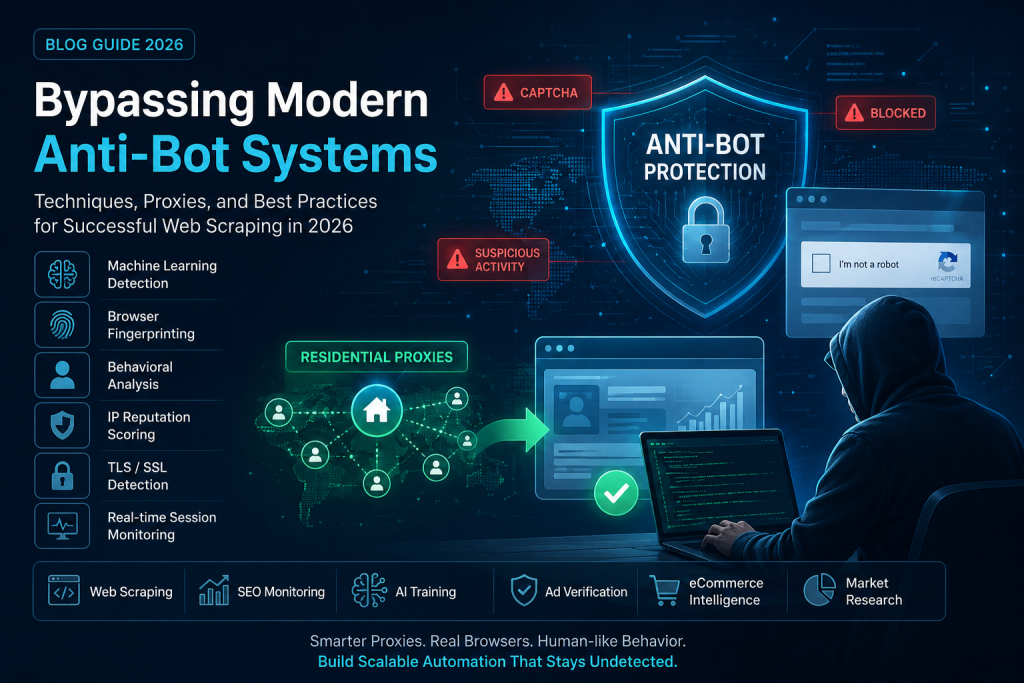
The internet has become increasingly restrictive toward automated traffic. In 2026, websites are no longer relying on simple rate limits or basic firewall rules to stop bots. Modern anti-bot systems now combine machine learning, browser fingerprinting, behavioral analysis, TLS detection, IP reputation scoring, and real-time session monitoring to identify suspicious traffic with remarkable accuracy. For businesses involved in web scraping, SEO monitoring, AI training, ad verification, social media automation, eCommerce intelligence, or market research, bypassing these systems has become one of the biggest technical challenges in large-scale automation.
The reality is that traditional scraping methods are no longer effective against enterprise-level protection systems. Sending repeated requests from datacenter IPs with outdated automation scripts usually leads to immediate blocks, CAPTCHA challenges, or account suspensions. Websites today can identify automated traffic long before a request even reaches the application layer. This is why developers and data collection teams are shifting toward more advanced proxy infrastructure, real browser automation, and sophisticated session management strategies.
In this guide, we will explain how modern anti-bot systems work, why residential proxies have become essential for automation, and what practical methods professionals use to reduce detection rates while maintaining stable scraping performance.
Why Anti-Bot Systems Have Become More Aggressive
The rapid growth of AI tools, automated data collection, and large-scale scraping operations has pushed websites to strengthen their defenses. Platforms such as Amazon, TikTok, LinkedIn, Instagram, Walmart, and Google process enormous amounts of traffic every day, making them constant targets for automated systems. As a result, companies now invest heavily in advanced anti-bot infrastructure to protect their platforms from abuse, fraud, spam, account farming, and unauthorized data extraction.
Modern anti-bot providers such as Cloudflare, DataDome, Akamai, HUMAN Security, Kasada, and PerimeterX have significantly changed the landscape of web automation. These systems do not simply analyze IP addresses anymore. They evaluate complete browsing environments and compare user behavior against large datasets generated from real visitors. Even subtle inconsistencies can trigger detection mechanisms.
For example, if a browser claims to be running on Windows while exposing rendering properties associated with Linux, the session may immediately appear suspicious. If a user changes countries multiple times within a few minutes while maintaining identical browser fingerprints, anti-bot systems can classify that activity as automated behavior. Detection engines are becoming increasingly capable of identifying patterns that humans would never notice manually.
This shift means that bypassing anti-bot systems is no longer about sending requests through random proxies. It now requires a complete infrastructure strategy that combines high-quality IPs, browser fingerprint consistency, behavioral simulation, and intelligent session management.
How Websites Detect Automated Traffic
Most websites today rely on multiple layers of bot detection working simultaneously. IP reputation is still important, but it represents only one part of a much larger detection framework. Websites collect hundreds of signals from every visitor session and evaluate those signals in real time.
One major factor is browser fingerprinting. Modern browsers expose a large amount of information through JavaScript APIs, including screen resolution, GPU rendering details, installed fonts, operating system properties, WebGL behavior, CPU architecture, timezone settings, audio processing characteristics, and hardware performance metrics. Anti-bot systems combine these values to create unique browser fingerprints capable of tracking users across multiple sessions.
Behavioral analysis has also become extremely sophisticated. Websites monitor mouse movements, scrolling speed, click intervals, keyboard timing, page interaction patterns, and navigation behavior. Human interactions naturally contain randomness, hesitation, and inconsistency. Bots, on the other hand, often generate highly predictable patterns that machine learning systems can identify quickly.
TLS fingerprinting is another powerful detection method widely used in 2026. Websites inspect how browsers establish encrypted connections and compare those characteristics against known browser signatures. Many automation frameworks generate network fingerprints that differ from genuine browsers, making them easier to identify even before any page interaction occurs.
Because these detection layers operate together, bypassing anti-bot systems requires more than simply hiding your IP address. Every part of the browsing environment must appear realistic and internally consistent.
Why Residential Proxies Are Essential
Residential proxies have become one of the most important tools for bypassing modern anti-bot systems. Unlike datacenter proxies, residential IPs originate from real household devices connected through legitimate internet service providers. This makes them significantly more trustworthy in the eyes of anti-bot platforms.
Most websites already maintain databases containing suspicious IP ranges associated with cloud hosting providers such as AWS, Google Cloud, Azure, and OVH. Traffic coming from these providers is often flagged immediately because many large-scale bots operate from datacenter infrastructure. Residential proxies reduce this risk because they resemble genuine consumer traffic.
In addition to improving trust scores, residential proxies also help distribute requests naturally across multiple geographic locations. This is especially important for web scraping projects involving localized search results, regional content access, ad verification, sneaker automation, or eCommerce price monitoring.
High-quality providers such as ColaProxy offer rotating residential proxy networks designed specifically for automation and large-scale data collection. Access to clean residential IPs can dramatically reduce CAPTCHA frequency, lower block rates, and improve long-term session stability. In many scraping environments, the quality of the proxy network directly determines whether a project succeeds or fails.
Browser Automation Has Replaced Traditional Scraping
Several years ago, many scraping projects relied on direct HTTP requests because websites were relatively simple and server-rendered. That approach is far less effective today. Modern websites depend heavily on JavaScript frameworks, asynchronous rendering, dynamic APIs, and client-side verification systems that require full browser execution.
As a result, browser automation frameworks such as Playwright, Puppeteer, and Selenium have become standard tools for modern web scraping. These frameworks allow developers to control real browsers capable of executing JavaScript, rendering pages correctly, and interacting with websites like human users.
However, launching a browser alone is not enough to bypass advanced detection systems. Websites can still identify automation frameworks through browser inconsistencies, missing APIs, unusual rendering behavior, or abnormal interaction patterns. Professional scraping operations therefore combine browser automation with stealth patches, fingerprint management systems, and residential proxy infrastructure.

Successful automation now focuses on realism rather than raw speed. Bots that attempt to scrape hundreds of pages per minute usually trigger detection systems quickly. More sophisticated setups intentionally mimic natural browsing behavior by introducing delays, scrolling actions, realistic mouse movements, and session persistence.
How Stealth Browsers Reduce Detection
Stealth browser frameworks modify browser behavior to reduce detectable automation signals.
For example, Puppeteer Stealth patches:
- navigator.webdriver
- Browser plugins
- Chrome runtime APIs
- WebGL behavior
- Browser permissions
- Media codecs
- Language settings
Example setup:
const puppeteer = require('puppeteer-extra');
const StealthPlugin = require('puppeteer-extra-plugin-stealth');

puppeteer.use(StealthPlugin());

(async () => {
  const browser = await puppeteer.launch({
    headless: false
  });

  const page = await browser.newPage();

  await page.goto('https://example.com');

  console.log(await page.title());

  await browser.close();
})();
Stealth patches dramatically improve browser realism.
However, browser stealth alone still does not solve:
- IP reputation
- TLS fingerprints
- Session trust
- Behavioral analysis
- Request correlation
This is why modern anti-detection systems require multiple infrastructure layers working together.
The Importance of Browser Fingerprint Consistency
One of the biggest mistakes in automation is ignoring browser fingerprint consistency. Many users rotate proxies aggressively while keeping the same browser environment unchanged. This creates unrealistic behavior because real users do not instantly switch countries while maintaining identical hardware fingerprints and browser configurations.
Modern anti-bot systems compare IP geolocation against timezone settings, browser language, keyboard layouts, WebRTC information, and other environmental factors. If these values do not align logically, the session may receive a higher risk score.
For example, a browser using a French residential IP should ideally display French language preferences, a matching timezone, and realistic regional behavior. If the browser simultaneously reports an Asian keyboard layout and a North American timezone, the inconsistency becomes detectable.
Advanced scraping systems therefore synchronize fingerprints carefully with proxy locations. This level of consistency helps sessions appear much more authentic and significantly improves long-term success rates.
Session Management Is Critical for Large-Scale Automation
Another important aspect of bypassing anti-bot systems is session management. Real users maintain browsing continuity over time. They store cookies, revisit websites, preserve login sessions, and interact with pages naturally across multiple visits.
Bots that constantly create fresh sessions without preserving state often appear suspicious. Websites interpret repeated logins, excessive cookie resets, and unstable browsing identities as signs of automation.
Professional scraping systems therefore prioritize session persistence. Cookies are stored and reused, login sessions remain active for extended periods, and IP rotation strategies are carefully controlled rather than randomized excessively. Long-lived residential sessions often perform much better than rapidly rotating proxy pools because they resemble genuine user behavior more closely.
This is particularly important for account management tasks involving social media platforms, eCommerce accounts, advertising dashboards, or marketplace automation systems where trust scores influence account stability.
CAPTCHA Avoidance and Detection Reduction
CAPTCHA systems remain one of the most common barriers in web automation. Although CAPTCHA-solving services exist, relying heavily on them increases costs and slows scraping operations significantly.
The most effective strategy is reducing CAPTCHA triggers before they occur. High-quality residential proxies play a major role in this process because trusted IPs naturally generate fewer security challenges. Stable browser fingerprints, realistic interaction patterns, and proper session persistence also help maintain lower detection rates.
Many developers mistakenly believe that rotating IPs constantly will improve success rates. In reality, excessive rotation often creates suspicious patterns because genuine users typically maintain consistent sessions for reasonable periods of time.
Websites increasingly evaluate overall browsing trust rather than individual requests. A stable residential session with realistic behavior often performs far better than aggressive scraping setups using thousands of rapidly changing IP addresses.
The Future of Anti-Bot Bypass Technology
The battle between automation systems and anti-bot providers continues to evolve rapidly. Artificial intelligence is now being used on both sides. Websites deploy AI-driven detection engines capable of analyzing massive behavioral datasets in real time, while scraping developers use AI models to generate more human-like interaction patterns.
This technological competition means that simple scraping scripts will continue losing effectiveness. Successful automation in the future will depend on infrastructure quality, browser realism, behavioral simulation, and adaptive scraping strategies.
Residential proxies will remain one of the most important components in this ecosystem because IP trust continues to influence nearly every stage of anti-bot analysis. Providers capable of delivering clean, stable, and geographically diverse residential IPs will play a critical role in modern data collection operations.
As websites become more sophisticated, automation teams must shift away from outdated scraping methods and focus on building systems that behave as closely as possible to real human users.
Conclusion
Bypassing anti-bot systems in 2026 requires a comprehensive approach rather than simple proxy rotation. Websites now analyze browser fingerprints, behavioral patterns, session history, TLS signatures, and IP reputation simultaneously. This makes modern automation significantly more complex than it was only a few years ago.
Residential proxies, browser fingerprint consistency, realistic behavior simulation, and intelligent session management are now essential components of successful web scraping infrastructure. Businesses involved in data collection, AI training, SEO monitoring, ad verification, and multi-account management must invest in high-quality automation systems capable of operating within increasingly restrictive environments.
Solutions such as ColaProxy residential proxies provide the stable IP infrastructure necessary for reducing detection risks and improving scraping reliability at scale. As anti-bot technology continues evolving, the most successful automation systems will be those that prioritize realism, trust, and long-term session stability over raw scraping speed.