In 2026, Crawl4AI vs Firecrawl comparison shows that web scraping is no longer just about extracting data—it is about surviving increasingly advanced detection systems.
Modern platforms such as Google, Amazon, TikTok, and Shopee no longer simply respond to requests. Instead, they evaluate every interaction through multiple layers of detection, including:
- IP reputation and ASN trust scoring
- Browser fingerprint consistency
- Session behavior and navigation patterns
- Geo-location alignment
If a scraping system does not closely resemble real-user behavior, requests will not only fail but may also be silently throttled, filtered, or degraded.
This shift is why the Crawl4AI vs Firecrawl comparison is no longer about feature differences alone, but about real-world reliability under anti-bot systems.
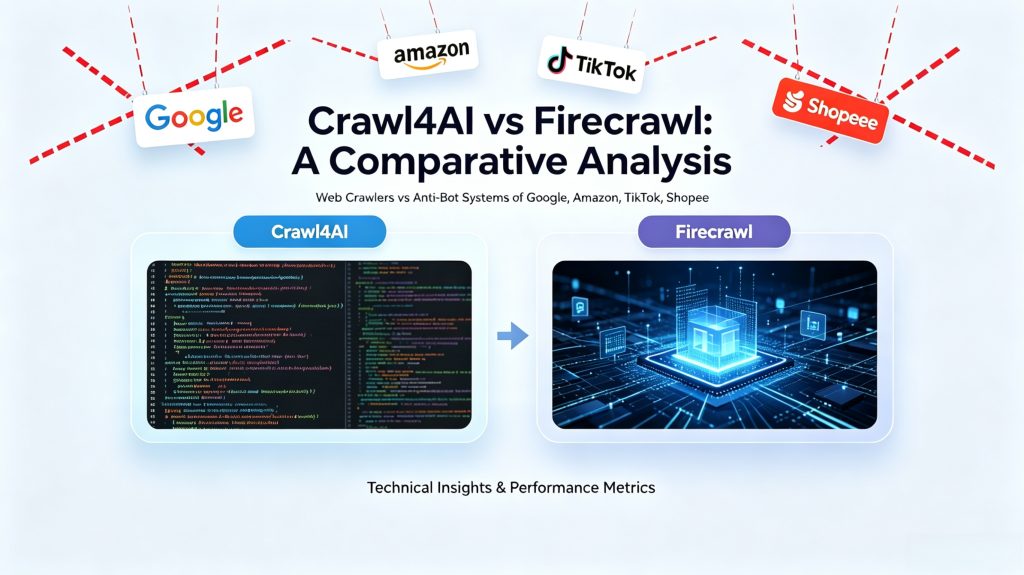
Table of Contents
Crawl4AI vs Firecrawl: Quick Answer (2026)
If you need a fast decision:
Firecrawl is best for quick web scraping, MVPs, and simple API-based data extraction.
Crawl4AI is best for scalable web scraping, AI data pipelines, and anti-detection environments.
This comparison of Crawl4AI vs Firecrawl helps developers choose the right scraping architecture in 2026.
Two Different Philosophies: Framework vs Abstraction
The difference between Crawl4AI vs Firecrawl comparison becomes especially important when building production-grade web scraping systems.
In modern AI-driven workflows, the choice of scraping tool directly impacts data quality, system scalability, and resistance to detection mechanisms.
Although both tools aim to extract structured data from websites, their architectural design is fundamentally different.
Crawl4AI is designed as a composable scraping framework. It exposes core components such as request handling, browser automation, session management, and proxy integration. This gives developers full control over the scraping pipeline, but also requires more engineering effort.
Firecrawl, on the other hand, abstracts the entire scraping process behind a simple API interface. Users only need to submit a URL and receive structured output. This significantly reduces setup complexity, but also limits deep customization and behavioral control.
The trade-off in the Crawl4AI vs Firecrawl comparison is clear: control versus convenience.
| Feature | Crawl4AI | Firecrawl |
|---|---|---|
| Product Type | Framework | API Service |
| Control Level | Full | Limited |
| Setup Complexity | Higher | Minimal |
| Flexibility | High | Moderate |
| Proxy Integration | Full control | Abstracted |
| Best Use Case | Scalable scraping systems | Quick extraction tools |
What Changes in Real-World Environments
In the Crawl4AI vs Firecrawl comparison, low-complexity environments such as blogs, documentation sites, and static content pages show similar performance.
However, the difference becomes significant when scraping high-protection platforms.
For example, in Google SERP scraping, repeated requests from a single IP address are quickly flagged by rate limiting systems or CAPTCHA challenges. Without proper IP rotation, success rates drop significantly.
With Crawl4AI, developers can integrate rotating residential proxies and control request behavior more precisely. This allows each request to simulate a unique real-user session, significantly improving reliability at scale.
Firecrawl can handle basic scraping scenarios effectively. However, when request volume increases or anti-bot systems become more aggressive, its limited customization options restrict adaptability. In such cases, users are dependent on the internal logic of the API provider.
A similar pattern appears in eCommerce scraping environments such as Amazon and Shopee. These platforms do not only analyze requests—they evaluate contextual behavioral signals, including:
- Geographic consistency of IP addresses
- Session continuity across page visits
- Human-like navigation behavior
Without the ability to control these signals, scraping stability becomes inconsistent.
Where Proxies Become the Core Layer
In the Crawl4AI vs Firecrawl comparison, one of the most common misconceptions is treating proxies as an optional add-on. In reality, they are part of the core architecture.
A production-grade scraping setup typically includes:
- A scraping framework (e.g., Crawl4AI)
- A browser automation layer (e.g., Playwright)
- A proxy network (residential or ISP-based)
- Session and fingerprint management
With Crawl4AI, proxies are not just “plugged in”—they can be orchestrated. You can rotate IPs per request, bind sessions to specific locations, or distribute traffic across regions.
Here’s a simplified example:
from crawl4ai import Crawler

crawler = Crawler(
    proxy="http://username:password@gateway.colaproxy.com:port",
    headless=True
)

result = crawler.fetch("https://www.amazon.com")
print(result.content)
The code itself is straightforward. The real impact comes from the proxy layer behind it.
Using a residential proxy infrastructure such as ColaProxy enables Crawl4AI systems to operate more reliably under modern anti-bot and detection environments.
This allows developers to significantly improve scraping stability and success rates by:
- Rotating IPs dynamically across multiple regions
- Accessing accurate geo-specific search results and pricing data
- Reducing block rates on high-protection platforms such as Google, Amazon, and TikTok
Firecrawl, by contrast, abstracts proxy usage entirely. While that simplifies setup, it also removes your ability to optimize or troubleshoot when issues arise.
AI Data Pipelines: A Subtle but Important Difference
Another area where Crawl4AI stands out in the Crawl4AI vs Firecrawl comparison is its alignment with AI workflows.
When building systems like RAG pipelines or training datasets, consistency and structure matter. Crawl4AI allows you to shape output formats in a way that integrates directly into downstream processes.
Firecrawl can return structured content, but it’s optimized for general-purpose extraction. For simple use cases, that’s enough. For complex pipelines, additional processing is often required.
This difference becomes more noticeable as your data requirements grow.
Cost Isn’t Just About Pricing
In the Crawl4AI vs Firecrawl comparison, Firecrawl appears more cost-efficient due to its API-based pricing model and minimal infrastructure requirements.
However, cost behavior changes significantly at scale.
API-based systems typically scale linearly with usage, which limits optimization opportunities because core logic cannot be modified.
Crawl4AI requires infrastructure setup and proxy investment. However, it provides significantly greater flexibility in optimizing request patterns and system efficiency.
In large-scale scraping environments, this often results in a lower cost per unit of data collected.
Choosing Based on Your Use Case
The decision in the Crawl4AI vs Firecrawl comparison becomes clearer when framed around actual needs.
If your goal is to quickly build a tool, validate an idea, or extract small amounts of data, Firecrawl is a strong choice. It minimizes setup and allows you to move fast.
If you’re dealing with:
- Continuous data collection
- High-protection platforms (Google, Amazon, TikTok)
- AI-driven data pipelines
- Or any workload that requires stability at scale
Then Crawl4AI is better suited—provided you have the infrastructure to support it.
A More Practical Perspective
Many comparisons try to answer which tool is “better,” but that framing misses the real issue.
In most production environments, the limiting factor isn’t the scraping tool—it’s the quality of the environment behind it.
When requests originate from trusted residential IPs and follow realistic behavior patterns, most tools perform well. When they don’t, even the most advanced frameworks struggle.
This is why experienced teams increasingly focus on proxy infrastructure—choosing networks that offer stable, globally distributed IPs and consistent performance—rather than relying solely on tooling.
Final Thoughts
In the Crawl4AI vs Firecrawl comparison, both tools represent two fundamentally different approaches to modern web scraping.
Firecrawl prioritizes simplicity and speed.
Crawl4AI prioritizes control, scalability, and system-level flexibility.
Neither is universally superior—the right choice depends on the complexity and scale of your scraping system.
However, in 2026, one principle defines success:
Scraping performance is no longer determined by the tool you choose, but by how closely your system behaves like a real user under modern detection systems.
And achieving that level of realism requires not just code—but a properly designed infrastructure stack.structure stack.