AI has changed how developers approach web scraping.
In 2026, tools like ChatGPT make it possible to generate scraping scripts in seconds—even if you’re not an experienced developer. But while AI simplifies the process, it doesn’t eliminate the technical challenges behind large-scale data extraction.
This guide explains how to use ChatGPT for web scraping effectively, and more importantly, how to turn AI-generated code into a reliable, scalable scraping system.
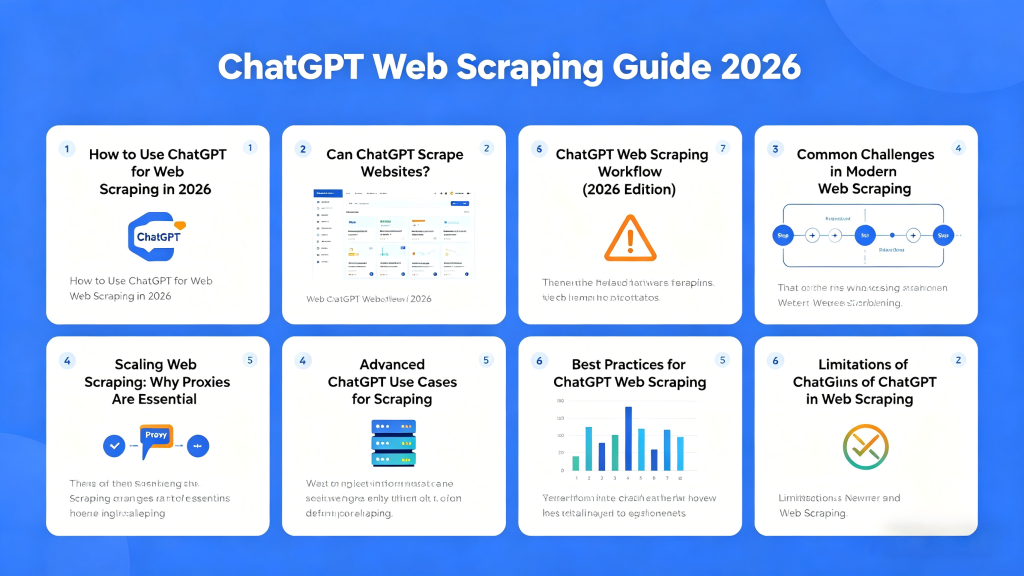
Can ChatGPT Scrape Websites?
The short answer: Yes—but only at a very limited scale.
With built-in browsing or search capabilities, ChatGPT can:
- Retrieve and summarize web content
- Extract small amounts of structured data
- Help with quick research tasks
However, this is not the same as real web scraping.
For production-level scraping, you still need:
- Custom scripts (Python, JavaScript)
- Scraping frameworks (BeautifulSoup, Playwright)
- Infrastructure (proxies, request management)
The correct way to think about it:
ChatGPT is not a scraper—it’s a scraper development assistant.
ChatGPT Web Scraping Workflow (2026 Edition)
Instead of relying on AI alone, successful scraping projects follow a structured workflow.
1. Define Your Data Extraction Goal
Start with clarity:
- What data do you need? (prices, titles, reviews)
- How many pages?
- Static or dynamic content?
SEO tip: This is where most “web scraping with ChatGPT” attempts fail—vague prompts lead to unusable code.
2. Inspect Website Structure
Use browser DevTools to:
- Locate HTML elements (class, ID, XPath)
- Identify API endpoints
- Check if content is JavaScript-rendered
Without this step, even the best AI-generated code won’t work.
3. Generate Scraper Code with ChatGPT
Example prompts:
- “Write a Python script using BeautifulSoup to extract product titles and prices.”
- “Use Playwright to scrape dynamic content from a JavaScript-heavy site.”
You can also request:
- Pagination logic
- Headers & cookies
- Retry mechanisms
4. Review and Optimize the Code
AI-generated code is a starting point—not production-ready.
Ask ChatGPT to improve it:
- Add error handling
- Optimize performance
- Remove hardcoded values
5. Execute and Test
Run your script and expect issues like:
- 403 Forbidden
- Empty results
- Broken selectors
This is where real scraping begins.
Common Challenges in Modern Web Scraping
1. IP Blocking and Rate Limiting
Websites detect repeated requests from the same IP.
Result:
- Temporary bans
- Incomplete data
- Request failures
2. Dynamic Content (JavaScript Rendering)
Modern websites rely on:
- React / Vue frameworks
- API-driven content
- Lazy loading
Solution:
- Use Playwright or Puppeteer
- Or reverse-engineer API calls
3. Anti-Bot Systems
Advanced protections analyze:
- Request patterns
- Headers
- Browser fingerprints
Basic scripts fail quickly in these environments.
Scaling Web Scraping: Why Proxies Are Essential
Once you move beyond small-scale scraping, proxies become critical.
A proper proxy setup allows you to:
- Rotate IP addresses
- Avoid detection and bans
- Scrape geo-restricted content
- Maintain high success rates
Types of Proxies for Web Scraping
- Residential proxies → High anonymity, harder to detect
- Datacenter proxies → Fast and cost-effective
- Rotating proxies → Essential for large-scale scraping
This is the difference between:
- A script that works once
- And a system that works at scale
Advanced ChatGPT Use Cases for Scraping
Code Debugging
“Why is my scraper getting blocked?”
Performance Optimization
“Rewrite this scraper using async requests”
Data Parsing
“Convert this HTML into structured JSON”
Automation Pipelines
“Turn this script into a scheduled scraping workflow”
Best Practices for ChatGPT Web Scraping
- Be specific with prompts
- Always validate selectors
- Simulate real user behavior
- Use proper headers
- Combine AI with real infrastructure
Limitations of ChatGPT in Web Scraping
Even in 2026:
- ChatGPT cannot run large-scale scraping tasks
- It cannot bypass anti-bot systems automatically
- It does not manage infrastructure
It accelerates development—but doesn’t replace engineering.
Conclusion
ChatGPT has made web scraping more accessible than ever.
But the real advantage comes from combining:
- AI-generated code
- Human validation
- Scalable infrastructure
If you approach it correctly, ChatGPT becomes a powerful tool—not for scraping itself, but for building efficient, production-ready scraping systems.