
ProxySite vs Paid Proxies has become a far more important discussion as the internet grows increasingly sophisticated in 2026. In the early days of the web, free proxy tools were often enough to bypass simple restrictions and browse anonymously. Users looking to access blocked websites or change their IP address could open a service like ProxySite, enter a URL, and continue browsing within seconds. For casual browsing, that simplicity and convenience made free proxies extremely popular.
However, the modern internet operates very differently.
Today, websites are no longer protected by basic firewalls or simple IP bans alone. Major platforms such as Amazon, TikTok, LinkedIn, Instagram, Walmart, and Google now rely on advanced anti-bot systems that analyze browser fingerprints, TLS signatures, behavioral patterns, session consistency, traffic reputation, and AI-generated risk scores in real time. These detection systems are designed to identify suspicious traffic with remarkable accuracy, making low-quality proxy traffic easier to block than ever before.
As a result, the gap between free proxy services and professional paid proxy infrastructure has become significantly larger than most users realize. Many people still search for terms like “free proxy,” “ProxySite alternative,” or “anonymous browsing tool,” assuming all proxies work similarly. In reality, the difference between a browser-based free proxy and a modern residential proxy network is enormous — both technically and operationally.
This article explores the key differences between ProxySite and paid proxies, explains why free proxy systems are becoming increasingly ineffective, and examines why businesses, developers, marketers, and data teams are rapidly moving toward professional residential proxy infrastructure for scalable online operations.
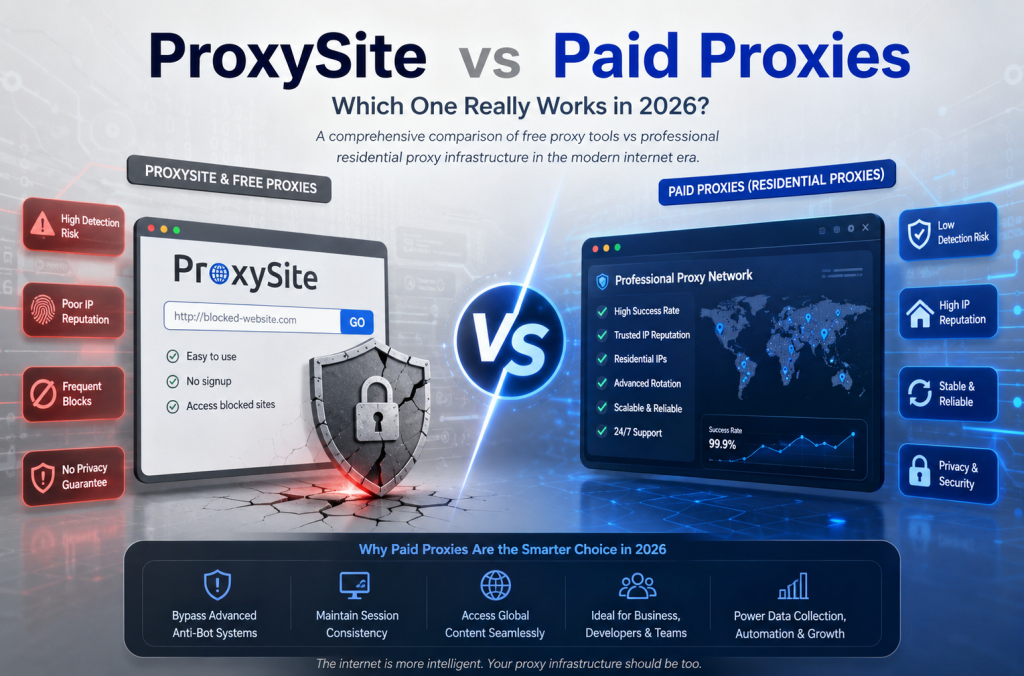
ProxySite vs Paid Proxies: Quick Comparison
| Feature | ProxySite | Paid Residential Proxies |
|---|---|---|
| IP Type | Shared Public IPs | Real Residential IPs |
| Detection Risk | High | Low |
| Speed Stability | Unstable | Enterprise-grade |
| CAPTCHA Frequency | Very High | Low |
| Session Persistence | Limited | Supported |
| Geo-Targeting | Basic | City/ASN Level |
| Best For | Casual Browsing | Scraping & Automation |
Understanding What ProxySite Actually Does
ProxySite belongs to a category of browser-based web proxy services designed primarily for lightweight browsing tasks. Instead of connecting directly to a website, users route traffic through ProxySite’s intermediary servers. This masks the user’s original IP address and may help bypass basic regional restrictions or local network filters.
For simple browsing scenarios, this approach can appear useful. A user attempting to access a blocked article, watch region-restricted content, or hide their local IP address temporarily may find ProxySite sufficient for a short session.
However, the core limitation lies in how these systems are structured.
Free web proxies are generally built around heavily shared infrastructure. Thousands — sometimes millions — of users rely on the same proxy gateways simultaneously. This creates severe congestion issues and rapidly damages IP reputation. Once a shared proxy IP becomes associated with spam, scraping, abuse, or automation traffic, major websites quickly flag or blacklist it.
This problem has become much worse in recent years because modern detection systems no longer evaluate traffic based solely on IP addresses. Websites now examine the entire browsing environment, including connection behavior, browser consistency, request timing, TLS fingerprints, device attributes, and session history.
A free browser proxy simply cannot provide the level of traffic legitimacy required to operate reliably on modern platforms.
That distinction explains why professional proxy networks have become essential for serious online operations.
Why Free Proxies Are Losing Effectiveness
The decline of free proxies is directly connected to the evolution of modern anti-bot infrastructure.
Years ago, websites primarily relied on basic rate limiting. Rotating IP addresses frequently was often enough to continue scraping data or automating requests. Today, detection systems are significantly more advanced.
Modern platforms use layered security architectures that combine machine learning models, behavioral analytics, browser fingerprinting, and reputation scoring systems simultaneously. These systems are designed specifically to identify non-human traffic patterns.
When traffic originates from public free proxies, detection becomes relatively easy.
Shared proxy servers typically exhibit abnormal behavior characteristics such as:
- Massive request volume from a single IP
- Multiple unrelated user sessions sharing identical fingerprints
- Suspicious geographic inconsistencies
- High CAPTCHA trigger rates
- Unnatural browsing behavior
- Datacenter routing signatures
- Historical abuse reports
Because free proxies are publicly accessible, they are constantly abused by bots, spam systems, and malicious actors. Over time, their reputation deteriorates across anti-bot databases.
As a result, users frequently encounter problems such as endless CAPTCHA loops, login verification failures, connection timeouts, blocked sessions, HTTP 403 errors, and Cloudflare challenges.
This issue becomes even more severe for automation tasks.
Modern websites increasingly prioritize traffic trustworthiness rather than raw connection access. In other words, successfully opening a website is no longer enough. The traffic itself must appear legitimate across multiple technical layers.
Paid proxy providers solve this problem by offering cleaner IP environments, better session management, lower abuse rates, and infrastructure optimized for real-world browsing simulation.
Infrastructure Is the Biggest Difference Between Free and Paid Proxies
The most important difference between ProxySite and professional proxy providers is infrastructure quality.
Free proxies operate on overcrowded public systems with limited scalability. Their primary goal is to provide temporary anonymous access for large numbers of users at minimal operational cost. Performance consistency is rarely the priority.
Professional proxy providers operate entirely differently.
Modern paid proxy networks involve complex infrastructure ecosystems that include global routing systems, ISP relationships, residential IP sourcing mechanisms, session persistence technology, rotation management, and large-scale bandwidth optimization.
This infrastructure directly impacts reliability.
For example, residential proxy providers such as ColaProxy maintain large IP pools composed of real residential addresses associated with legitimate internet service providers. These IPs behave far more like normal users because they originate from authentic ISP environments rather than publicly abused datacenter gateways.
This distinction matters enormously in 2026 because anti-bot systems increasingly evaluate traffic authenticity.
A request sent through a heavily abused public proxy may immediately trigger risk analysis systems. Meanwhile, a properly managed residential IP often blends naturally into standard user traffic patterns.
The difference becomes especially important for operations involving:
- Large-scale web scraping
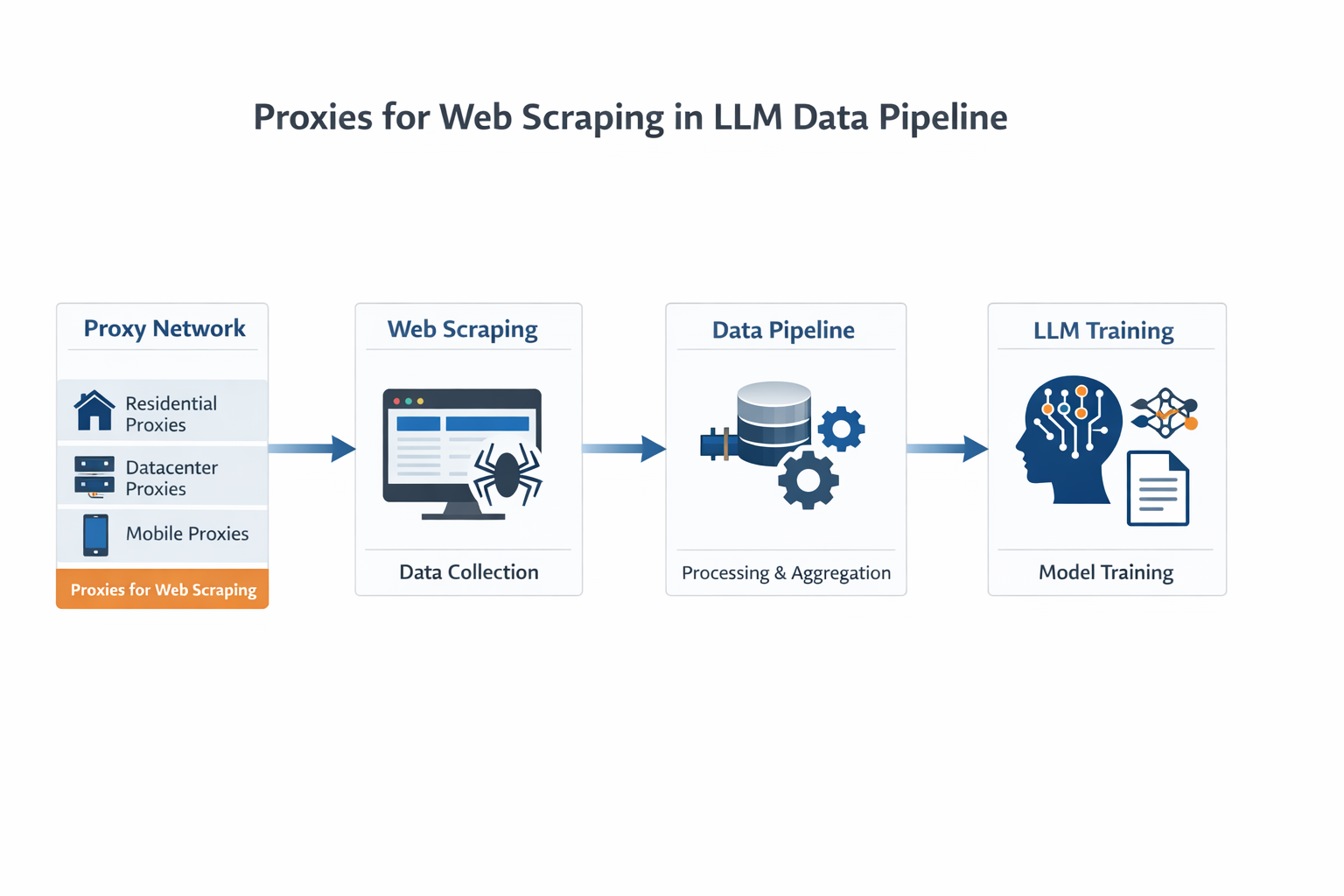
- AI training data collection
- Multi-account management
- Social media automation
- Ad verification
- E-commerce monitoring
- Localized SEO tracking
- Market intelligence gathering
At scale, infrastructure quality directly determines operational success rates.
Speed and Stability Matter More Than Most Users Expect
Many users initially evaluate proxies based only on whether they can access a website. However, for automation workflows, scraping systems, and business operations, connection stability is just as important as accessibility.
Free proxies are notoriously unstable because bandwidth resources are shared across massive user pools. During high-traffic periods, servers become overloaded, resulting in slow response times and failed requests.
For manual browsing, this may simply feel inconvenient.
For automated systems, unstable connections can become operationally catastrophic.
A scraping framework collecting thousands of pages per hour cannot tolerate high timeout rates. Similarly, browser automation systems managing social media accounts require stable sessions to avoid triggering suspicious activity detection.
Professional proxy providers invest heavily in routing optimization, bandwidth scaling, and traffic balancing specifically to address these challenges.
Paid residential proxies typically provide:
- Lower latency connections
- Higher request success rates
- Better session consistency
- Reduced packet loss
- More stable long-duration browsing sessions
- Faster page rendering
This stability is particularly important for JavaScript-heavy websites where incomplete page loading can break automation workflows entirely.
In modern automation environments, connection quality is no longer a luxury feature — it is foundational infrastructure.
IP Reputation Has Become a Critical Factor
One of the least understood aspects of proxy usage is IP reputation.
In 2026, websites maintain sophisticated reputation scoring systems that continuously evaluate incoming traffic sources. IPs associated with abuse, scraping, spam, bot activity, or suspicious automation quickly accumulate negative trust signals.
Free proxies almost always suffer from poor reputation scores because they are publicly accessible and heavily abused.
This creates a cycle of declining effectiveness. Once an IP becomes widely flagged, more websites begin blocking it automatically, further reducing usability.
Residential proxies work differently because they rely on real ISP-issued IP addresses assigned to legitimate household networks. These IPs naturally inherit stronger trust profiles compared to public datacenter infrastructure.
This is why residential proxies consistently outperform free proxies for tasks involving detection-sensitive environments.
For example, platforms such as TikTok, Amazon, Instagram, LinkedIn, and Google evaluate IP trust continuously during user sessions. Low-quality IPs often trigger immediate friction mechanisms including verification requests, temporary bans, or account restrictions.
High-quality residential proxies dramatically reduce these risks because their traffic patterns resemble genuine users far more closely.
Providers such as ColaProxy focus specifically on maintaining clean residential proxy infrastructure optimized for lower detection rates and long-term operational consistency.
Security Risks Associated With Free Proxies
Security is another major reason businesses avoid free proxy services.
Operating a free proxy network involves infrastructure costs. Because users are not paying directly, many free services monetize traffic indirectly through logging, analytics, ad injection, or data collection mechanisms.
This introduces serious privacy concerns.
When users route sensitive traffic through untrusted proxy infrastructure, they potentially expose:
- Login credentials
- Session cookies
- Browser activity
- Business data
- Authentication tokens
- Financial information
For casual browsing, users may underestimate these risks. For businesses, however, proxy security becomes a critical operational consideration.
Professional proxy providers generally implement stronger authentication systems, encrypted routing, private account access controls, and more transparent infrastructure policies.
As automation workflows increasingly interact with sensitive accounts and business systems, security standards become just as important as performance metrics.
Why Businesses Are Moving Toward Residential Proxies
The rapid growth of residential proxy adoption is closely tied to the evolution of anti-bot technology.
Businesses operating online today face an environment where almost every major platform actively monitors traffic legitimacy. Whether scraping data, verifying advertisements, managing accounts, or monitoring competitors, organizations require infrastructure capable of operating naturally within modern detection environments.
Residential proxies solve this challenge by making automated traffic appear more human-like from a network perspective.
This explains why residential proxies have become standard infrastructure for industries such as:
- E-commerce intelligence
- Market research
- AI data collection
- SEO monitoring
- Social media management
- Cybersecurity research
- Ad verification
- Travel aggregation
- Brand protection
Compared to free browser proxies, residential proxy networks provide dramatically better scalability, reliability, and operational safety.
More importantly, they align with the direction modern internet infrastructure is moving toward — trust-based traffic evaluation rather than simple access filtering.
The Future of Proxy Technology
The proxy industry is evolving rapidly because anti-bot systems are evolving rapidly.
Over the next several years, websites will continue expanding their use of AI-driven traffic analysis, behavioral modeling, browser fingerprint correlation, and session-level identity tracking. Detection systems will increasingly evaluate users holistically rather than relying on isolated signals.
This means low-quality free proxies will continue losing effectiveness.
Successful proxy infrastructure in the future will depend on several factors simultaneously:
- IP trust quality
- Browser consistency
- Behavioral legitimacy
- Session stability
- Geographic authenticity
- Traffic diversity
- Routing quality
Professional proxy providers are already adapting by investing in larger residential IP pools, smarter rotation systems, fingerprint-aware infrastructure, and advanced session management technologies.
For businesses involved in automation, scraping, or data acquisition, choosing the right proxy infrastructure is becoming a strategic operational decision rather than a simple technical tool selection.
Final Thoughts
ProxySite and other free proxy services still serve a limited role for temporary anonymous browsing and basic restriction bypassing. For lightweight personal use, they may remain convenient in certain situations.
However, the modern internet has fundamentally changed.
Websites now operate sophisticated anti-bot ecosystems capable of detecting low-quality proxy traffic with remarkable precision. Shared public proxies struggle to maintain reliability because their infrastructure, reputation, and traffic patterns no longer align with modern detection standards.
Professional paid proxies offer a completely different level of infrastructure quality, operational stability, security, and scalability.
Residential proxy networks, in particular, have become essential for organizations involved in web scraping, automation, AI data collection, SEO intelligence, social media operations, and large-scale digital research.
As detection systems continue advancing, the gap between free proxies and professional proxy infrastructure will only grow larger.
For users seeking long-term reliability, scalable performance, and lower detection rates, professional residential proxy providers such as ColaProxy represent a far more sustainable solution for modern internet operations.