Summary
In 2026, the digital landscape demands privacy and efficiency. What are proxies? At their core, proxies are intermediate servers that act as a bridge between you and the internet. By masking your IP address, they allow for seamless web scraping, multi-account management, and enhanced security.
This guide provides a deep dive into the technical mechanics, practical applications, and “No-BS” advice on selecting the right proxy service—from rotating residential to static ISP proxies—based on real-world industry experience and proven methodology.
What Are Proxies? Understanding the Gateway to the Modern Web
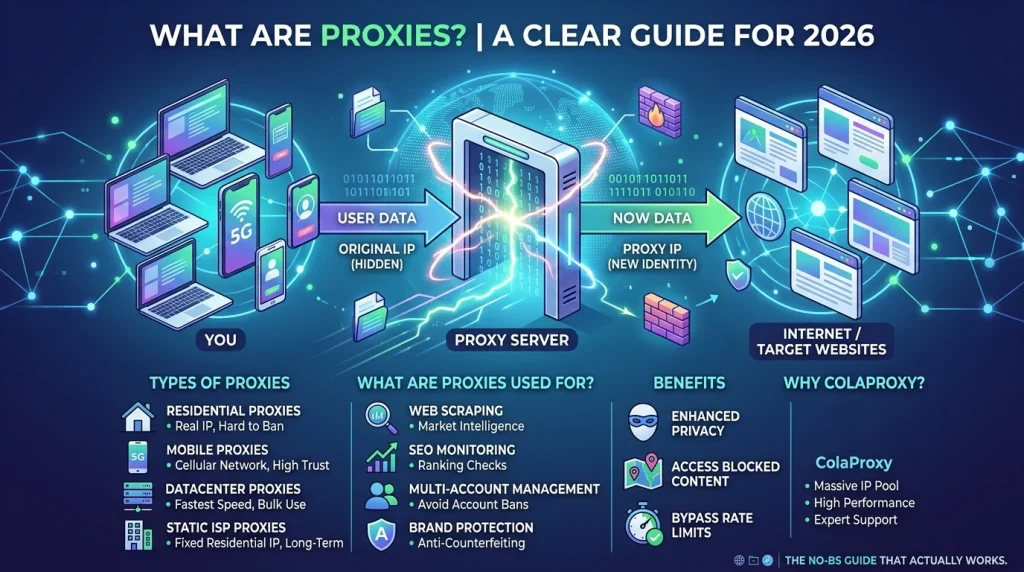
- If you have ever been blocked from a website or wondered how competitors scrape data without getting banned, you’ve likely asked yourself: what are proxies? In the simplest terms, a proxy server is a computer on the internet that accepts your requests, fetches the data from the target website, and sends it back to you.
- When people ask “whats a proxy?” or “what’s a proxy?”, they are usually looking for a way to stay anonymous. In 2026, what is proxying has evolved from a simple privacy trick into a multi-billion dollar industry essential for e-commerce, SEO, and brand expansion. Whether you need a proxy service for personal privacy or professional automation, understanding the underlying technology is the first step to digital freedom.
Quick Glossary of Terms
- Proxy service meaning: A commercial provider that gives you access to a pool of IP addresses.
- What is a proxy service: The infrastructure that manages the routing of your traffic through different nodes.
- Proxy explanation: Think of it as a “middleman” for your internet connection.
Why Use a Proxy? What Are Proxies Used For in 2026?
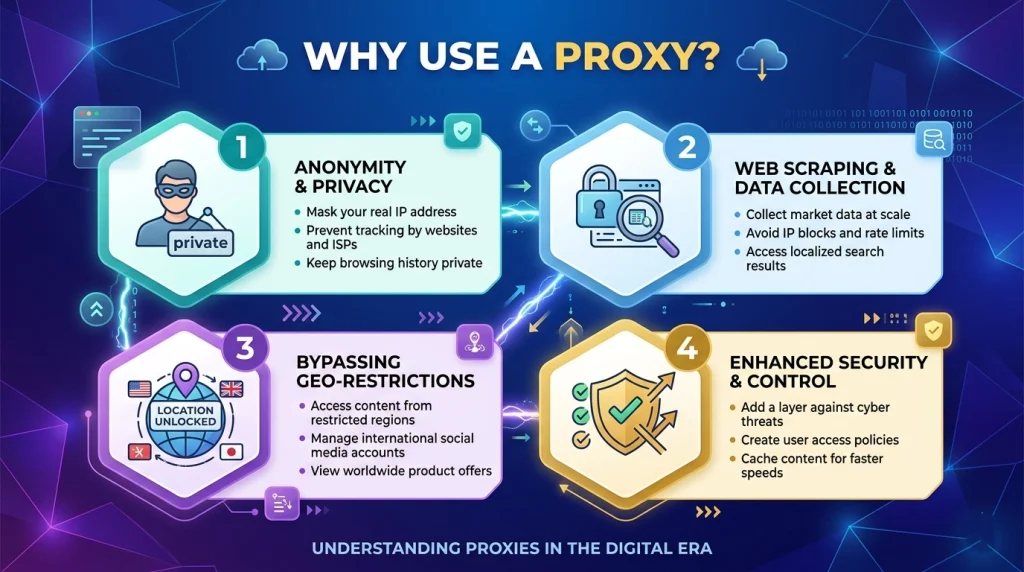
The question isn’t just what is a proxy for, but rather, how can it give you a competitive edge? Based on our work at ColaProxy, we see thousands of users utilizing these tools for specific, high-stakes tasks.
1. Web Scraping and Data Harvesting
Modern websites use sophisticated anti-bot measures. If you try to scrape price data from a single IP, you will be blocked. What are proxy sites used for here? They allow you to distribute your requests across thousands of different IPs, making your bot look like thousands of real users.
2. Multi-Account Management (SMM)
For professionals in “Brand 出海” (international brand expansion), managing 50 TikTok or Instagram accounts is standard. Using one IP for all accounts is a death sentence for your reach. What are internet proxies doing in this scenario? They assign a unique, localized identity to each account to prevent shadow-banning.
3. Bypassing Geo-Restrictions
What is a proxy website good for if you can’t see the content you need? Proxies allow you to appear as if you are browsing from London, New York, or Tokyo, bypassing regional blocks and localized pricing.
Comparison: Proxy vs VPN vs Reverse Proxy
Many beginners get confused between these three. Let’s break it down with a structured comparison.
| Feature | Forward Proxy (Our Focus) | VPN | Reverse Proxy |
| Who it protects | The User (Client) | The User (Client) | The Server (Website) |
| What it hides | Client’s IP address | Entire device identity | Origin server’s IP |
| Main Usage | Scraping, SEO, Multi-accounting | General privacy, encryption | Load balancing, security |
| Speed | High (Direct) | Medium (Encryption overhead) | N/A (Server-side) |
What is a vpn vs proxy? While a VPN encrypts everything, a proxy service is more surgical, allowing for faster speeds and easier integration into automated scripts.
The Different Faces of a Proxy: Residential, ISP, and Mobile
Understanding what are proxies requires a look at the “source” of the IP address. This determines your level of “trust” in the eyes of a website.
1. Rotating Residential Proxies
What is a residential proxy? These are IPs assigned by an ISP to a physical home. Because they belong to real people, they are the most trusted.
ColaProxy Insight: Our rotating residential pool is ideal for high-security targets like Amazon or Google.
2. Static ISP Proxies
This is the “best of both worlds.” You get the high speed of a datacenter but the “residential” tag from an ISP.
3. Mobile Proxies (4G/5G/6G)
What are proxy services for mobile? These use IPs from cellular towers. They are virtually impossible to ban because thousands of real users share them.
How to Choose a Proxy Service: A Practical Checklist
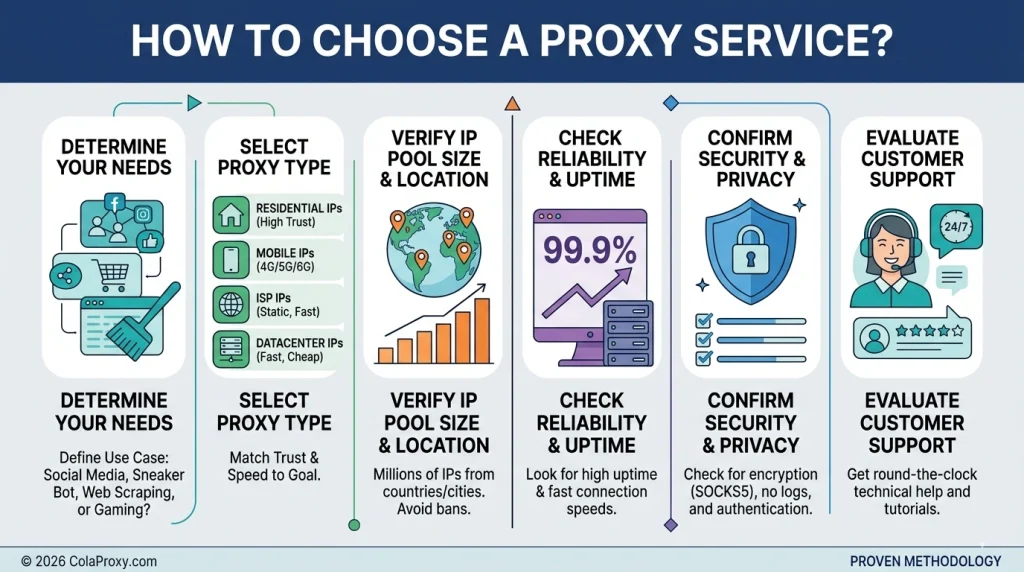
Don’t fall for the “free proxy” trap. If you are wondering are proxies safe, the answer is: only if you pay for them. Free proxies often log your data or inject ads.
Checklist for Selecting Your Provider:
- IP Pool Size: Does the provider have millions of IPs or just a few hundred?
- Location Coverage: Can you target specific cities or just countries?
- Protocol Support: Do they offer SOCKS5 (best for apps) or just HTTP/HTTPS?
- Uptime and Reliability: Look for 99.9% uptime.
- Customer Support: Do they offer 24/7 technical help?
ColaProxy provides all of the above, specifically optimized for the 2026 SEO landscape.
Step-by-Step: How to Configure Proxy Settings
- Setting up a proxy doesn’t require a degree in computer science. Whether you’re looking for what is proxy in wifi or what is a proxy server address, the process follows a standard flow.
- Get your credentials: From your ColaProxy dashboard, get your IP, Port, Username, and Password.
- Open Settings: In Chrome, go to Settings > System > Open your computer’s proxy settings.
- Enter Details: Toggle “Use a proxy server” and enter the address and port.
- Verify: Visit an IP checker to confirm your location has changed.
Case Study: Avoiding Bans in TikTok Marketing
A real-world project we handled involved a client trying to scale their TikTok presence. They asked, “what is a proxy used for in social media?”
The Challenge: They used cheap datacenter proxies and were shadow-banned instantly.
The Solution: We transitioned them to ColaProxy Rotating Mobile Proxies.
The Result: By using mobile IPs that refreshed every 30 minutes, the client bypassed TikTok’s bot detection. In three months, they grew to 100,000 followers across 10 accounts without a single ban.
FAQ: Common Questions About Proxies
What is proxy server vs. proxy service?
A proxy server is the physical or virtual machine. A proxy service is the company (like ColaProxy) that gives you access to thousands of these servers.
Are proxy servers illegal?
Generally, no. Are proxy servers illegal depends on your jurisdiction and your intent. Using them for data scraping is legal; using them for hacking is not.
What is the proxy address?
It is the numerical label (IP) of the proxy server, such as 192.168.1.1.
What do you mean by proxy in networking?
It refers to the proxy service meaning of acting as an intermediary to handle requests and responses.
What is a reverse proxy?
While a standard proxy hides the user, a reverse proxy hides the server. It is often used for load balancing.
Final Takeaways: Why ColaProxy is the Ultimate Choice
When you ask what are proxies, you are looking for a solution to a problem—be it privacy, access, or automation. In 2026, the quality of your IP pool is your most valuable asset.
ColaProxy Offers:
- Rotating Residential Proxies: Maximum anonymity.
- Static ISP Proxies: Long-term account stability.
- Mobile Proxies: The gold standard for social media.
Don’t let IP bans hold your business back. Get started with ColaProxy today and experience the difference that a professional-grade proxy service makes.