
Introduction
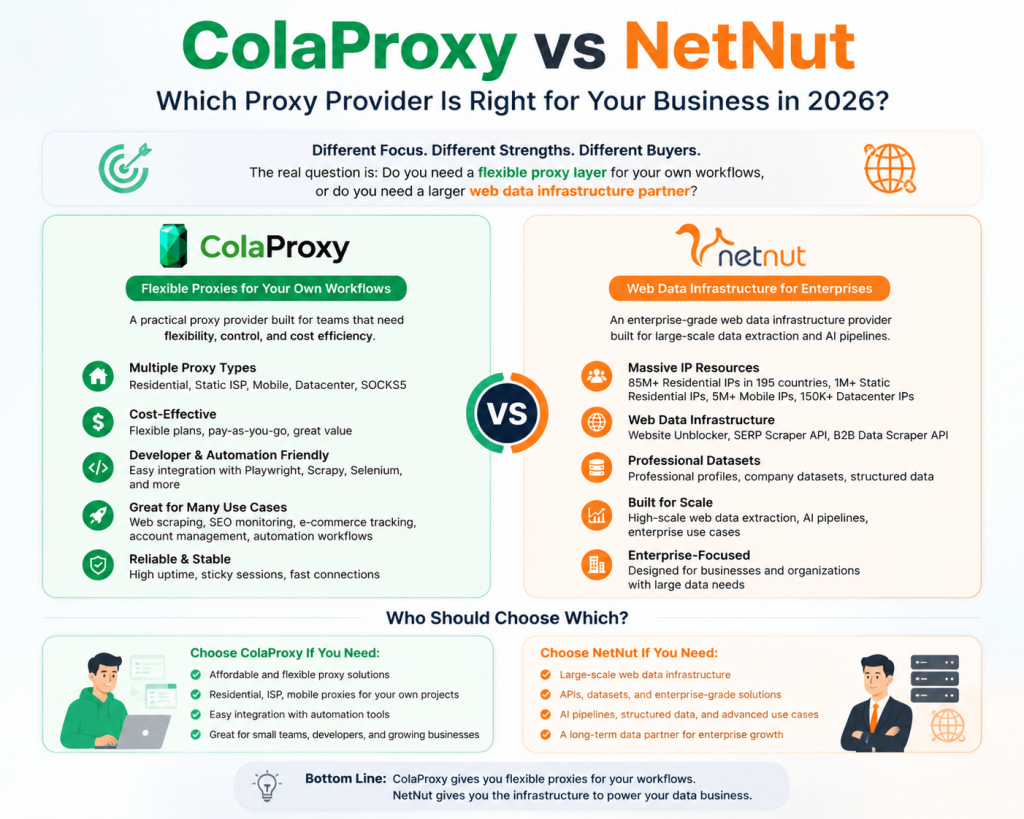
The ColaProxy vs NetNut comparison is not a simple residential proxy price comparison. These two providers are positioned for different kinds of proxy buyers.
ColaProxy is a practical proxy provider for teams that need flexible residential proxies, static ISP proxies, mobile proxies, SOCKS5 support, and cost-efficient proxy access for web scraping, SEO monitoring, Playwright automation, e-commerce tracking, and account workflows.
NetNut is positioned more like an enterprise web data infrastructure provider. Its website highlights 85M+ residential IPs in 195 countries, 1M+ static residential IPs, 5M+ mobile IPs, 150K+ datacenter IPs, Website Unblocker, SERP Scraper API, B2B Data Scraper API, professional profile datasets, company datasets, and AI-focused data infrastructure. NetNut also emphasizes high-scale web data extraction, AI pipelines, structured data, and enterprise use cases.
So the real buying question is not “which provider is better?” It is:
Do you need a flexible proxy layer for your own workflows, or do you need a larger web data infrastructure partner?
Executive Summary
| Category | ColaProxy | NetNut |
|---|---|---|
| Best fit | Teams that need flexible proxy access for scraping, SEO, automation, and account workflows | Enterprise teams that need large-scale proxy infrastructure, scraping APIs, datasets, and AI data pipelines |
| Core positioning | Proxy access layer | Web data infrastructure provider |
| Residential proxies | Cost-efficient dynamic residential proxies | 85M+ residential IPs in 195 countries |
| Static proxies | Static ISP and static mobile options | 1M+ static residential IPs with 24/7 availability |
| Mobile proxies | Dynamic and static mobile proxies | 5M+ mobile IPs, 3G/4G/5G/LTE |
| Datacenter proxies | Not the main public focus | 150K+ worldwide datacenter IPs |
| Scraper products | Proxy-first approach | Website Unblocker, SERP Scraper API, B2B Data Scraper API |
| Best decision logic | Choose for control, flexibility, and cost-efficient proxy workflows | Choose for scale, enterprise support, datasets, and managed data extraction |
The Core Difference: Proxy Workflow vs Data Infrastructure
ColaProxy is best understood as a proxy workflow provider. It gives teams access to proxy resources they can connect to their own tools. If your team already uses Playwright, Selenium, Scrapy, Python crawlers, SEO rank trackers, anti-detect browsers, or internal monitoring systems, ColaProxy fits naturally into that stack.
NetNut is moving further up the value chain. It does not only sell proxies. Its website positions the company around web data extraction, AI applications, structured datasets, Website Unblocker, SERP Scraper API, and B2B data collection. This makes NetNut more relevant when the buyer wants infrastructure plus higher-level data delivery products.
That difference matters because it changes how teams evaluate value.
A ColaProxy buyer may ask: “Can we complete scraping and automation tasks reliably at a reasonable proxy cost?”
A NetNut buyer may ask: “Can this provider support our larger data collection pipeline, scraping APIs, datasets, and AI data infrastructure?”
Both are valid needs, but they are not the same need.
What Is ColaProxy?
ColaProxy is a proxy IP service provider offering dynamic residential proxies, static ISP proxies, dynamic mobile proxies, static mobile proxies, and unlimited residential proxy plans.
According to ColaProxy’s website, the service provides 195+ country coverage, 99.9% uptime, HTTP(S)/SOCKS5 support, and 24/7 technical support. Its dynamic residential proxies start from $0.8/GB, static ISP proxies from $1.5/IP, dynamic mobile proxies from $2.5/GB, and static mobile proxies from $3/IP.
ColaProxy is especially relevant for teams that already own the logic of their workflows. These teams usually manage the crawler, browser automation, session rules, parsing, retries, cookies, and storage themselves. They need proxies that are stable, compatible, and cost-efficient, not necessarily a complete managed data platform.
Typical ColaProxy users include scraping teams, SEO agencies, e-commerce monitoring teams, account operators, ad verification users, and developers working with Playwright or Selenium.
What Is NetNut?
NetNut is a proxy and web data infrastructure provider. Its public website highlights rotating residential proxies, static residential proxies, mobile proxies, datacenter proxies, Website Unblocker, SERP Scraper API, B2B Data Scraper API, professional profile datasets, company datasets, and AI data infrastructure.
NetNut advertises 85M+ residential IPs in 195 countries, 1M+ static IPs, 5M+ mobile IPs, 150K+ worldwide datacenter IPs, and 500B+ monthly routed requests. It also promotes use cases such as SEO monitoring, SERP tracking, market research, ad verification, price comparison, travel aggregation, website change monitoring, alternative data, threat intelligence, food delivery data, brand protection, and social media management.
This makes NetNut more than a basic proxy provider. It is better positioned for teams that need data collection infrastructure at scale, especially where proxies, scraping APIs, datasets, and AI workflows are part of the same procurement conversation.
Where ColaProxy Has a Practical Advantage
ColaProxy is stronger when the buyer wants to keep the workflow lightweight and controllable.
For many teams, proxies are only one part of the system. The team already has scraping scripts, browser automation flows, SEO tools, dashboards, or internal data pipelines. They do not need to buy a complete data extraction stack. They need proxy access that is easy to connect and cost-effective to run.
This is where ColaProxy fits well.
It is useful when a team wants to run recurring web scraping, collect product pages, monitor SERP results, automate browser sessions, verify landing pages, or maintain account workflows. In these cases, the most important metrics are success rate, session stability, proxy compatibility, and cost per successful task.
ColaProxy also makes sense for small and mid-sized teams that do not want to overpay for enterprise features they may not use. If the team can manage headers, cookies, browser fingerprints, retries, and parsing internally, a simpler proxy layer may be more efficient.
Where NetNut Has a Strategic Advantage
NetNut becomes more compelling when the buyer needs scale, broader infrastructure, or higher-level data products.
For example, a company building AI models may need public web data at scale. A B2B intelligence company may need company or professional profile datasets. An enterprise search team may need SERP data APIs. A large data operation may need Website Unblocker, dynamic fingerprinting, CAPTCHA handling, IP rotation, and auto-retry capabilities.
NetNut’s website directly speaks to these broader use cases. It presents products for scrapers, datasets, AI data infrastructure, and structured data delivery. This gives NetNut a stronger story for enterprise buyers who want more than proxy access.
NetNut is also stronger where datacenter proxies or static residential scale are important. Its public product lineup includes 150K+ worldwide datacenter IPs and 1M+ static residential IPs with 24/7 availability.
Proxy Product Comparison
Residential Proxies
Residential proxies are the foundation for many web scraping, SEO monitoring, ad verification, and market research tasks.
ColaProxy’s advantage is cost efficiency and direct workflow fit. Its dynamic residential proxies are positioned for users who want to run recurring data tasks without building a heavy procurement process around them.
NetNut has the advantage of scale. It advertises 85M+ residential IPs in 195 countries and positions its residential proxies for data collection, AI training, and large-scale web scraping.
If your team needs affordable residential proxy traffic for its own scraping stack, ColaProxy is a strong fit. If your team needs a large enterprise residential network tied into broader data infrastructure, NetNut is more relevant.
Static Residential and ISP-Like Stability
Stable IP identity matters for account workflows, dashboards, login sessions, and long-running browser automation.
ColaProxy offers static ISP proxies and static mobile proxies, which are useful for teams that need predictable identity without constant rotation.
NetNut promotes 1M+ static residential IPs with 24/7 IP availability and one-hop proxy connectivity. This is a strong positioning for buyers who care about persistent IP availability and stable connections at scale.
The difference is buyer profile. ColaProxy is practical for teams that need static identity as part of a broader proxy workflow. NetNut is more compelling for enterprise users that need large-scale static residential availability.
Mobile Proxies
Mobile proxies are important for app testing, mobile ad verification, mobile-first content, social media workflows, and carrier-sensitive environments.
ColaProxy offers dynamic mobile proxies and static mobile proxies, making it useful for both rotating mobile tasks and stable mobile identity.
NetNut advertises 5M+ mobile IPs, 100 countries, 3G/4G/5G/LTE mobile proxies, and high success rates. This makes NetNut a stronger candidate when mobile IP scale is a central requirement.
For normal mobile proxy use inside scraping or account workflows, ColaProxy may be enough. For larger mobile proxy programs, NetNut deserves evaluation.
Datacenter Proxies
This is one area where NetNut has a clearer advantage.
NetNut lists 150K+ worldwide datacenter IPs, rotating and static IPs, and 99.99% uptime for datacenter proxy use cases. Datacenter proxies are useful for low-risk targets, performance-sensitive tasks, and scalable workloads where residential identity is not required.
ColaProxy is not primarily positioned around datacenter proxies. Its stronger fit is residential, ISP, mobile, and automation-related use cases.
If datacenter proxies are central to the buying decision, NetNut is the stronger option.
Scraper APIs and Dataset Products
This is another major difference.
ColaProxy is proxy-first. It is most useful when the buyer already has tools and needs the proxy layer.
NetNut offers Website Unblocker, SERP Scraper API, B2B Data Scraper API, ChatGPT Scraper API, Gemini Scraper API, Google AI Mode Scraper API, Perplexity Scraper API, Copilot Scraper API, professional profile datasets, and company datasets.
That is a very different product category. These products are not just proxies. They are data acquisition and data delivery tools.
If your team wants raw proxy access, ColaProxy is simpler. If your team wants structured data, scraper APIs, AI visibility monitoring, or ready-made datasets, NetNut has a broader offering.
Cost Model: What Are You Paying For?
A fair ColaProxy vs NetNut comparison should not only compare proxy prices. These providers bundle value differently.
With ColaProxy, the buyer is primarily paying for proxy access. The value comes from whether the team can complete scraping, automation, SEO, or account workflows at a lower cost.
With NetNut, the buyer may be paying for a wider infrastructure layer. That may include proxies, unblocker technology, scraper APIs, datasets, support, integrations, documentation, endpoint generation, public API management, and enterprise account support.
That means NetNut may be more expensive or more complex for teams that only need proxies. But it may be more efficient for teams that would otherwise need to build and maintain several internal systems.
Performance Evaluation: What to Test
Performance should be tested differently depending on the provider and workflow.
For ColaProxy, the key question is whether the proxy layer performs well inside your existing stack. You should test success rate, latency, session stability, block rate, CAPTCHA rate, and cost per successful request.
For NetNut, you should test both proxy performance and product-layer performance. If using Website Unblocker or a Scraper API, you should measure structured output quality, success rate, retry behavior, response time, data accuracy, and cost per delivered result.
| Test Area | ColaProxy Focus | NetNut Focus |
|---|---|---|
| Scraping success rate | Proxy completion rate in your crawler | Proxy or API completion rate |
| Session stability | Sticky and static proxy behavior | Static residential and API continuity |
| Automation fit | Playwright/Selenium compatibility | Proxy fit or managed product fit |
| Data output | Your parser quality | API or dataset output quality |
| Cost metric | Cost per successful request | Cost per delivered result |
| Scale | Traffic efficiency | Infrastructure and product scalability |
Use Case Analysis
Web Scraping
ColaProxy is a strong fit for web scraping teams that already own the crawler. If your team uses Python, Node.js, Scrapy, Playwright, Selenium, Puppeteer, or internal scraping tools, ColaProxy can provide a practical proxy layer.

NetNut is stronger when web scraping is part of a larger data operation. If the team needs Website Unblocker, SERP Scraper API, B2B scraping, structured extraction, or dataset products, NetNut can reduce internal engineering work.
SEO and SERP Monitoring
ColaProxy is useful for SEO teams that need country-level proxy access, recurring rank checks, competitor monitoring, and cost control.
NetNut is more specialized if the buyer needs SERP Scraper API, structured search results, or AI search visibility tracking. Its product lineup includes APIs for SERP and AI answer monitoring, which makes it relevant for search intelligence teams.
E-Commerce Monitoring
ColaProxy fits recurring price monitoring and product data collection where the user controls the crawler and parser.
NetNut fits e-commerce and market intelligence teams that want more managed extraction, broader data infrastructure, or structured data delivery.
AI Data Infrastructure
NetNut has a stronger public AI data story. Its website highlights AI applications, AI data infrastructure, model pipelines, and scraper APIs for AI platforms.
ColaProxy can still support AI data collection, but mainly as the proxy layer. If your team builds its own crawler, ColaProxy can be cost-effective. If your team wants a broader AI data collection infrastructure, NetNut is more specialized.
Account Workflows and Browser Automation
ColaProxy is a strong fit for Playwright, Selenium, anti-detect browsers, account sessions, and workflows where the team controls browser behavior.
NetNut can also support automation through proxies, but its stronger differentiation is not basic browser automation. It is broader infrastructure, static residential scale, scraper products, and data services.
Buyer Fit
Choose ColaProxy if your team wants control, flexibility, and cost efficiency. It is especially suitable for teams that already manage their own scraping or automation logic and want proxies that fit into existing workflows.
Choose NetNut if your team needs larger infrastructure, broader data products, or enterprise-scale web data extraction. It is especially suitable for organizations that want proxy access plus scraper APIs, datasets, AI data infrastructure, and managed data products.
Decision Framework
| Priority | Better Fit |
|---|---|
| Cost-efficient residential proxy workflows | ColaProxy |
| Playwright or Selenium automation | ColaProxy |
| SEO monitoring with your own tools | ColaProxy |
| E-commerce scraping with internal crawlers | ColaProxy |
| Account workflows with static IP needs | ColaProxy |
| Enterprise web data infrastructure | NetNut |
| SERP Scraper API | NetNut |
| Website Unblocker | NetNut |
| B2B data extraction | NetNut |
| Professional or company datasets | NetNut |
| AI data pipelines | NetNut |
| Datacenter proxy infrastructure | NetNut |
FAQ
What is the main difference between ColaProxy and NetNut?
ColaProxy is mainly a flexible proxy provider for scraping, SEO, automation, and account workflows. NetNut is a broader web data infrastructure provider with proxies, scraper APIs, datasets, Website Unblocker, and AI data products.
Which provider is better for web scraping?
ColaProxy is better if your team manages its own crawler and wants cost-efficient proxy access. NetNut is better if your team needs Website Unblocker, scraper APIs, structured data, or larger data infrastructure.
Which provider is better for SEO monitoring?
ColaProxy is suitable for SEO teams using their own rank trackers or SERP workflows. NetNut is stronger if the team needs SERP Scraper API or structured search data products.
Which provider is better for AI data collection?
NetNut is stronger for AI data infrastructure because it offers data products, scraper APIs, and AI-focused data workflows. ColaProxy can support AI data collection as the proxy layer if the team builds its own crawler.
Does NetNut offer more products than ColaProxy?
Yes. NetNut offers proxies, Website Unblocker, SERP Scraper API, B2B Data Scraper API, AI-related scraper APIs, professional profile datasets, and company datasets. ColaProxy is more focused on proxy access.
Is ColaProxy better for smaller teams?
Often, yes. Smaller teams that already manage their own scraping, SEO, or automation workflows may prefer ColaProxy because it is simpler and more cost-efficient as a proxy layer.
Is NetNut better for enterprise buyers?
NetNut may be more suitable for enterprise buyers that need large-scale data infrastructure, support, datasets, scraper APIs, and AI data workflows.
Conclusion
The ColaProxy vs NetNut decision depends on whether your team needs a flexible proxy layer or a broader web data infrastructure provider.
ColaProxy is the better fit for teams that already control their scraping, SEO, automation, or account workflows and need residential proxies, static ISP proxies, mobile proxies, SOCKS5 support, and predictable proxy access.
NetNut is the better fit for teams that need enterprise-scale data infrastructure, scraper APIs, Website Unblocker, datasets, AI data products, and broader managed data collection capabilities.
If your team wants to keep its stack lightweight and cost-efficient, test ColaProxy first. If your team wants a more complete web data infrastructure partner, NetNut should be part of the evaluation.