Introduction
Most proxy comparisons start with the same checklist: residential proxies, mobile proxies, ISP proxies, SOCKS5 support, country coverage, rotation rules, and pricing. That format is useful, but it often misses the real business decision.
The real question in a ColaProxy vs SOAX comparison is not “which provider has more targeting features?” It is this:
Are you solving a data access problem, or are you solving a location accuracy problem?
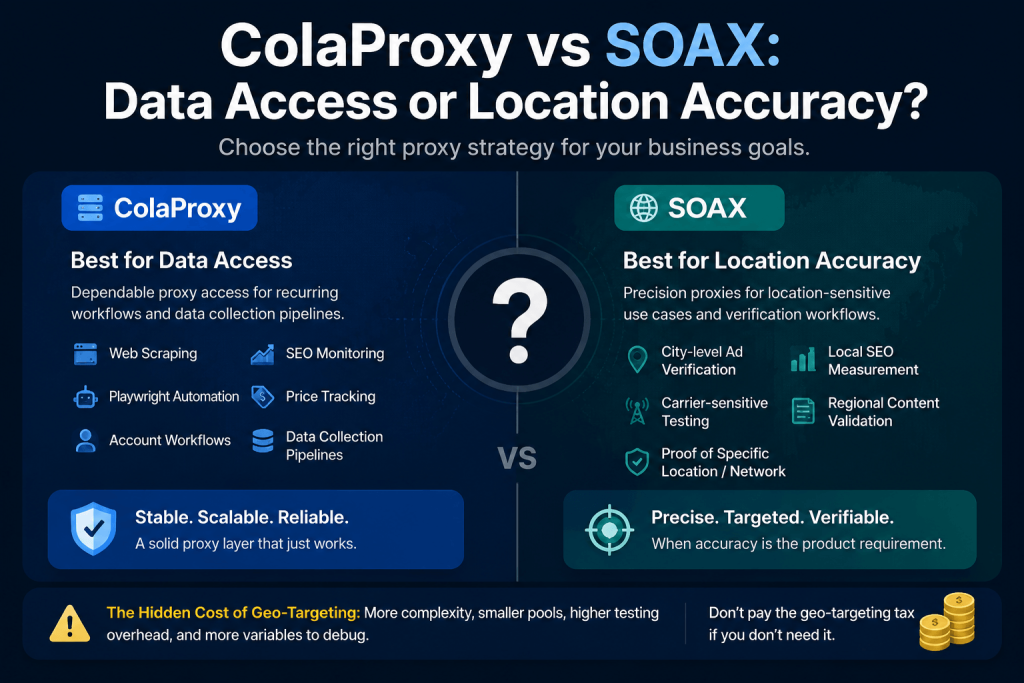
ColaProxy is a better fit for teams that need dependable proxy access for recurring workflows: web scraping, SEO monitoring, Playwright automation, price tracking, account workflows, and data collection pipelines.
SOAX is a better fit when location precision is the product requirement itself. That includes city-level ad verification, local SEO measurement, carrier-sensitive testing, regional content validation, and workflows where the buyer must prove that traffic came from a very specific location or network.
This difference matters because advanced geo-targeting is not free. Even when the pricing looks manageable, granular targeting adds operational complexity, testing overhead, smaller available proxy pools, and more variables to debug. In many cases, teams do not need that complexity. They need a stable proxy layer that works.
The Core Idea: Not Every Team Needs Precision
SOAX is often appealing because it offers more control. For advanced users, that control can be valuable. But more control does not always mean a better outcome.
A team scraping product pages across several countries may only need country-level residential proxies. A team running weekly SEO checks may not need city-level or ASN-level filtering. A team using Playwright for browser automation may care more about stable sessions and SOCKS5 compatibility than carrier simulation.
This is where ColaProxy becomes the more practical choice. It is not trying to turn every proxy workflow into a precision targeting exercise. It gives teams a direct proxy layer they can connect to their existing scraping, automation, SEO, and monitoring tools.
SOAX becomes more compelling when precision changes the business result. If a report must prove that an ad was visible in a specific city, or if local search results must be measured at a metro level, then targeting depth is not optional. It is part of the deliverable.
Quick Positioning
| Decision Factor | ColaProxy | SOAX |
|---|---|---|
| Best role | Practical proxy layer for recurring workflows | Precision proxy platform for geo-sensitive validation |
| Strongest use case | Scraping, SEO, automation, price monitoring | Local SEO, ad verification, carrier or ASN targeting |
| Main buyer concern | Cost per successful workflow | Accuracy of location simulation |
| Operational model | Simpler setup, easier to scale | More control, more configuration |
| Best default choice | Teams that need reliable access | Teams that need precise proof of location |
What ColaProxy Is Really Competing On
ColaProxy is not competing on having the most complicated control panel. Its value is simpler: it helps teams run proxy-dependent workflows without overpaying for targeting capabilities they may not need.
For many teams, this is the more important advantage.
A scraping team does not make money from configuring filters. It makes money from completed data collection jobs. An SEO team does not benefit from extra targeting controls unless those controls improve the report. A Playwright automation team does not need more proxy variables if the main issue is session stability.
ColaProxy fits these workflows because its value is tied to execution. It provides residential proxies, static ISP proxies, mobile proxies, HTTP(S)/SOCKS5 support, and broad country coverage. That makes it useful for practical workflows where the team already controls the crawler, browser automation, retry logic, parsing, and storage.
The buyer who should look at ColaProxy is usually asking:
“Can we collect the data reliably without making the proxy stack more complicated than necessary?”
What SOAX Is Really Competing On
SOAX is stronger when the workflow requires a more exact proxy identity.
The value of SOAX is not simply that it has residential or mobile proxies. The value is that it can support more granular targeting and proxy control. This matters when the data itself changes based on location, city, carrier, or network.
For example, local search results may differ between two cities in the same country. Ads may appear in one region but not another. Mobile app behavior may vary by carrier. Market research may require location-specific sampling. In these cases, a country-level proxy may not be enough.
SOAX is a better fit for teams that ask:
“Can we prove what a user sees from this exact local context?”
That is a different question from standard scraping. It is more specialized, and it justifies a more specialized proxy platform.
The Geo-Targeting Tax
Advanced targeting creates what I would call a geo-targeting tax.
This tax is not only financial. It also shows up in setup time, QA, debugging, monitoring, and operational risk.
When you target broadly, you usually have more available IPs and fewer variables. When you target narrowly, the available pool may shrink. Rotation may become less flexible. Sticky sessions may become harder to maintain. Location validation becomes a separate QA task.
If a request fails, the team has more possible causes to investigate. Was the proxy blocked? Was the browser fingerprint wrong? Was the target website rate-limiting traffic? Was the city filter too narrow? Was the ASN unavailable? Did the session rotate too early? Did the target site detect an inconsistency between IP location and browser settings?
For advanced teams, these tradeoffs may be acceptable. For standard scraping and monitoring teams, they are often unnecessary.
This is why the “most powerful” proxy platform is not always the best operational choice.
When ColaProxy Is the Better Choice
ColaProxy is the better choice when the workflow is repeatable, cost-sensitive, and not dependent on hyper-local validation.
That includes recurring web scraping, country-level SEO monitoring, product price tracking, competitor monitoring, account workflows, and browser automation tasks where the main requirement is stable access rather than exact local simulation.
For Playwright and Selenium users, ColaProxy can be especially practical. Browser automation usually needs stable sessions, proxy protocol compatibility, consistent identity, and predictable behavior. It does not always need city-level targeting. In many automation workflows, adding too many proxy targeting rules can make testing harder rather than easier.
ColaProxy also makes sense when the team already owns the technical stack. If your engineers control headers, cookies, retries, browser profiles, parsing, and storage, then a simpler proxy layer can be more efficient than a more complex platform.
When SOAX Is the Better Choice
SOAX is the better choice when the proxy is part of a verification requirement.
A local SEO platform may need city-level ranking data. An ad verification provider may need to confirm ad visibility in specific metro areas. A brand protection team may need to detect geo-cloaking. A telecom testing team may need mobile carrier simulation. A compliance-sensitive buyer may need stronger governance around proxy use.
In these cases, SOAX’s additional control is not decoration. It is part of the business value.
SOAX is also a better choice when users have the operational maturity to manage more proxy variables. Teams that already have QA processes for geo-validation, monitoring for session behavior, and clear requirements for targeting depth can benefit from the extra controls.
How to Decide Without Overbuying
Before choosing between ColaProxy and SOAX, define the smallest targeting level that affects the result.
If the result only changes by country, start with country-level coverage. If the result changes by city, test city-level targeting. If the result changes by carrier or ASN, then advanced targeting becomes necessary.
Do not start with the most complex setup. Start with the simplest setup that can produce the required result.
A good decision process looks like this:
- Define the real output of the workflow.
- Identify the smallest location level required.
- Test proxy success rate under real conditions.
- Measure cost per successful result.
- Add targeting complexity only if it improves the result.
This approach prevents teams from paying for precision they do not use.
Practical Scenarios
Scenario 1: Weekly SEO Rank Tracking
A team checks rankings across 15 countries every week. The reports are country-level. The client does not need city-level SERP data.
ColaProxy is the better starting point because the workflow values repeatability, coverage, and cost control.
Scenario 2: City-Level Local SEO Platform
A platform tracks search visibility across hundreds of cities. The product promise depends on city-level accuracy.
SOAX is more appropriate because location precision is central to the deliverable.
Scenario 3: E-Commerce Price Monitoring
A team monitors competitor prices across multiple countries. Prices differ by country, but not meaningfully by city or carrier.
ColaProxy is the more efficient option because the task needs reliable residential throughput, not advanced targeting.
Scenario 4: Ad Verification in Specific Regions
An ad verification team checks whether campaigns appear correctly in specific cities and whether landing pages change by location.
SOAX is the stronger fit because the task requires proof of local visibility.
Scenario 5: Playwright Account Workflow
A technical team uses Playwright to run login-based browser workflows. The key requirements are stable sessions, SOCKS5 support, and consistent identity.
ColaProxy is usually the better fit unless the workflow also requires exact city or carrier simulation.
Buyer Fit
| Buyer Type | Better Fit | Reason |
|---|---|---|
| Scraping team | ColaProxy | Needs throughput and cost control |
| SEO agency | ColaProxy | Often needs country-level monitoring |
| E-commerce monitoring team | ColaProxy | Needs recurring product data collection |
| Playwright automation team | ColaProxy | Needs stable sessions and proxy compatibility |
| Local SEO platform | SOAX | Needs city-level accuracy |
| Ad verification provider | SOAX | Needs local visibility proof |
| Telecom testing team | SOAX | Needs carrier or network simulation |
| Compliance-sensitive enterprise | SOAX | May value governance and controls |
FAQ
What is the main difference between ColaProxy and SOAX?
ColaProxy is better for efficient proxy access and recurring scraping or automation workflows. SOAX is better for granular geo-targeting, local validation, carrier-level testing, and controlled proxy rotation.
Is SOAX better than ColaProxy?
SOAX is better only when the workflow requires advanced location precision. For standard scraping, SEO monitoring, price tracking, and Playwright automation, ColaProxy may be more practical and cost-efficient.
Is ColaProxy better for web scraping?
For most standard web scraping workflows, yes. ColaProxy is a strong fit when the team needs reliable residential proxy throughput and does not require city-level or ASN-level targeting.
When should I choose SOAX?
Choose SOAX when the business result depends on exact local simulation. This includes city-level SEO, local ad verification, carrier testing, and regional content validation.
Which provider is better for Playwright?
ColaProxy is usually better for common Playwright workflows such as scraping, login sessions, browser testing, and account automation. SOAX is better if the Playwright workflow must simulate a specific city, ISP, ASN, or mobile carrier.
Does advanced geo-targeting always improve results?
No. Advanced geo-targeting only improves results when location precision affects the business outcome. Otherwise, it may add cost, reduce available proxy supply, and increase debugging complexity.
Conclusion
The ColaProxy vs SOAX decision is really about whether your workflow needs efficient access or precision targeting.
ColaProxy is the better default for teams running recurring scraping, SEO monitoring, e-commerce tracking, browser automation, and account workflows. It keeps the proxy layer practical, cost-aware, and easier to integrate.
SOAX is the better specialist when location precision is part of the product requirement. If your workflow depends on city-level validation, ASN or ISP filtering, mobile carrier simulation, or geo-proof for reporting, SOAX is worth evaluating.
The most professional approach is not to buy the most advanced proxy platform by default. It is to buy the least complex proxy setup that can reliably produce the business result.