Introduction
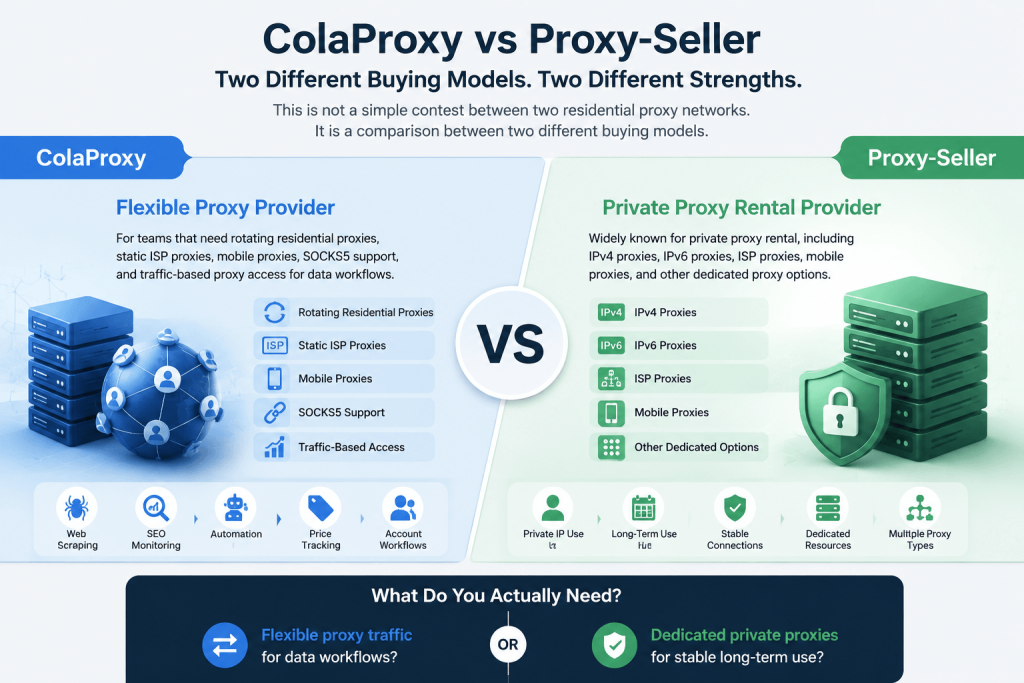
The ColaProxy vs Proxy-Seller comparison is different from many proxy provider comparisons. This is not a simple contest between two residential proxy networks. It is a comparison between two different buying models.
ColaProxy is better understood as a flexible proxy provider for teams that need rotating residential proxies, static ISP proxies, mobile proxies, SOCKS5 support, and traffic-based proxy access for web scraping, SEO monitoring, automation, price tracking, and account workflows.
Proxy-Seller has a different historical strength. It is widely known for private proxy rental, including IPv4 proxies, IPv6 proxies, ISP proxies, mobile proxies, and other dedicated proxy options. Its model is often more attractive to users who want to rent fixed proxy resources for a specific period instead of buying residential traffic by GB.
So the real question is not only “which provider is better?” The better question is: do you need flexible proxy traffic for data workflows, or do you need dedicated private proxies for stable long-term use?
Quick Comparison
| Category | ColaProxy | Proxy-Seller |
|---|---|---|
| Core positioning | Flexible proxy provider for scraping, automation, SEO, and account workflows | Private proxy rental provider with IPv4, IPv6, ISP, mobile, and other proxy options |
| Best for | Web scraping, Playwright automation, SEO monitoring, price tracking, rotating residential traffic | Fixed IP use cases, long-term proxy rental, private proxies, IPv4/IPv6 needs |
| Buying model | Traffic-based and product-based proxy plans | Proxy rental by type, location, quantity, and duration |
| Residential proxies | Strong focus on dynamic residential proxies | Available, but not the only core positioning |
| Static proxies | Static ISP and static mobile options | Strong fit for dedicated/static private proxy use |
| IPv6 proxies | Not the primary commercial angle | Stronger fit if IPv6 proxy rental is required |
| Automation fit | Strong for Playwright, Selenium, scraping scripts, and rotating sessions | Strong when stable fixed IPs are needed |
| Main advantage | Flexible proxy access with strong residential proxy value | Dedicated proxy inventory and long-term rental flexibility |
| Best decision rule | Choose when traffic flexibility and scraping workflows matter | Choose when fixed proxy rental and dedicated IP inventory matter |
The Main Difference: Traffic Flexibility vs Fixed Proxy Rental
The key difference between ColaProxy and Proxy-Seller is the way users usually buy and use proxies.
ColaProxy is more aligned with traffic-driven workflows. These are tasks where users need many IPs, rotating sessions, residential identity, broad country coverage, and compatibility with automation tools. Common examples include web scraping, SEO monitoring, SERP checks, e-commerce price monitoring, ad verification, and Playwright or Selenium automation.
Proxy-Seller is more aligned with private proxy rental. Users often choose a proxy type, location, quantity, and rental duration. This model is useful when the user wants a predictable set of proxies for a fixed period. Examples include dedicated IPv4 proxies, IPv6 proxies, ISP proxies, mobile proxies, and fixed account environments.
This difference matters because the wrong buying model can increase cost or reduce performance. A scraping team that needs frequent IP rotation may not benefit from a small pool of fixed proxies. A user who needs stable private IPs for long-term access may not need a large rotating residential traffic plan.
What Is ColaProxy?
ColaProxy is a proxy IP service provider offering dynamic residential proxies, static ISP proxies, dynamic mobile proxies, static mobile proxies, and unlimited residential proxy plans. It is positioned around practical business use cases such as web scraping, SEO monitoring, online marketing, price monitoring, app testing, account management, and data collection.
According to ColaProxy’s public website, the service offers 195+ country coverage, 99.9% uptime, HTTP(S)/SOCKS5 support, and 24/7 support. Its dynamic residential proxies start from $0.8/GB, static ISP proxies from $1.5/IP, dynamic mobile proxies from $2.5/GB, and static mobile proxies from $3/IP.
ColaProxy is especially useful for users who already have a workflow and need proxy infrastructure behind it. These users may be running Python crawlers, Playwright scripts, Selenium automation, SEO rank trackers, anti-detect browsers, or e-commerce monitoring tools.
What Is Proxy-Seller?
Proxy-Seller is a proxy service provider known for private proxy rental. Its product categories include IPv4 proxies, IPv6 proxies, ISP proxies, mobile proxies, residential proxies, and other proxy options. The platform is often used by customers who want dedicated proxies for specific countries, specific periods, and specific connection needs.
Proxy-Seller is more inventory-oriented than traffic-oriented. Instead of thinking only in GB, users often think in terms of how many proxies they need, which location they need, how long they want to rent them, and whether the proxies should be IPv4, IPv6, ISP, mobile, or residential.
This model can be useful for users who need stable private proxy resources rather than large rotating residential traffic.
Buyer Intent: Who Is Actually Comparing ColaProxy and Proxy-Seller?
People comparing ColaProxy and Proxy-Seller usually fall into one of four groups.
The first group is scraping and SEO teams. They want proxies for data collection, SERP monitoring, price tracking, and competitor research. These users usually care about residential proxy quality, rotation, sticky sessions, and cost per successful request.
The second group is automation users. They use Playwright, Selenium, Puppeteer, anti-detect browsers, or account management tools. These users care about session stability, SOCKS5 support, sticky IPs, and whether the proxy fits browser-based workflows.
The third group is private proxy buyers. They may need IPv4 or IPv6 proxies for fixed periods. They care less about rotating traffic and more about whether they can rent stable proxy resources in the locations they need.
The fourth group is account and platform operators. They may need static ISP proxies, mobile proxies, or stable IP environments. For them, consistency can matter more than scale.
ColaProxy is stronger for the first two groups. Proxy-Seller is often more relevant for the third group and can also be useful for the fourth group depending on proxy type and location.
Proxy Type Comparison
Residential Proxies
Residential proxies are useful when a website is more likely to trust traffic from real residential networks. They are commonly used for web scraping, SEO monitoring, e-commerce data collection, ad verification, and localized research.
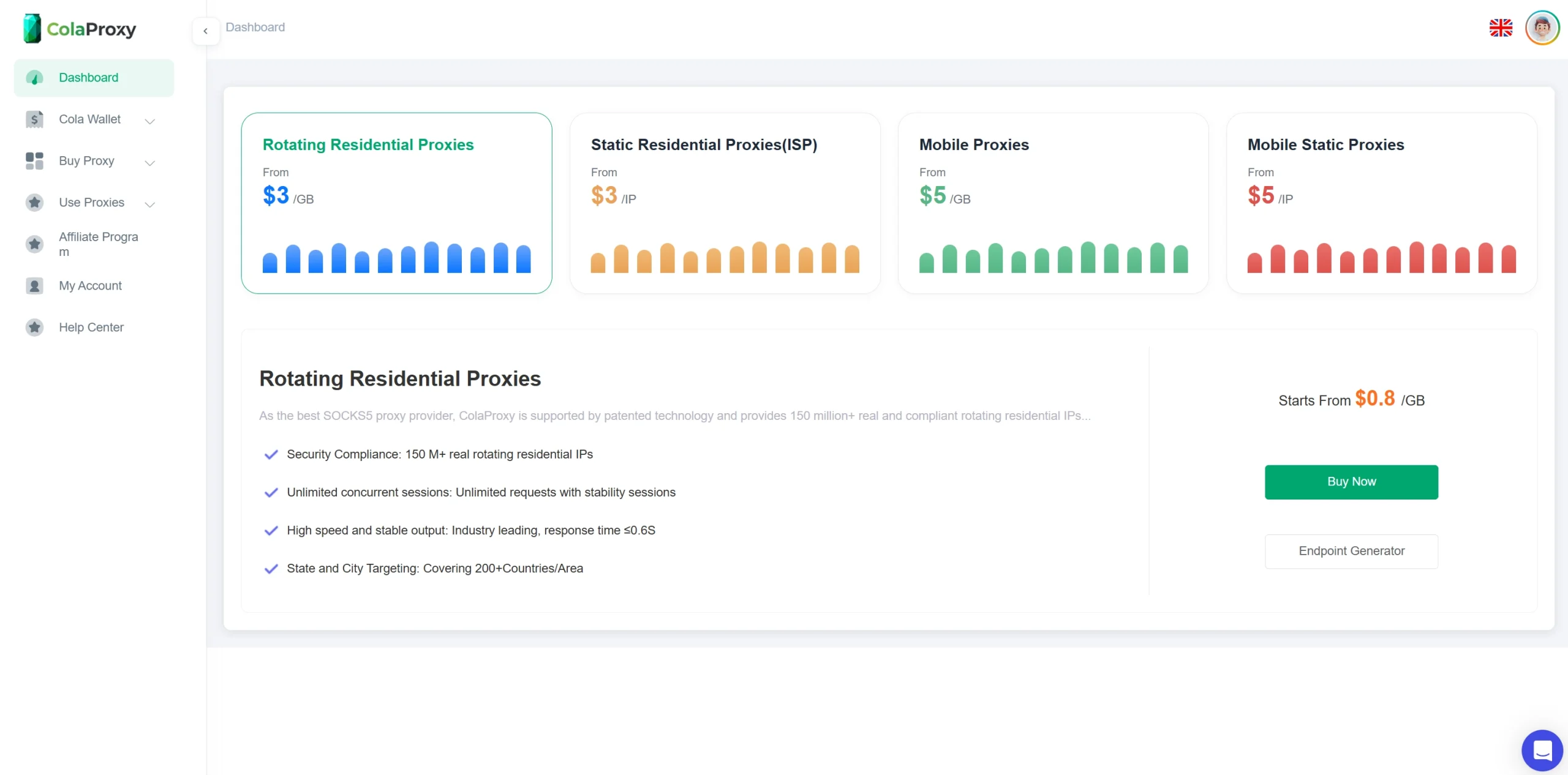
ColaProxy has a stronger value proposition for traffic-based residential proxy workflows. Its dynamic residential proxy pricing starts from $0.8/GB, which makes it attractive for teams that need recurring residential proxy traffic.
Proxy-Seller also offers residential proxies, but its broader identity is not only residential traffic. It is also known for private proxies, IPv4, IPv6, ISP, and mobile proxy options.
If your main goal is rotating residential traffic for scraping or monitoring, ColaProxy is likely the more natural fit. If residential proxies are only one part of a broader private proxy rental setup, Proxy-Seller may still be worth considering.
IPv4 Proxies
IPv4 proxies are still widely used because many tools, platforms, and websites work most predictably with IPv4 addresses. They are often used for account environments, browser profiles, manual workflows, automation tools, and general proxy needs.
This is one area where Proxy-Seller has a clearer positioning. Users looking specifically for private IPv4 proxy rental may find Proxy-Seller more aligned with their buying intent.
ColaProxy is not primarily positioned around IPv4 private proxy rental. Its stronger commercial angle is residential, ISP, mobile, and flexible proxy traffic.
If your search intent is “rent private IPv4 proxies,” Proxy-Seller may be the closer match. If your intent is “run scraping or SEO monitoring with residential proxy traffic,” ColaProxy is more relevant.
IPv6 Proxies
IPv6 proxies are often cheaper and more abundant than IPv4 proxies, but they are not suitable for every website or workflow. Some platforms support IPv6 well, while others still behave more predictably with IPv4.
Proxy-Seller is a stronger candidate when IPv6 proxy rental is a direct requirement. Users who need large quantities of IPv6 proxies for compatible platforms may find this model useful.
ColaProxy is less focused on IPv6 as a primary commercial use case. Its advantage is stronger in residential proxy workflows, static ISP identity, and mobile proxy scenarios.
ISP Proxies
ISP proxies are useful when users need a more stable identity than rotating residential proxies can provide. They can be used for account workflows, long sessions, browser automation, dashboards, and tasks where frequent IP changes would look unnatural.
Both providers can be relevant here.
ColaProxy offers static ISP proxies from $1.5/IP. This makes it a useful option for users who need fixed, stable proxy identity alongside residential or mobile proxy workflows.
Proxy-Seller also fits static proxy use cases well because its rental model is naturally aligned with fixed resources. If the user wants dedicated ISP proxies for a specific period, Proxy-Seller may be a practical option.
The decision depends on whether ISP proxies are part of a broader scraping and automation workflow or part of a fixed private proxy rental setup.
Mobile Proxies
Mobile proxies are useful for app testing, mobile ad verification, social media workflows, mobile-first platforms, and region-specific mobile access.
ColaProxy offers dynamic mobile proxies and static mobile proxies, making it relevant for users who need both rotation and stable mobile identity.
Proxy-Seller also offers mobile proxies, which may appeal to users looking for mobile proxy rental in specific regions.
For automation and recurring data workflows, ColaProxy may be easier to integrate with a broader proxy strategy. For fixed mobile proxy rental needs, Proxy-Seller can be part of the evaluation.
Pricing Model Comparison
Pricing is one of the biggest differences between ColaProxy and Proxy-Seller.
ColaProxy is easier to understand from a traffic and workflow perspective. If your task consumes residential traffic, you can estimate usage by GB. If you need static ISP or mobile IPs, you can evaluate cost per IP.
Proxy-Seller pricing is more rental-oriented. The cost depends on proxy type, quantity, location, and rental duration. This can be useful for users who know exactly how many fixed proxies they need.
| Pricing Question | Better Fit |
|---|---|
| I need residential proxy traffic by GB | ColaProxy |
| I need a fixed set of private proxies | Proxy-Seller |
| I need static ISP proxies for account workflows | Both |
| I need IPv6 proxy rental | Proxy-Seller |
| I need rotating residential proxies for scraping | ColaProxy |
| I need long-term private proxy rental | Proxy-Seller |
| I want to calculate cost per successful scrape | ColaProxy |
| I want to rent specific proxy inventory | Proxy-Seller |
A low proxy price is not enough by itself. The better metric is cost per successful task. For scraping, that means cost per successful request. For account workflows, that means cost per stable session. For private proxy rental, that means whether the rented IPs remain usable for the full rental period.
Performance Comparison
Speed
Proxy-Seller may perform well when users rent fixed private proxies close to their target region. Static IPv4, ISP, or datacenter-style proxies can be fast when the target website does not aggressively block them.
ColaProxy is better suited when speed must be balanced with residential trust and rotation. In web scraping and SEO monitoring, raw speed is not always the most important factor. A slightly slower residential proxy that completes requests successfully can be more valuable than a faster proxy that gets blocked often.
Stability
Stability means different things in different workflows.
For ColaProxy users, stability often means low timeout rates, reliable session control, and consistent performance across repeated scraping or automation tasks.
For Proxy-Seller users, stability often means the rented proxy remains available and usable throughout the rental period.
This is why the two providers should be tested differently. ColaProxy should be tested by request success rate and session behavior. Proxy-Seller should be tested by IP availability, speed consistency, and whether the proxy remains clean for the intended platform.
Block Rate
For websites with strong anti-bot systems, residential proxies usually have an advantage over simple datacenter or private proxy formats. ColaProxy’s residential proxy products are better suited for this type of traffic.
Proxy-Seller can still work well for lower-risk platforms, fixed account environments, or use cases where dedicated private proxies are preferred. But if the target website is sensitive to non-residential traffic, users should be careful when choosing proxy type.
Session Control
Session control is important for both providers, but the use cases differ.
ColaProxy is better for workflows that switch between rotating sessions and sticky sessions. For example, a scraper might use rotating residential proxies for public page collection, then switch to static ISP proxies for logged-in workflows.
Proxy-Seller is better when the user wants a fixed proxy identity from the beginning. Instead of rotating frequently, the goal is often to keep the same proxy for a rental period.
Use Case Comparison
Web Scraping
ColaProxy is better for web scraping when users need rotating residential proxies, country targeting, SOCKS5 support, and cost-efficient traffic. It fits teams that run Python crawlers, Scrapy, Playwright, Selenium, Puppeteer, or custom scraping pipelines.
Proxy-Seller can support scraping if the user chooses the right proxy type, but it is usually more attractive for fixed proxy rental than for high-volume rotating residential scraping.
For large-scale scraping, ColaProxy is usually the more natural fit.
SEO Monitoring
SEO monitoring often requires repeated access to search engines or localized content from different countries. The main requirements are residential IP quality, location coverage, repeatability, and cost control.
ColaProxy is a better fit for recurring SEO monitoring and SERP checks. Its 195+ country coverage and residential proxy pricing make it practical for rank tracking and competitor monitoring.
Proxy-Seller may be useful for SEO users who need fixed proxies for specific tools or regions, but for rotating SERP workflows, ColaProxy is usually easier to justify.
E-Commerce Price Monitoring
E-commerce price monitoring usually requires repeated visits to product pages, category pages, seller pages, and regional storefronts.
ColaProxy fits this use case well because it supports rotating residential traffic and can help distribute requests across many IPs.
Proxy-Seller can be useful when the monitoring workflow requires stable private IPs for a specific marketplace or account environment. However, for broad price collection, ColaProxy is usually more suitable.
Account Management
Account management is more nuanced.
For account workflows, stability matters more than rotation. Users often need a consistent IP identity, predictable session behavior, and long-term access. Static ISP proxies or fixed private proxies can both be useful.
ColaProxy is strong when account management is part of a broader proxy strategy involving ISP proxies, mobile proxies, and residential proxies.
Proxy-Seller is strong when the main requirement is renting a specific set of stable private proxies for a fixed period.
Browser Automation
For Playwright and Selenium automation, ColaProxy is better when users need a mix of rotating and sticky sessions. This is common in scraping, testing, monitoring, and multi-step automation.
Proxy-Seller is better when the browser automation task requires a stable fixed proxy identity instead of frequent rotation.
The decision depends on the automation design. If the workflow is request-heavy and changes targets frequently, ColaProxy is usually stronger. If the workflow depends on persistent identity, Proxy-Seller may be worth testing.
IPv4 and IPv6 Workflows
This is where Proxy-Seller deserves separate attention.
Some users specifically need IPv4 or IPv6 private proxies. They may not care about residential traffic by GB. They may care about renting a defined number of IPs for a defined duration.
For that buyer intent, Proxy-Seller is more aligned.
ColaProxy should be chosen when proxy traffic quality, rotating residential access, and business workflows matter more than simply renting IPv4 or IPv6 proxy inventory.
Decision Framework
| If Your Priority Is… | Choose |
|---|---|
| Rotating residential proxies | ColaProxy |
| Residential traffic cost efficiency | ColaProxy |
| Web scraping proxy workflows | ColaProxy |
| SEO monitoring | ColaProxy |
| E-commerce price tracking | ColaProxy |
| Playwright scraping workflows | ColaProxy |
| Static ISP identity | Both |
| Long-term private proxy rental | Proxy-Seller |
| IPv4 proxy rental | Proxy-Seller |
| IPv6 proxy rental | Proxy-Seller |
| Fixed proxy inventory | Proxy-Seller |
| Stable private proxies for a defined rental period | Proxy-Seller |
Pros and Cons
ColaProxy Pros
ColaProxy is strong for users who need flexible proxy access for real business workflows. Its residential proxy pricing is attractive for recurring scraping and SEO monitoring. Its static ISP and mobile proxy options make it useful for account workflows and automation. It also supports HTTP(S) and SOCKS5, which helps with tool compatibility.
ColaProxy Cons
ColaProxy is not primarily positioned as an IPv4 or IPv6 private proxy rental marketplace. Users who specifically want to rent fixed IPv4 or IPv6 proxy inventory may find Proxy-Seller more aligned with that need.
Proxy-Seller Pros
Proxy-Seller is strong for users who want private proxy rental by proxy type, location, quantity, and duration. It is especially relevant for IPv4 proxies, IPv6 proxies, ISP proxies, mobile proxies, and fixed proxy workflows.
Proxy-Seller Cons
Proxy-Seller may not be the first choice for high-volume rotating residential scraping. Users who need large-scale residential proxy traffic, SEO monitoring, or scraping workflows may find ColaProxy more direct and cost-efficient.
Testing Plan Before Buying
Before choosing either provider, test with your actual workflow.
| Test Area | What to Measure |
|---|---|
| Scraping success rate | Percentage of pages successfully collected |
| Response time | Average and p95 latency |
| Block rate | Percentage of blocked requests |
| CAPTCHA rate | CAPTCHA frequency |
| Session stability | Whether sticky sessions remain stable |
| IP availability | Whether rented proxies stay usable |
| Geo accuracy | Whether the target website sees the correct location |
| Cost efficiency | Cost per successful request or stable session |
For ColaProxy, test rotating and sticky sessions separately. For Proxy-Seller, test the specific proxy type and location you plan to rent.
FAQ
What is the main difference between ColaProxy and Proxy-Seller?
ColaProxy is more focused on flexible proxy access for scraping, SEO monitoring, automation, residential traffic, ISP proxies, and mobile proxies. Proxy-Seller is more focused on private proxy rental, including IPv4, IPv6, ISP, mobile, and other dedicated proxy options.
Which provider is better for web scraping?
ColaProxy is usually better for web scraping because it is more aligned with rotating residential proxies, traffic-based proxy usage, and scraping workflows. Proxy-Seller can work for scraping if the selected proxy type fits the target website.
Which provider is better for IPv4 proxies?
Proxy-Seller is more aligned with IPv4 proxy rental. ColaProxy is stronger when users need residential proxy traffic, ISP proxies, mobile proxies, and scraping workflows.
Which provider is better for IPv6 proxies?
Proxy-Seller is the better fit if IPv6 proxy rental is a specific requirement. ColaProxy is not primarily positioned around IPv6 private proxy rental.
Which provider is better for SEO monitoring?
ColaProxy is usually better for SEO monitoring because recurring SERP checks and localized rank tracking often require residential proxy traffic, broad country coverage, and cost control.
Which provider is better for account management?
It depends on the account workflow. ColaProxy is strong when account management requires ISP proxies, mobile proxies, and broader proxy flexibility. Proxy-Seller is strong when the user wants a fixed set of private proxies for a defined rental period.
Is ColaProxy cheaper than Proxy-Seller?
The pricing models are different, so the answer depends on the use case. ColaProxy is easier to evaluate by residential traffic cost. Proxy-Seller is easier to evaluate by proxy rental cost, quantity, location, and duration.
Should I choose rotating proxies or fixed private proxies?
Choose rotating proxies for scraping, SERP collection, price monitoring, and large numbers of independent requests. Choose fixed private proxies for stable account environments, long sessions, and workflows that require consistent IP identity.
Conclusion
The ColaProxy vs Proxy-Seller decision depends on whether you need flexible proxy traffic or fixed private proxy rental.
Choose ColaProxy if your priority is web scraping, SEO monitoring, Playwright automation, residential proxy traffic, static ISP proxies, mobile proxies, and cost-efficient business workflows.
Choose Proxy-Seller if your priority is renting fixed private proxies, especially IPv4 proxies, IPv6 proxies, ISP proxies, or other dedicated proxy inventory for a specific duration.
For scraping, monitoring, and automation teams, ColaProxy is usually the more natural first test. For users who know they need fixed private proxy rental, Proxy-Seller is worth evaluating.