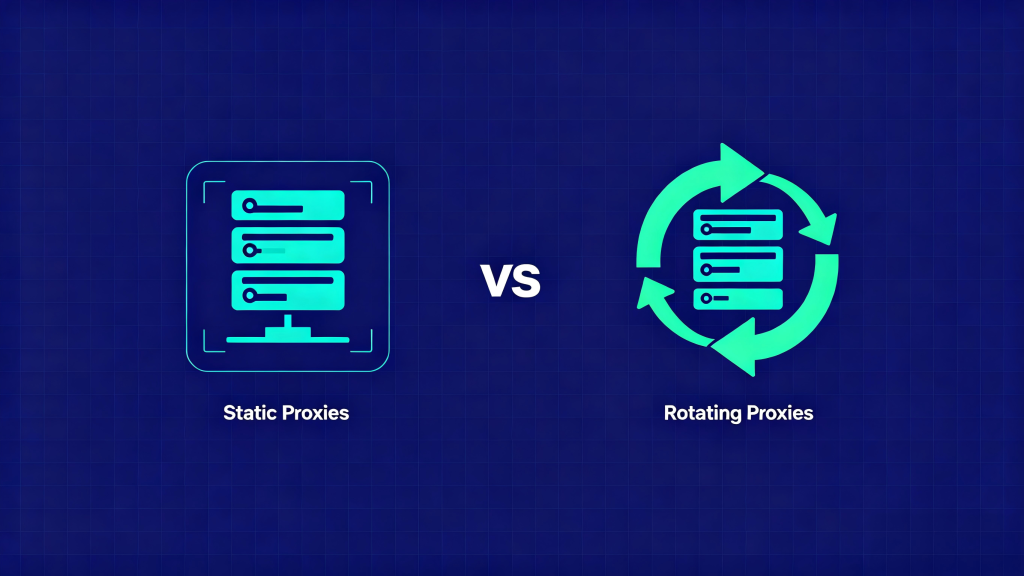
Choosing the right proxy type is one of the most important decisions when two of the most commonly used options are static proxies and rotating proxies. While they may seem similar at first glance, they serve very different purposes.
This guide explains how each type works, when to use them, and how to decide which one fits your specific use case.
Table of Contents
What Are Static Proxies?
Static proxies use a fixed IP address for consistent sessions
Static proxies assign you a single IP address (or a small set of IPs) that remains the same over time. This consistency makes them ideal for tasks that require stable identity, such as account management, login sessions, or long-term tracking.
Because the IP does not change, websites are more likely to recognize the connection as coming from the same user. This can be beneficial in scenarios where session persistence matters, but it also increases the risk of detection if too many requests are sent.
When static proxies are the better choice
Static proxies work best when stability is more important than anonymity. For example, if you’re managing multiple accounts, monitoring dashboards, or interacting with platforms that require login sessions, a consistent IP can prevent frequent re-authentication or security flags.
However, they are not ideal for high-volume scraping, as repeated requests from the same IP can quickly trigger rate limits or bans.
What Are Rotating Proxies?
Rotating proxies automatically change IP addresses over time
Rotating proxies provide access to a pool of IP addresses and assign a different IP to each request or session. This makes it significantly harder for websites to detect scraping activity.
Instead of appearing as a single user making repeated requests, your traffic is distributed across many IPs, mimicking natural user behavior.
Why rotating proxies are essential for web scraping
For large-scale data collection, rotating proxies are often the default choice. They allow you to send thousands of requests without overloading a single IP, which greatly improves success rates and reduces the chance of blocking.
This makes them particularly useful for scraping search engines, e-commerce platforms, and other data-rich websites.
Static vs Rotating Proxies: What’s the Real Difference?
The difference lies in stability versus scalability
The key distinction between static and rotating proxies is how they balance consistency and anonymity.
Static proxies provide a stable identity, making them suitable for session-based activities. Rotating proxies, on the other hand, prioritize distribution and anonymity, making them better suited for high-volume operations.
Performance, cost, and use case considerations
In terms of performance, static proxies are often faster and more predictable, especially when using datacenter infrastructure. Rotating proxies may introduce slight latency due to IP switching, but they compensate with higher reliability in scraping scenarios.
Cost structures also differ. Static proxies are typically priced per IP, while rotating proxies are often billed based on traffic usage or request volume.
Ultimately, the right choice depends on whether your priority is maintaining a stable session or scaling data collection efficiently.
Which Proxy Type Is Better for Web Scraping?
Rotating proxies are generally better for large-scale scraping
If your goal is to collect large amounts of data from websites, rotating proxies are usually the better option. They reduce the likelihood of IP bans and allow your scraper to run continuously without interruptions.
Static proxies can still be useful in specific scenarios
There are cases where static proxies make sense in scraping workflows. For example, when accessing authenticated content or maintaining a consistent session over time, a fixed IP can simplify the process.
In practice, many advanced setups combine both types to balance stability and scalability.
Is There a Better Alternative to Managing Proxies Yourself?
Scraping APIs can simplify complex proxy management
Managing proxies manually can become complicated, especially at scale. Scraping APIs offer an alternative by handling proxy rotation, request retries, and even JavaScript rendering for you.
This allows developers to focus on data extraction logic instead of infrastructure.
However, this convenience comes at a cost, and may not be necessary for smaller projects or teams with existing proxy setups.
How to Choose the Right Proxy for Your Needs
Start by defining your primary use case
Before choosing a proxy type, it’s important to understand your goal. Are you managing accounts, or scraping large datasets? Do you need session persistence, or maximum anonymity?
Answering these questions will help you determine whether static or rotating proxies are more suitable.
Consider scalability from the beginning
Even if your current needs are small, it’s worth thinking about future growth. Switching proxy strategies later can be time-consuming, especially if your system is already built around a specific setup.
Planning for scalability early can save significant effort in the long run.
Conclusion
Static and rotating proxies serve different purposes, and neither is universally better than the other. The right choice depends on your specific use case, whether it’s maintaining stable sessions or scaling data collection.
Understanding these differences is essential for building reliable scraping systems and avoiding common pitfalls like IP bans or unstable connections.