Web scraping has evolved significantly in recent years. While traditional scraping techniques worked well for static HTML pages, modern websites now rely heavily on JavaScript to load content dynamically.
This shift has made data extraction more complex, especially for developers who are used to simple request-based scraping methods.
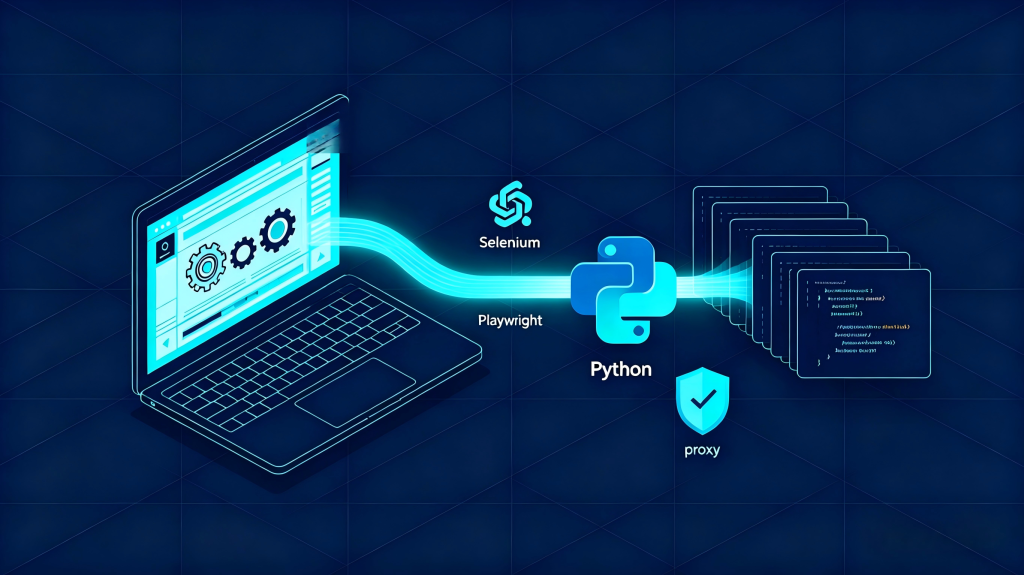
In this guide, you’ll learn how to scrape dynamic websites using Python, understand when to use tools like Selenium or Playwright, and how to scale your scraping setup for real-world use cases.
What Makes a Website “Dynamic”?
Dynamic websites load content using JavaScript instead of static HTML
A dynamic website does not deliver all its content in the initial HTML response. Instead, it uses JavaScript to fetch data from APIs and render it in the browser after the page loads.
This means that if you try to scrape such a page using basic tools like requests, you may receive an empty or incomplete HTML structure, because the actual data is loaded later.
In contrast, static websites contain all their content directly in the HTML, making them much easier to scrape with traditional methods.
Why dynamic content breaks traditional scraping methods
The main issue with dynamic content is that it requires a browser environment to execute JavaScript. Without rendering the page, your scraper cannot “see” the final content.
This is why many beginners encounter problems where their scraper runs successfully but returns no useful data. The issue is not the code itself—it’s the lack of JavaScript execution.
Key Challenges in Scraping Dynamic Websites
JavaScript rendering and delayed content loading
Modern websites often fetch data asynchronously, meaning content appears only after API calls are completed. Scrapers must wait for this process to finish before extracting data.
Anti-bot systems and request validation
Dynamic websites are more likely to implement anti-scraping mechanisms such as rate limiting, IP blocking, and browser fingerprinting. This makes naive scraping attempts unreliable at scale.
Complex interactions like scrolling and user events
Some data is only loaded when users scroll, click buttons, or interact with the page. Scrapers must replicate these behaviors to access the full dataset.
Approaches to Scraping Dynamic Websites in Python
Using browser automation tools for full rendering
One of the most reliable ways to scrape dynamic websites is to use browser automation tools that can execute JavaScript and render the page fully before extracting data.
These tools simulate real user behavior, making them suitable for complex websites where data is deeply embedded in client-side rendering.
Scraping Dynamic Content with Selenium
Selenium provides a straightforward way to control a real browser
Selenium is one of the most widely used tools for dynamic web scraping. It allows you to open a browser, load a page, wait for elements to appear, and then extract data.
A typical workflow involves launching a browser instance, navigating to a URL, waiting for specific elements, and then retrieving their content. This approach is easy to understand and works well for many use cases, especially for beginners.
However, Selenium can be slower and more resource-intensive compared to newer tools, especially when running large-scale scraping tasks.
Scraping Dynamic Content with Playwright
Playwright offers better performance and modern browser control
Playwright is a newer alternative that provides faster execution and more advanced control over browser behavior. It supports multiple browsers and allows for efficient handling of asynchronous content.
Compared to Selenium, Playwright is generally better suited for large-scale scraping due to its speed and reliability. It also includes built-in features for handling network requests, waiting conditions, and browser contexts.
For developers building scalable scraping systems, Playwright is often the preferred choice.
Scraping Without a Browser: A More Efficient Alternative
Extracting data directly from APIs instead of rendering pages
In many cases, dynamic websites fetch data through API calls. Instead of rendering the entire page, you can inspect network requests and directly access the underlying API endpoints.
This approach is significantly faster and more efficient, as it avoids the overhead of running a browser. However, it requires understanding how the website communicates with its backend and may involve handling authentication or headers.
Handling Infinite Scrolling and Dynamic Pagination
Simulating user behavior to load additional data
Websites with infinite scrolling require special handling, as new content is loaded only when the user scrolls down. In such cases, your scraper must simulate scrolling actions and wait for new data to load before extracting it.
This can be done using browser automation tools or by identifying API calls that return paginated data.
Using scraping APIs for complex dynamic targets
For highly protected or complex websites, scraping APIs can simplify the process by handling rendering, proxy rotation, and request management on your behalf.
This approach is especially useful when dealing with large-scale data extraction or when maintaining your own infrastructure becomes too complex.
Scaling Dynamic Web Scraping with Proxies
Why IP rotation becomes essential at scale
When scraping dynamic websites at scale, sending repeated requests from a single IP address will quickly lead to blocking or throttling.
Proxies allow you to distribute requests across multiple IP addresses, reducing detection risk and improving success rates.
Choosing the right proxy setup for dynamic scraping
Different proxy types serve different purposes. Residential proxies are more difficult to detect, while datacenter proxies offer better speed and lower cost. Rotating proxies are particularly useful for continuous scraping tasks.
A well-configured proxy setup is often the difference between a scraper that fails after a few requests and one that runs reliably over time.
Conclusion
Scraping dynamic websites in 2026 requires more than just basic HTTP requests. As websites become more interactive and protected, developers must adopt more advanced tools and strategies.
By combining browser automation tools like Selenium or Playwright, efficient API-based approaches, and scalable infrastructure such as proxies, you can build reliable and high-performing scraping systems.