Residential Proxies for AI Agents: A Practical Guide to Web Data Access in 2026
2026.06.11·Proxy
AI agents are moving beyond chat interfaces. They can now browse websites, compare products, monitor search results, verify advertisements, collect public information, and interact with dynamic pages. But an agent that works reliably in a small demonstration may struggle when it needs to access thousands of pages across multiple regions.
The problem is often not the model itself. It is the network layer.
Websites may return different content based on location, limit repeated requests from one IP address, or interrupt long workflows when the connection changes unexpectedly. Residential proxies can help teams build a more flexible access layer for authorized AI browsing and public web data collection.
This guide explains how residential proxies for AI agents work, when to use rotating or sticky sessions, how to design a reliable proxy workflow, and what to evaluate before choosing a provider.
Responsible-use note: Proxies do not grant permission to access restricted data. Always follow applicable laws, website terms, robots directives, privacy requirements, and contractual obligations.
A residential proxy routes an internet request through an IP address associated with an internet service provider and a residential network. The destination website sees the proxy IP rather than the direct IP of the agent’s server.
For an AI agent, the proxy acts as part of the connection layer:
The agent decides which page or resource it needs.
The application sends the request through a proxy gateway.
The proxy assigns an IP based on the selected country, city, or session rule.
The destination returns content for that network location.
The agent parses the response and continues its task.
Residential proxies do not replace browsers, crawlers, parsers, or large language models. They complement those components by providing geographic flexibility and reducing dependence on a single server IP.
Why AI Agents Need a Reliable Proxy Layer
Traditional crawlers usually follow predefined URLs and extraction rules. AI browsing agents may make decisions while a task is running. They can search, open results, follow links, render JavaScript, compare information, and revisit earlier pages.
That behavior creates several network challenges.
Localized content
Prices, inventory, advertisements, search results, and product availability can vary by country or city. A residential proxy with geographic targeting lets an agent observe the appropriate local version of a public page.
Repeated requests
Large research tasks may generate many requests. Sending all of them from one IP can trigger rate limits even when the underlying activity is legitimate. A managed rotation strategy distributes requests more appropriately.
Multi-step workflows
Some tasks require several consecutive page views, such as searching for a product, opening its detail page, selecting a location, and checking availability. Changing the IP in the middle of that sequence can reset the session or produce inconsistent results.
Dynamic websites
Modern sites often rely on JavaScript, cookies, regional APIs, and browser state. The proxy identity, browser session, cookies, language, and requested location must remain logically consistent.
Production reliability
An AI agent needs more than a working IP. It needs timeout handling, retries, session control, monitoring, and a way to replace unhealthy routes without repeating completed work.
Rotating vs. Sticky Residential Proxies
The right session type depends on the task. More rotation is not always better.
Requirement
Recommended session
Collect independent public pages at scale
Rotating residential proxy
Monitor search results across regions
Rotating proxy with geo-targeting
Complete a multi-page browsing flow
Sticky residential session
Maintain a login for an authorized account
Sticky or static ISP proxy
Keep one consistent identity for a long task
Static ISP proxy
Test how content differs by location
Rotating proxy with controlled country or city selection
Rotating residential proxies
A rotating residential proxy can assign a new IP for each request or after a defined interval. It is useful when requests are independent and IP diversity matters more than session continuity.
Common applications include:
AI web scraping of public pages
Search engine results monitoring
E-commerce price and inventory research
Advertisement verification
Travel fare comparison
Localized market research
Rotation should be controlled by the application. Switching IPs during every request can be inefficient when a workflow depends on cookies or session state.
Sticky residential sessions
A sticky session keeps the same residential IP for a specified period. It is a better choice for multi-step navigation, forms, shopping-flow testing, and other tasks that expect a consistent visitor.
A sticky IP should be paired with the same cookie jar, user-agent profile, language, and location settings. An IP from one country combined with unrelated browser signals can produce inconsistent responses.
Static ISP proxies
A static ISP proxy provides a fixed IP associated with an internet service provider. It is useful for long-running, authorized workflows that require a persistent network identity.
Static IPs offer continuity, but they should not be treated as disposable. Sensible request rates and careful error handling are especially important because the same address is reused.
Seven AI Agent Use Cases for Residential Proxies
1. E-commerce intelligence
AI agents can collect public product prices, stock status, shipping estimates, and regional catalog differences. Residential geo-targeting helps the system request the version intended for a specific market.
The collected data can support competitive research, pricing analysis, assortment planning, and inventory monitoring.
2. Localized SERP monitoring
Search results vary by location, language, device, and query history. Residential proxies allow an SEO agent to request results from selected markets and track how rankings change across regions.
For reliable comparisons, keep the query, language, device profile, and location settings consistent between runs.
3. Ad verification
An AI agent can check whether an advertisement appears in the intended country, whether its landing page works, and whether the displayed offer matches the campaign brief.
This workflow benefits from city or country targeting and a fresh browser context for each test.
4. Travel data aggregation
Flight, hotel, and rental information may vary by region and time. Agents can gather publicly accessible offers from multiple markets and normalize the results for analysis.
Because travel pages are highly dynamic, the system should record collection time, currency, locale, and location alongside each result.
5. Brand and marketplace monitoring
Agents can look for public listings, unauthorized product descriptions, pricing anomalies, or potential trademark misuse across regional marketplaces.
Residential IP coverage helps teams monitor markets without relying on a single geographic viewpoint.
6. Website localization testing
Quality assurance agents can verify redirects, translated content, currency, regional promotions, and local availability from different locations.
Unlike a basic uptime check, this approach tests what an actual visitor in the selected market is likely to receive.
7. Retrieval for research and RAG
Authorized agents can collect current public information for research or retrieval-augmented generation systems. The proxy layer helps distribute requests and reach location-dependent sources.
Teams should retain source URLs, collection timestamps, and provenance metadata so generated answers can be audited.
How to Build a Proxy Workflow for an AI Agent
Step 1: Classify the task
Decide whether requests are independent or part of a continuous session. This determines whether the agent should use rotating, sticky, or static proxies.
Step 2: Set the target location
Choose a country or city only when the task genuinely requires localized content. Avoid random location changes because they make results harder to compare.
Step 3: Keep identity signals consistent
Align the proxy location with browser language, timezone, cookies, and other session settings. Store one coherent browser context for each sticky session.
Step 4: Add rate controls
Set concurrency and request intervals according to the destination’s capacity and rules. Unlimited proxy concurrency does not mean unlimited requests should be sent to a website.
Step 5: Use bounded retries
Retry temporary connection failures with exponential backoff and a maximum attempt count. Do not retry permanent errors indefinitely.
Step 6: Rotate for a reason
Replace an IP when a session expires, a route becomes unhealthy, the task moves to another location, or the workflow begins a new independent unit. Avoid uncontrolled rotation.
Step 7: Monitor useful metrics
Track:
Successful responses
Connection and read timeouts
Response latency
Retry rate
Session completion rate
Data completeness
Cost per successful result
These measurements are more useful than evaluating a provider by advertised IP pool size alone.
Example Architecture
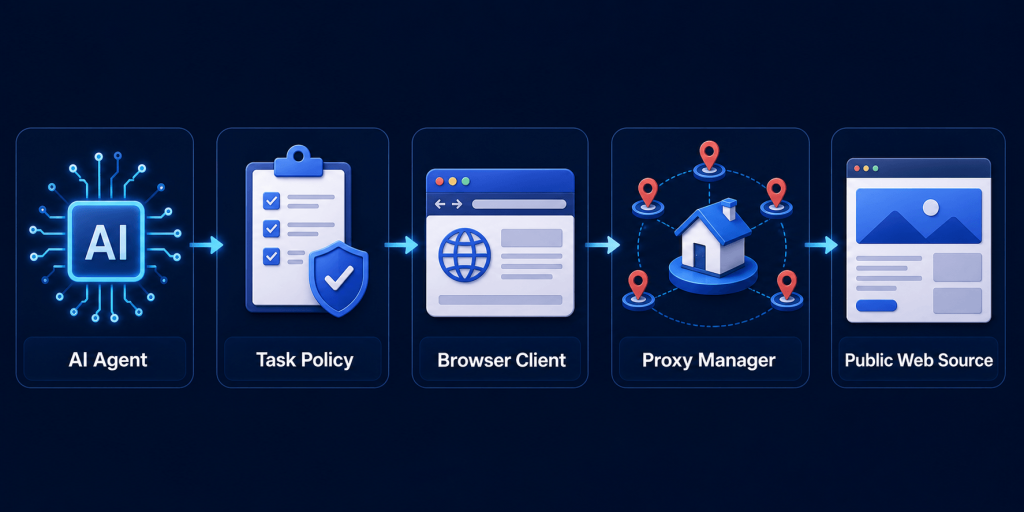
A production system can separate decision-making from network execution:
AI Agent
   |
Task and Policy Layer
   |
Browser or HTTP Client
   |
Proxy Session Manager
   |
Residential Proxy Gateway
   |
Public Web Source
The policy layer decides whether access is permitted, which location is required, how quickly requests may be sent, and whether a session should be reused. The proxy session manager then handles credentials, rotation, sticky-session identifiers, retries, and health checks.
Keeping these responsibilities separate makes the workflow easier to test and audit.
Common Proxy Mistakes in AI Automation
Rotating too frequently
Changing the IP during a multi-page task can invalidate cookies and produce inconsistent content. Use a sticky session when continuity matters.
Ignoring browser state
A stable IP alone is not enough. Cookies, headers, timezone, and language also influence how a website interprets a session.
Maximizing concurrency without limits
High concurrency can increase errors, duplicate work, and cost. Scale gradually while monitoring successful task completion.
Measuring only response speed
The fastest response is not valuable if the page is incomplete or belongs to the wrong region. Measure data quality and completed workflows.
Treating every error as an IP problem
Failures can come from application bugs, selector changes, JavaScript rendering, DNS issues, expired authentication, or the destination itself. Log enough detail to identify the real cause.
Collecting data without governance
AI projects should document what data is collected, why it is needed, how long it is stored, and who can access it. Proxy infrastructure does not remove those responsibilities.
How to Choose a Residential Proxy Provider for AI Agents
Evaluate providers with a workload-specific test rather than a generic speed check.
Look for:
Residential IP coverage in the countries and cities you need
Per-request rotation and sticky-session support
HTTP, HTTPS, or SOCKS5 compatibility
Clear authentication and API documentation
Traffic and session visibility
Responsive technical support
Transparent pricing
Acceptable-use and compliance policies
Stable performance under your expected concurrency
Run a representative pilot against authorized targets. Record success rate, latency percentiles, geographic accuracy, retry frequency, and cost per completed task.
Using ColaProxy for AI Web Data Workflows
ColaProxy provides dynamic residential proxies designed for public web data collection, regional testing, SEO monitoring, price monitoring, and other business workflows.
According to ColaProxy’s product information as reviewed on June 11, 2026, its dynamic residential proxy service includes:
More than 50 million residential IPs
Coverage across 195+ countries and regions
Country, state, and city-level targeting
Per-request rotation and sticky sessions
HTTP(S) and SOCKS5 support
Pay-as-you-go traffic that does not expire
API integration
24/7 technical support
ColaProxy also offers static ISP and mobile proxy options for workflows that need a persistent identity or a mobile-network route.
Not always. An agent accessing a small number of unrestricted pages may work without one. Residential proxies become useful when a legitimate project needs geographic targeting, controlled IP rotation, or greater resilience across many public requests.
What is the best proxy type for AI web scraping?
Rotating residential proxies are usually suitable for independent public-page requests. Sticky residential sessions are better for multi-step browsing, while static ISP proxies fit long-running workflows that require one consistent IP.
Can residential proxies prevent every block?
No. Access decisions depend on request behavior, browser signals, account state, rate, website policies, and many other factors. A proxy is only one component of a reliable collection system.
How often should an AI agent rotate its IP?
Rotate according to the workflow. Independent tasks can use frequent rotation. Multi-page sessions should normally retain the same IP until the task ends or the session becomes unhealthy.
Are residential proxies legal?
Proxy technology is legal in many jurisdictions, but legality depends on how it is used, what data is accessed, and which laws and contracts apply. Obtain legal advice for sensitive or large-scale projects.
Can I use residential proxies with Playwright, Puppeteer, Selenium, or Scrapy?
Yes, these tools support proxy configurations. The exact setup depends on the protocol, authentication method, and whether the application needs a rotating or sticky session.
Final Thoughts
AI agents need dependable web access, but dependable does not mean aggressive. The most effective systems choose the right session type, preserve coherent browser state, respect request limits, monitor data quality, and collect only authorized information.
Rotating residential proxies are useful for distributed public-data requests and localized research. Sticky residential sessions support multi-step browser tasks. Static ISP proxies provide continuity for longer authorized workflows.
The right proxy strategy is therefore not simply “rotate more.” It is to match network identity to the agent’s task, maintain consistent sessions, and measure successful outcomes from end to end.
Ready to test a residential proxy workflow? Explore ColaProxy residential proxies and select the location and session model that fits your AI agent.
About the Author
A
Alyssa
Senior Content Strategist & Proxy Industry Expert
Alyssa is a veteran specialist in proxy architecture and network security. With over a decade of experience in network identity management and encrypted communications, she excels at bridging the gap between low-level technical infrastructure and high-level business growth strategies. Alyssa focuses her research on global data harvesting, identity anonymization, and anti-fingerprinting technologies, dedicated to providing authoritative guides that help users stay ahead in a dynamic digital landscape.
The ColaProxy Team
The ColaProxy Content Team is comprised of elite network engineers, privacy advocates, and data architects. We don't just understand proxy technology; we live its real-world applications—from social media matrix management and cross-border e-commerce to large-scale enterprise data mining. Leveraging deep insights into residential IP infrastructures across 200+ countries, our team delivers battle-tested, reliable insights designed to help you build an unshakeable technical advantage in a competitive market.
Why Choose ColaProxy?
ColaProxy delivers enterprise-grade residential proxy solutions, renowned for unparalleled connection success rates and absolute stability.
Global Reach: Access a massive pool of 50 million+ clean residential IPs across 200+ countries.
Versatile Protocols: Full support for HTTP/SOCKS5 protocols, optimized for both dynamic rotating and long-term static sessions.
Elite Performance: 99.9% uptime with unlimited concurrency, engineered for high-intensity tasks like TikTok operations, e-commerce scaling, and automated web scraping.
Expert Support: Backed by a deep engineering background, our 24/7 expert support ensures your global deployments are seamless and secure.
Disclaimer
All content on the ColaProxy Blog is provided for informational purposes only and does not constitute legal advice. The use of proxy technology must strictly comply with local laws and the specific Terms of Service of target websites. We strongly recommend consulting with legal counsel and ensuring full compliance before engaging in any data collection activities.