
In cross-border e-commerce, social media management, and data collection, account bans, flagged IPs, and mid-task blocks are no longer rare exceptions — they are recurring headaches. At the root of most of these problems lies one common factor: the quality and type of proxy IP you are using.
Residential proxies route traffic through IP addresses assigned by real Internet Service Providers (ISPs) to actual home broadband connections. Because these IPs closely mimic the behavior of everyday internet users, they significantly reduce the risk of account suspensions, ad restrictions, and data collection interruptions. On platforms like Amazon, eBay, Shopee, TikTok, and Facebook, multi-account management and ad operations depend heavily on high-quality residential proxies to maintain account security and business continuity.
However, the web is flooded with low-effort proxy content — machine-translated fluff, shallow listicles, and affiliate-driven puff pieces that offer little practical value. This article takes a different approach. These residential proxy recommendations are grounded in real-world use cases, covering application scenarios, selection criteria, and an honest comparison of major providers, so cross-border sellers, social media operators, and data teams can find the solution that actually fits their workflow.
Why Is Demand for Residential Proxies Surging in 2026?
Over the past few years, residential proxies have quietly moved from a niche tool to an essential piece of infrastructure for cross-border e-commerce teams, social media agencies, ad buyers, and data analytics firms. For many global-facing operations, proxy IPs are no longer optional — they directly impact account safety, data throughput, and operational stability.
The driving force behind this shift is straightforward: platform anti-fraud systems are evolving faster than ever.
In the early days, most websites and platforms relied primarily on IP geolocation to verify user identity. As long as your IP came from the target country, access was typically granted without issue. By 2026, that is no longer enough. Modern detection engines evaluate multiple signals simultaneously — IP type (residential, mobile, or data center), ASN information, IP reputation history, browser fingerprinting, device environment, behavioral patterns, and network consistency.
Take Facebook ad accounts as an example. If the same account repeatedly logs in from data center IPs, the system may flag it as anomalous activity — even if the ads themselves are fully compliant — triggering additional verification, delivery restrictions, or outright account suspension. The same pattern plays out on TikTok, Instagram, Google Ads, and Amazon, where increasingly aggressive risk-detection layers raise the operational bar every quarter.
For cross-border sellers, a flagged or linked store can wipe out months of work overnight. For social media teams, account anomalies disrupt not just posting schedules but also ad performance and partnership deals. For data collection projects, constant CAPTCHAs, access denials, and IP bans tank efficiency and data completeness.
This is why residential proxy recommendations increasingly point toward residential IPs as the industry default for high-stakes operations. Because residential IPs originate from genuine home broadband networks, they carry higher authenticity and trust scores. When accessing platforms, they resemble ordinary user traffic far more closely than data center alternatives, dramatically reducing the probability of detection and restriction.
As cross-border commerce, social media marketing, AI data gathering, and global digital operations continue to grow, the importance of residential proxies will only increase. For businesses and individuals running long-term accounts, conducting market research, or executing large-scale data collection, a reliable residential proxy setup is no longer a nice-to-have — it is core infrastructure.
What Exactly Are Residential Proxies — and Why Cheap Alternatives Fall Short
A residential proxy routes your traffic through an IP address assigned by a local ISP to a real household. Here is how the three main proxy types compare:
| Type | IP Source | Detection Risk | Typical Use Cases |
|---|---|---|---|
| Data Center Proxy | Cloud server farms | High | Basic browsing, low-sensitivity tasks |
| Residential Proxy | Real home broadband | Low | Account management, e-commerce, data scraping |
| Mobile Proxy | Carrier mobile networks | Very Low | Ad verification, social media, high-trust scenarios |
Why not just use a cheaper alternative? Because modern anti-fraud systems look at far more than IP geolocation. IP type classification, ASN data, historical reputation scores, and traffic behavior patterns — all of these light up red on data center IPs. Residential IPs, by contrast, score normally across every dimension. That is what makes them valuable.
Primary Use Cases for Residential Proxies
Residential proxies have become a go-to tool in cross-border operations not simply because they use real home broadband IPs, but because they enable users to maintain stable and authentic-looking access identities in complex network environments. Different use cases demand different proxy configurations. Below are the most common scenarios today.
Cross-Border E-Commerce Multi-Account Management
For sellers operating on Amazon, eBay, Shopee, Etsy, Walmart, and similar platforms, account linkage detection is a persistent operational concern.
Platforms analyze login IPs, device fingerprints, browser environments, and behavioral patterns to determine whether multiple storefronts belong to the same operator. If several accounts share the same network environment, they risk triggering association flags — even when product listings and account details are entirely distinct.
This means each storefront generally needs its own dedicated residential IP, maintained consistently over time. This is especially true for daily operations like store management, customer service, and ad campaign oversight, where staying logged in for extended periods is the norm. Frequent IP changes in these scenarios can actually draw unwanted attention.
Static residential proxies or rotating proxies with long-duration sticky sessions are better suited to these needs, helping sellers build stable network identities and reduce both linkage and risk-management friction.
Social Media Management and Ad Operations
Platforms like Facebook, TikTok, Instagram, and X (Twitter) have become increasingly strict about network environment authenticity.
Many operators encounter frequent verification prompts, account restrictions, or outright bans during account creation, warm-up, or ad campaigns — and in many cases, IP quality is the silent culprit.
For TikTok account operations targeting the US market, for example, using low-quality data center proxies makes it easy for the platform to identify the anomalous network environment and downgrade the account’s trust score. Similarly, in Facebook advertising, suspicious IP patterns can trigger extended ad review times, delivery throttling, or forced additional verification.
Residential proxies, by simulating authentic user browsing environments, make login activity, content publishing, and ad delivery behavior appear more natural. This is why they have become the standard choice for many social media operations teams and advertising agencies.
Data Collection and Market Research
Data collection represents one of the broadest use cases for residential proxies.
Whether monitoring competitor pricing, scraping e-commerce product data, pulling search engine results pages (SERPs), or gathering publicly available market intelligence, these tasks all require frequent access to target websites.
Most websites impose rate limits on incoming requests, however. When high volumes of traffic originate from a single IP, the response is predictable: CAPTCHAs, access restrictions, and eventually outright blocks.
This is where large-scale rotating residential proxy pools shine. By automatically cycling through a vast pool of residential IPs, the system distributes requests across diverse endpoints, reducing pressure on any single IP and improving both success rates and data completeness.
For teams involved in market research, brand monitoring, SEO analysis, and AI training data collection, residential proxies have become essential for maintaining throughput and data quality.
Streaming and Geo-Restricted Content Access
Beyond commercial applications, residential proxies are widely used to access region-locked content.
Many streaming platforms tailor their content libraries based on the user’s detected IP location. The same title may have entirely different licensing availability in the US, UK, Japan, or other countries.
To access a specific region’s content catalog, users need a residential IP from the corresponding country or region.
Additionally, certain live sports platforms, streaming services, and video providers maintain high IP-reputation standards. Compared to easily-flagged data center IPs, residential IPs more closely resemble genuine user environments, often delivering better stability and compatibility on these platforms.
For users who need to watch extended live broadcasts, participate in real-time events, or access country-specific content libraries, residential proxies with sticky session support provide a smoother experience by avoiding disruptive mid-session IP rotations.
SEO Monitoring and Localized Search Analysis
For SEO professionals and digital marketing teams, residential proxies offer another valuable capability.
Google, Bing, and other search engines display different results based on the searcher’s detected location. Even for the same keyword, users in the United States, the United Kingdom, and Japan may see entirely different ranking pages.
By routing through residential IPs in specific target countries or cities, SEO teams can view exactly what local users see in their search results — enabling accurate keyword rank tracking, competitor analysis, and localized SEO optimization.
For businesses serving global markets, this capability directly informs content strategy and market expansion planning.
How to Choose a Residential Proxy: 5 Hard Criteria (Real-World Residential Proxy Recommendations)
Dozens of providers compete in the residential proxy market, and their websites all look roughly the same. When it comes time to make an actual purchasing decision, here are the five dimensions that matter most.
1. IP Pool Size and Geographic Coverage
IP pool size directly determines resource availability and rotation capacity. For businesses that require frequent IP changes, a small pool means a higher probability of the same IP being reassigned repeatedly. When too many users share a limited set of IPs, those addresses quickly get flagged, reputation-scored downward, or blacklisted by target sites. Generally, pools in the tens of millions offer adequate rotation headroom, while hundred-million-scale pools better support large-scale scraping and high-concurrency workloads.
Beyond sheer numbers, geographic distribution matters just as much. Many providers advertise coverage across 200+ countries, but their actual IP resources are concentrated in a handful of popular locations — the United States, the United Kingdom, Germany. If your business targets Southeast Asia, the Middle East, Africa, or Latin America, you need to verify that sufficient residential IP resources actually exist in those regions. For cross-border e-commerce and localized marketing projects, country-level, state-level, or even city-level targeting can make or break campaign performance.
2. IP Purity
IP quantity matters, but IP quality is what actually determines the day-to-day experience. “Purity” in this context means whether the IPs in a provider’s pool genuinely originate from residential network environments, and whether those IPs maintain clean reputation records.
Some low-cost providers cut corners by mixing data center IPs or long-abused low-quality addresses into their residential pools. These IPs may appear functional at first glance, but they trigger verifications, CAPTCHAs, and account risk flags at far higher rates when accessing target platforms.
Quality residential proxy providers continuously monitor IP health, regularly retire addresses with declining reputation scores or widespread platform flags, and steadily replenish their pools with fresh residential resources. For account-based operations, IP quality often outweighs IP quantity — one high-reputation residential IP delivers more stability than dozens of degraded alternatives.
3. Sticky Session Duration
Different workflows demand completely different levels of IP stability. Data collection projects often benefit from frequent IP rotation to keep request rates below detection thresholds. Cross-border e-commerce store management, social media account maintenance, and ad account operations, on the other hand, require long-term consistency from a single IP.
This is where sticky session support becomes critical. Sticky sessions allow users to retain the same residential IP for a specified duration, rather than having the system automatically rotate it and disrupt the network environment. Session duration options vary widely across providers — from 1 minute, 10 minutes, and 30 minutes, up to 24 hours or indefinite hold.
If your operations involve Amazon storefronts, TikTok accounts, or Facebook ad accounts that demand persistent sessions, prioritize providers offering long-duration sticky session support.
4. Concurrent Connection Limits
Concurrency is often overlooked during the evaluation stage, but for teams and automated workflows, it can be the biggest bottleneck. Concurrent connections represent how many proxy tunnels can be established simultaneously. A single-account operation may need only 1–5 connections; multi-store management might require dozens; large-scale data collection systems could demand hundreds or even thousands of parallel requests.
Some providers cap concurrency and charge extra beyond the limit. Others offer unlimited concurrency and bill solely by traffic volume. But “unlimited concurrency” does not automatically mean strong performance — if the underlying IP pool is too small or the network architecture is under-provisioned, even unlimited connection allowances can result in degraded response times, rising failure rates, or excessive IP reuse.
When evaluating concurrency, prioritize real-world metrics: connection success rate, average response time, network stability, and request pass-through rate. These reveal far more about proxy quality than a spec sheet ever will.
5. Pricing Model
Residential proxy pricing varies enormously across providers, and billing structures differ just as much. The most common models are pay-per-traffic (per GB), pay-per-IP, and monthly subscriptions. Pay-per-traffic suits data scraping, SEO monitoring, market research, and AI data collection. Pay-per-IP works better for Amazon store management, Facebook ad accounts, and TikTok account matrices. Monthly subscriptions fit teams with steady, predictable usage patterns.
Beyond headline pricing, pay attention to the fine print: whether traffic has an expiration date, whether balances roll over indefinitely, whether minimum spend requirements apply, whether extra concurrency fees exist, and whether providers charge country-specific surcharges. For small teams and individual users, a traffic-never-expires model typically offers the most flexibility and avoids the frustration of losing unused bandwidth at the end of a billing cycle.
Major Provider Comparison
The comparison below is based on publicly available information and real-world user feedback. No paid placements are involved.
| Provider | Starting Price | Pool Size | Sticky Sessions | Highlights |
|---|---|---|---|---|
| Bright Data | $8.4/GB | 72M+ | Yes | Industry benchmark, full-featured, premium pricing |
| Oxylabs | $8/GB | 100M+ | Yes | Enterprise-grade, ideal for large-scale scraping |
| Smartproxy | $7/GB | 55M+ | Yes | Mid-range value, beginner-friendly |
| IPRoyal | $7/GB | 32M+ | Yes | Decent reputation, average coverage |
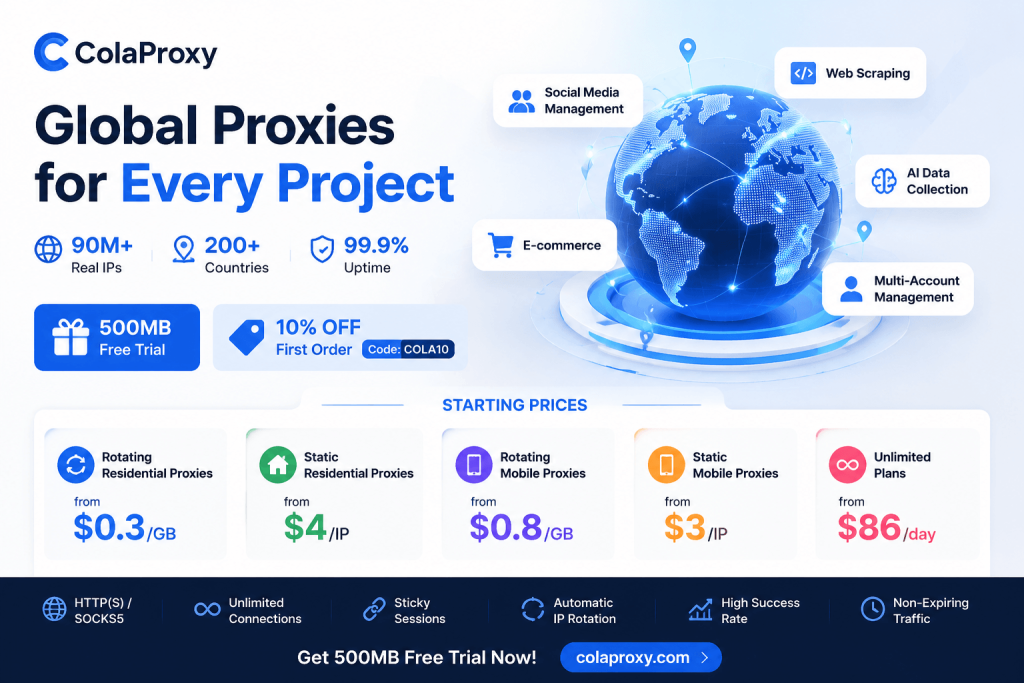
| ColaProxy | $0.3/GB | 90M+ | Yes | Best price-to-performance, traffic never expires |
Premium providers like Bright Data and Oxylabs offer undeniably comprehensive feature sets, but at $7–8 per GB, the cost adds up fast for small-to-medium teams and independent operators. If what you need is reliable performance without enterprise-level overhead, residential proxy recommendations from actual users consistently highlight high-value options like ColaProxy as the practical middle ground.
Why More Cross-Border Operators Are Choosing ColaProxy
Transparent Pricing, No Hidden Costs
Dynamic residential IPs start at 0.3/GB(1TBplan)—astarkcontrasttothe7–8/GB industry average. Traffic never expires: you use what you purchase, on your own timeline, without monthly zero-out cycles or pressure to burn through unused bandwidth. Static ISP proxies start at 4/IP,anddynamicmobileproxiesstartat0.8/GB, covering a full range of use cases under one roof.
90M+ Global Residential IPs
Covering 195+ countries and regions, with deep IP reserves across key cross-border markets including North America, Europe, Southeast Asia, and Latin America. All IPs are sourced from real ISP-assigned household devices — no data center IPs mixed into the pool, clean reputation scores across the board.
Flexible Session Control
Sticky sessions are supported from 1 minute to unlimited duration, covering everything from quick verification checks to persistent long-term account management. Automatic IP rotation is also available, so data collection workflows can run hands-free.
Unlimited Concurrency + Full Protocol Support
No cap on concurrent connections. HTTP(S) and SOCKS5 protocols are both supported, ensuring compatibility with proxy management tools, browser extensions, and custom scripts alike.
New user offer: 500 MB free trial + promo code COLA10 (10% off first order)
Website: https://www.colaproxy.com
Residential Proxy Best Practices: Avoiding Common Pitfalls
Steer Clear of Suspiciously Cheap “Residential” IPs
Some ultra-low-cost residential proxy services source their IPs through questionable means — botnets, hijacked devices, or unconsenting user endpoints. These IPs are not just unreliable; they can carry legal exposure. Stick with providers that have verifiable supplier credentials and transparent IP sourcing policies.
Match Your Proxy Type to Your Use Case
Using rotating IPs for e-commerce store management? Expect near-instant account flags. Conversely, using static IPs for large-scale scraping? Your limited pool will get burned through fast. Understanding which IP type and rotation strategy your specific workflow requires matters far more than chasing the lowest price tag.
Test Before You Commit
Before launching production workloads, run small-scale tests to verify connectivity rates, response times, and IP pass-through rates on your target platforms. Most reputable providers offer free trials or low-commitment starter plans — use them to validate performance before scaling up.
Proxy + Browser Fingerprinting = Complete Protection
IP address is only one dimension of anti-fraud detection. Pair your residential proxy with a fingerprint browser (such as AdsPower or Multilogin) to manage the full browser environment — time zone, language, User-Agent, WebRTC, and other fingerprint vectors — and keep them consistent with your proxy IP’s geographic location. Only then do you have a complete anti-association stack.
Frequently Asked Questions
What is the difference between a residential proxy and a VPN?
A VPN encrypts all traffic and routes it through a single server, typically using data center IPs that are trivial for platforms to identify. Residential proxies use real home broadband IPs, producing traffic patterns far closer to normal user behavior. Moreover, proxies can be configured per-application or per-browser, leaving the rest of your network activity unaffected.
Are residential proxies legal?
Using residential proxies is legal in itself, provided the IPs are sourced legitimately — with informed user consent and proper contractual agreements. Using them to violate target platform terms of service (e.g., bulk account creation, fake reviews) may fall into a gray area or constitute a breach of those platforms’ rules. Review the relevant platform policies before proceeding.
Which plan should a beginner start with?
For trial or low-frequency use, pick the lowest pay-per-traffic tier. ColaProxy’s 500 MB free trial is enough for thorough initial testing. For production use, start with a small traffic package from $0.3/GB and scale up as your needs grow.
Why are some residential proxies noticeably slow?
Residential proxies run through real home broadband connections. Speed is constrained by the local ISP’s infrastructure, the route quality from the proxy node to the target server, and the provider’s overall network architecture. Choose providers with well-optimized networks and reasonable node distribution, and always benchmark latency against your specific target regions before committing.
Conclusion
There is no single “best” residential proxy — only the best fit for your specific needs. The most actionable residential proxy recommendations come down to matching provider strengths against your actual workflow. If budget is no constraint, Bright Data and Oxylabs deliver feature-rich, battle-tested platforms that justify their premium pricing. But most cross-border operators do not need enterprise-level complexity or enterprise-level costs. A provider with clean IPs, sufficient geographic coverage, fair pricing, and traffic that never expires is the more sustainable long-term choice.
If you are evaluating residential proxy solutions for e-commerce, social media management, or data collection, ColaProxy’s free trial offers a low-risk starting point — validate performance first, then commit. That is the approach that keeps operations stable and budgets predictable.