When it comes to web scraping, automation, or large-scale data collection, most technical problems are not caused by code—they are caused by infrastructure decisions.
One of the most important decisions is choosing the right type of proxy.
Many users start with the wrong proxy setup and quickly run into issues such as:
- High block rates
- Inconsistent data
- Slow performance
- Unexpected costs
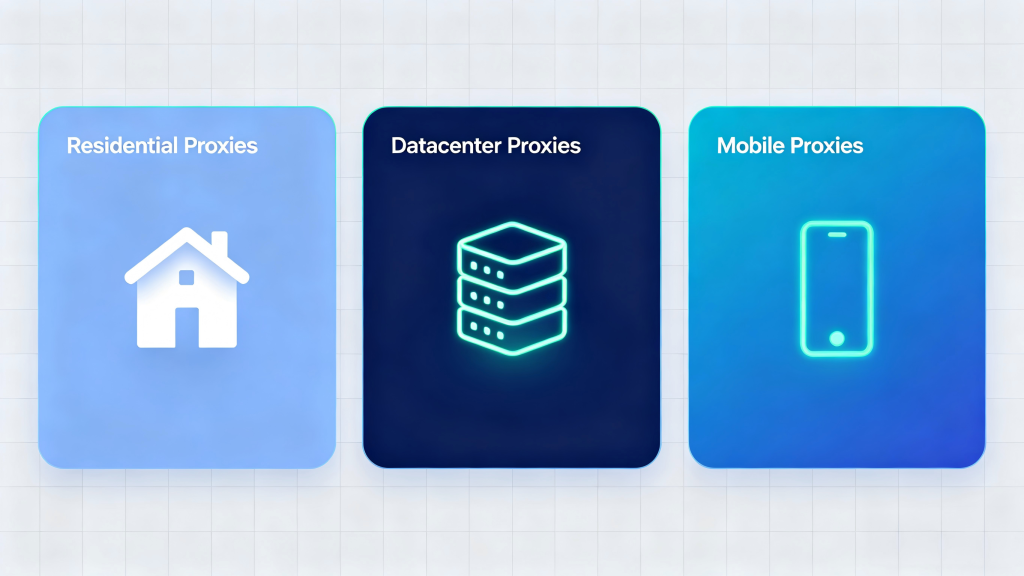
Residential, datacenter, and mobile proxies each solve a different problem. Understanding how they work—and when to use them—can dramatically improve both success rate and cost efficiency.
This guide provides a practical comparison to help you choose the right proxy type based on real-world use cases.
Table of Contents
What Are Residential Proxies?
Residential proxies use real IP addresses assigned by ISPs
Residential proxies route your traffic through real devices connected to Internet Service Providers. This makes your requests appear as if they are coming from normal users rather than automated systems.
Because of this, residential proxies are much harder for websites to detect or block. They blend naturally into regular traffic patterns, which is critical for accessing protected data.
Why residential proxies are widely used in scraping
Residential proxies are considered the industry standard for web scraping, especially when dealing with websites that actively monitor traffic behavior.
They are commonly used for:
- E-commerce data extraction (prices, listings, reviews)
- Search engine results scraping
- Travel fare aggregation
- Geo-specific content access
The main advantage is reliability. Even under strict anti-bot systems, residential proxies maintain a relatively high success rate.
Trade-offs: cost and speed
The downside of residential proxies is cost. Since they rely on real IPs, they are more expensive than datacenter proxies. Additionally, they may have slightly higher latency.
However, in most real-world scenarios, the improved success rate outweighs these drawbacks.
What Are Datacenter Proxies?
Datacenter proxies are generated from cloud infrastructure
Datacenter proxies are not tied to real users. Instead, they come from cloud servers or hosting providers. This allows them to be produced at scale, making them much cheaper and faster.
They are often used when speed and volume are the top priorities.
Why datacenter proxies are popular for scaling
For tasks that require sending a large number of requests quickly, datacenter proxies are highly efficient. They are commonly used for:
- Bulk data collection
- Market monitoring
- SEO tracking
- Non-sensitive automation tasks
Their low cost makes them ideal for projects where budget is a concern.
Limitations: easier detection
Because datacenter IPs are not associated with real users, many websites can identify and block them more easily. This makes them less reliable for scraping protected platforms.
In practice, datacenter proxies are best used where anti-bot systems are relatively weak.
What Are Mobile Proxies?
Mobile proxies use IPs from real mobile carriers
Mobile proxies route traffic through mobile networks (3G, 4G, 5G). These IPs are shared among many users, which makes them extremely difficult to block.
From a website’s perspective, blocking a mobile IP could disrupt real users, so these IPs are treated with higher trust.
Why mobile proxies offer the highest success rate
Mobile proxies are often the most reliable option for bypassing strict anti-bot systems. They are commonly used for:
- Social media automation
- Ad verification
- Sneaker and ticketing bots
- Highly protected platforms
In environments where residential proxies may still get blocked, mobile proxies often succeed.
Trade-offs: cost and availability
Mobile proxies are typically the most expensive option and may have limited availability depending on location. Because of this, they are usually reserved for high-value tasks where success rate is critical.
Residential vs Datacenter vs Mobile Proxies: A Practical Comparison
Comparing anonymity, speed, and cost
Each proxy type is optimized for a different priority:
- Datacenter proxies → fastest and cheapest
- Residential proxies → balanced reliability and anonymity
- Mobile proxies → highest trust and success rate
Choosing the right one depends on what matters most in your workflow.
Comparing performance in real-world scenarios
In real-world scraping environments:
- Datacenter proxies perform well on low-security websites
- Residential proxies perform well on most commercial websites
- Mobile proxies perform best on highly protected platforms
This makes it important to match the proxy type to the target website’s level of protection.
Which Proxy Is Best for Web Scraping?
Residential proxies are the default choice for most cases
For most scraping tasks, residential proxies offer the best balance between cost and success rate. They can handle moderate to high levels of protection while remaining relatively scalable.
Datacenter proxies are ideal for cost-sensitive scaling
If you need to scrape large volumes of data from less protected sources, datacenter proxies can significantly reduce costs.
A common strategy is to start with datacenter proxies and switch to residential proxies when encountering blocks.
Mobile proxies are used for the most difficult targets
When dealing with platforms that aggressively block automated traffic, mobile proxies provide the highest chance of success.
They are typically used in niche scenarios where other proxy types fail.
Should You Combine Multiple Proxy Types?
Hybrid proxy strategies are common in advanced setups
In real-world systems, many teams combine different proxy types to optimize both cost and performance.
For example:
- Use datacenter proxies for initial scraping
- Switch to residential proxies for blocked requests
- Use mobile proxies for the most sensitive targets
This layered approach allows you to control costs while maintaining high success rates.
Alternative Approach: Scraping APIs
Scraping APIs simplify proxy management
Instead of managing proxies manually, some teams use scraping APIs that handle proxy rotation, retries, and rendering automatically.
This reduces technical complexity but may increase operational cost.
How to Choose the Right Proxy for Your Use Case
Start with your primary goal
Your decision should depend on what you’re trying to achieve:
- Large-scale scraping → residential or datacenter
- Sensitive platforms → mobile
- Cost optimization → datacenter
Consider long-term scalability
Choosing the wrong proxy type early can lead to expensive system redesigns later. Planning for scale from the beginning ensures smoother growth.
Conclusion
There is no universal “best” proxy. Each type serves a different purpose, and the right choice depends on your specific use case.
By understanding the trade-offs between residential, datacenter, and mobile proxies, you can build more efficient, stable, and scalable systems.