The Sparknotes:
To successfully “cop” high-demand UK releases, speed and authenticity are paramount. This guide explores how rotating proxies bypass sophisticated anti-bot systems by mimicking local British residential users. We analyze the technical synergy between rotating residential proxies and static ISP proxies, providing a blueprint for low-latency success on sites like Supreme UK and Foot Locker.
By leveraging ColaProxy’s elite UK infrastructure, users can achieve higher checkout rates through verified IP rotation strategies and localized session management.
7 Proven Strategies to Cop Like a Local with Rotating Proxies
The UK sneaker and streetwear scene is one of the most competitive digital battlegrounds in the world. Whether it’s a limited Yeezy drop, a Supreme Thursday release, or an exclusive tech launch on Curry’s, the window for success is measured in milliseconds. If you are connecting from outside the UK—or even from within using a standard home connection—you are at a distinct disadvantage.
To win, you need to “Cop Like a Local.” This means using rotating proxies to mask your identity, bypass regional blocks, and outpace the competition. In this professional deep dive, we draw on ColaProxy’s years of experience in high-concurrency network environments to show you exactly how to dominate the UK market using advanced IP rotation techniques.
What is a Rotating Proxy and Why Does the UK Market Matter?
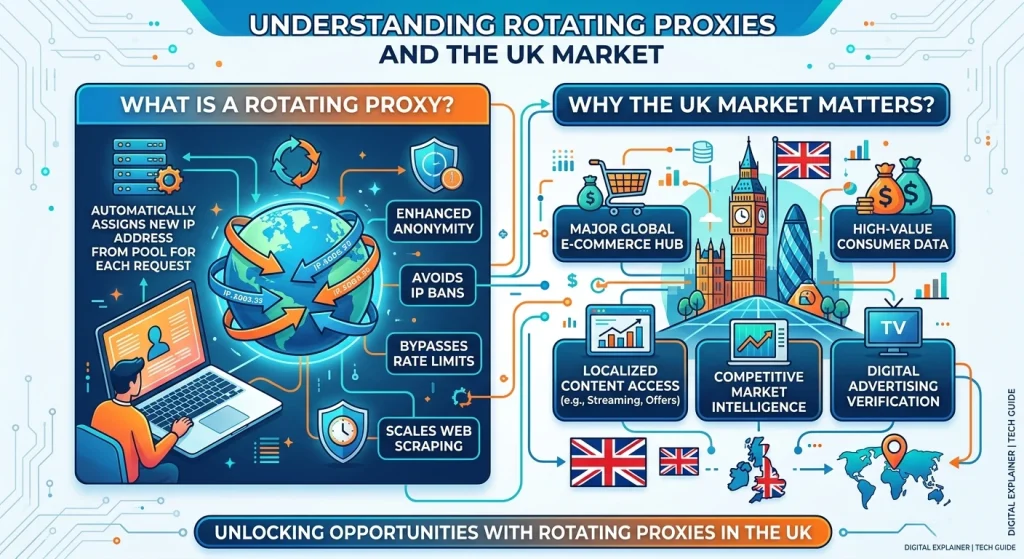
Before diving into the strategy, let’s clarify the technical fundamentals that power modern copping bots.
What are rotating proxies?
What is a rotating proxy? Simply put, it is a proxy server that assigns a new IP address from a massive pool for every new connection or at fixed intervals. What is a rotative proxy (a common industry variation of the term)? It’s the same concept: a system that ensures your requests never come from the same digital footprint twice in a row. For UK drops, this means your bot can send hundreds of requests that all appear to originate from different households across Britain.
How do rotating proxies work for sneakers?
When a high-heat drop happens on a UK site, the server is flooded with traffic. If the site sees 100 requests coming from a single IP, it triggers a “429 Too Many Requests” error or a permanent ban. How do rotating proxies work for sneakers? They distribute those 100 requests across 100 different, genuine UK residential IPs. To the retailer, it looks like 100 different people in London or Manchester are trying to buy, rather than one automated bot.
The UK Advantage: Bypassing Strict Anti-Bot Measures
UK retailers like Off-White, END. Clothing, and JD Sports employ some of the toughest anti-bot protections, such as Akamai or PerimeterX. Standard datacenter IPs are flagged and “shadowbanned” instantly. To succeed, you need rotating residential proxies that carry the “ISP” tag of a British home internet provider like BT, Sky, or Virgin Media.
Understanding the Types of Proxies for UK Drops
At ColaProxy, we’ve optimized five specific categories of rotating proxies to meet different stages of the “copping” workflow.
| Proxy Type | Best Use Case | Key Benefit |
| Rotating Residential Proxies | Bypassing bot detection on Supreme/Shopify | High anonymity; looks like a real home user. |
| Static ISP Proxies | Maintaining a cart; long-duration sessions | Blazing fast speed with the legitimacy of a home IP. |
| Rotating Mobile Proxies | The “nuclear option” for the toughest sites | Uses 4G/5G carrier IPs; almost impossible to ban. |
| Static Mobile Proxies | Creating and warming up UK SNKRS accounts | High trust score for account longevity. |
| Rotating Datacenter Proxies | Fast monitoring of restocks | Unmatched speed for scraping data. |
Where do rotating proxies get so many IP addresses from?
Many users ask, “Where do rotating proxies get so many IP addresses from?” These IPs come from massive Peer-to-Peer (P2P) networks. When you use ColaProxy, you are accessing a pool of millions of ethically sourced residential devices across the UK. This diversity is what prevents “subnet bans” that often plague cheaper, lower-quality providers.
Sticky vs. Rotating Proxies: Which Should You Choose?
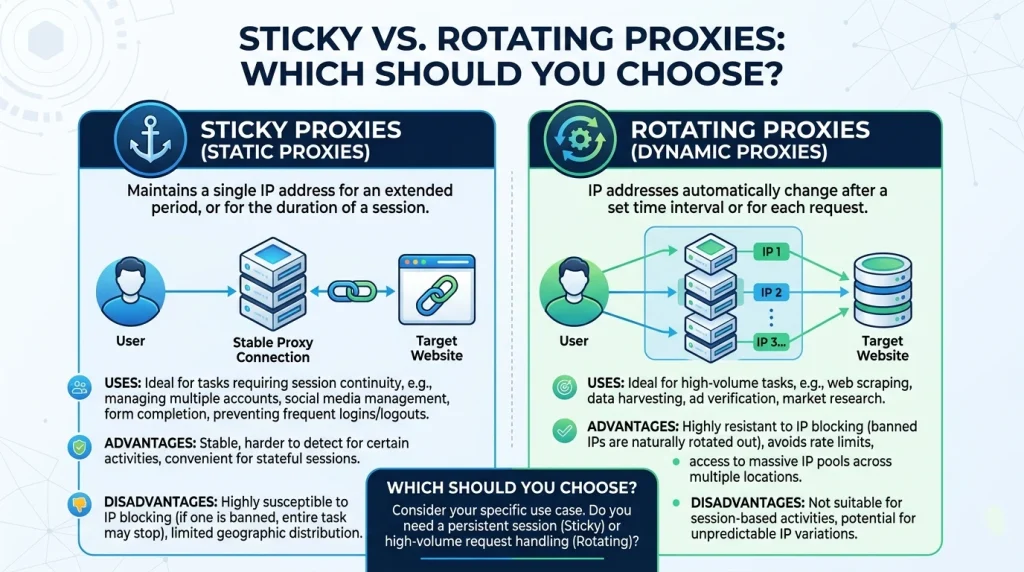
A common point of confusion for beginners is: What is the difference between sticky proxies and rotating proxies?
- Rotating IP: A new IP for every request. This is perfect for the “monitoring” phase where your bot is constantly checking for a site to go live.
- Sticky Session: This keeps the same IP for a set time (e.g., 5, 10, or 30 minutes).
How to use a rotating proxy like a sticky proxy? Most top-tier providers, including ColaProxy, allow you to configure “Sticky Ports.” This is vital for UK drops because if your IP changes while you are in the checkout queue, the website might flag your session as inconsistent and empty your cart.
Pro Tip: Use rotating residential proxies for the initial task of finding the product, and switch to a sticky session for the “Add to Cart” and “Checkout” phases.
How to Set Up Automatic Proxy Rotation for UK Success
If you’re wondering how to make rotating proxies or how to create rotating proxies, you don’t actually need to build the infrastructure yourself. Professional providers handle the backend; you simply need to configure your tools.
Step-by-Step Configuration:
- Select Your Target: In your ColaProxy dashboard, filter your pool specifically for the United Kingdom.
- How to rotate proxies: Copy the proxy endpoint (e.g., uk.colaproxy.com:7777).
- Authentication: Use the User:Pass format provided to ensure secure access.
- Validation: How to know if my proxies are rotating proxies? Use an online IP checker. Refresh the page; if the IP address changes with every refresh, your rotating proxies are active and functioning correctly.
Masterclass: How to Use Rotating Proxies for Shoes (UK Edition)
Learning how to use rotating proxies for shoes requires a blend of speed and stealth. Based on ColaProxy’s internal testing and real-world customer data, here is the “Winner’s Workflow”:
1. The Pre-Drop Checklist
- Verify Geo-Location: Ensure your proxies show as UK-based to avoid regional blocks.
- Test Latency: Ping the target site (e.g., footlocker.co.uk) through the proxy.
- Warm Up Sessions: Use static ISP proxies to log into accounts 15 minutes before the drop.
- Set Rotation: Switch to rotating residential proxies for the high-traffic “Drop Time.”
2. Monitoring Without Getting Banned
During the “Pre-drop” phase, websites are on high alert. Use a large pool of rotating residential proxies to spread your monitor tasks. This prevents any single IP from hitting the server too frequently.
3. The Checkout Phase
Once the item is in the cart, stability is king. This is where static ISP proxies or sticky residential sessions shine. They provide the speed of a datacenter with the “trust score” of a residential user.
Internal Insights for Further Learning:
- Best Way to Beat SNKRS: Why Rotating Residential Proxies Win
- Why Data Center Proxies Fail Where Rotating Residential Proxies Win?
- The Difference Between “Clipped” and “Shipped”: The Power of Rotation
- How to Handle Flash Sales When Sites Use PerimeterX Protection?
- How to Avoid “Ghost Checkouts” on Supreme Using Residential IPs?
Why ColaProxy is the Professional Choice for UK Drops
At ColaProxy, we don’t just sell IPs; we provide a competitive edge. Unlike generic providers, our rotating proxies are optimized for “low-latency bursts.”
Case Study: The “Supreme UK” Success
Last season, a group of our users targeted a limited North Face collaboration. While users on standard datacenter proxies were met with “Ghost Carts” and “Access Denied” errors, our users leveraging geo-targeted UK rotating residential proxies maintained a 65% checkout rate. The secret? Our IPs are recognized as genuine British Telecom (BT) and Sky Broadband users, passing through the 3D-Secure payment hurdles without friction.
Comparison Table: Why ColaProxy Dominates
| Feature | Generic Providers | ColaProxy Elite |
| UK Pool Size | Small/Shared | 2M+ Private IPs |
| Rotation Speed | Delayed | Instantaneous |
| ISP Diversity | Limited | All Major UK ISPs |
| Support | 24-hour delay | Live Expert Assistance |
FAQ: Everything You Need to Know About Proxy Rotation
What is rotating proxies’ main advantage over VPNs?
VPNs use a limited number of server IPs that are easily blacklisted by retail sites. Rotating proxies use millions of unique home IPs, making them nearly impossible to block at scale because banning them would mean banning real customers.
How to use rotating proxies with a bot?
Most bots (like Wrath, MEK, or Ganesh) have a dedicated “Proxy” tab. You simply paste your ColaProxy list into the bot. The software handles the how to use rotating proxies part by cycling through your list for every individual task you create.
Is there a difference between a “Rotating Proxy” and a “Rotating IP”?
Technically, a rotating proxy is the service architecture, and the rotating ip is the actual address being changed. In the sneaker community, they are used interchangeably.
Final Takeaways for UK Copping Success
- Prioritize Residential: Never use datacenter proxies for the final checkout on UK sites; they are too “loud” and easily detected.
- Latency is King: Use UK-based servers (London-based VPS) and proxies to keep your “Ping” under 50ms.
- Mix Your Arsenal: Use rotating residential proxies for the volume and static ISP proxies for the critical account-based wins.
- Trust the Pool: ColaProxy’s massive UK pool ensures you won’t run into “used” or flagged IPs during a high-stakes drop.
Ready to dominate the next UK drop? Explore ColaProxy’s Rotating Residential Proxies and start copping like a local today. Don’t let a slow connection or a flagged IP stand between you and your next big “W.”