Summary:
Retail security systems are designed to identify and flag consistent, repetitive behavior coming from a single point of origin. This is precisely why static IPs get banned on retail sites; their unchanging nature acts as a permanent “fingerprint” for bot detection. While static residential proxies are perfect for account management, they lack the agility needed for high-speed scraping or bulk purchasing.
The secret to bypassing these blocks lies in rotating residential proxies, which distribute requests across millions of unique nodes, mimicking organic human traffic and effectively neutralizing rate-limiting filters.
Stop Getting Blocked: Why Retail Sites Hate Static IPs
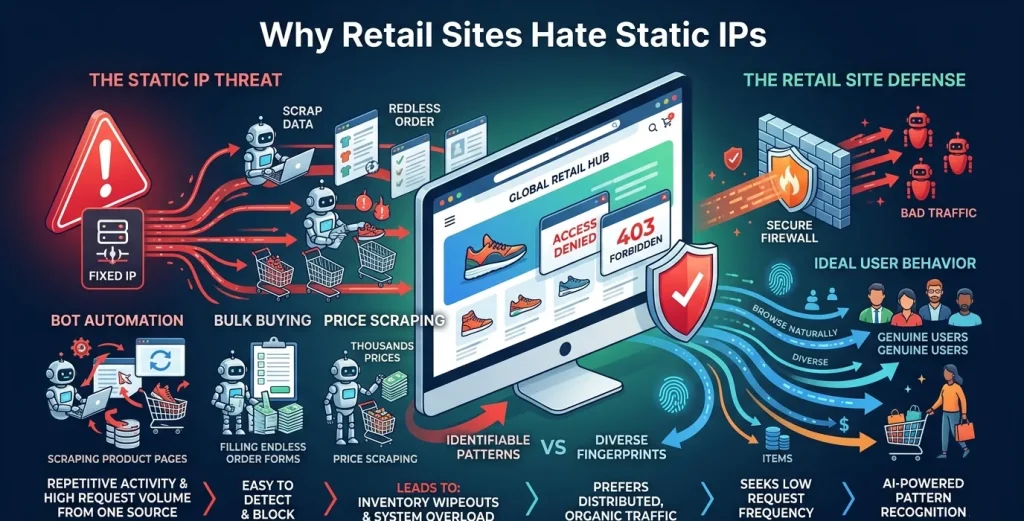
In the competitive world of e-commerce, data collection and automated purchasing have become essential survival tools. However, the biggest hurdle to these operations is the “IP Ban.” If you have spent any time using automation, you have likely asked: Why do my static IPs get banned on retail sites so easily? At ColaProxy, we have monitored millions of requests across platforms like Amazon, eBay, and Shopify. We’ve found that the “fixed” nature of a static IP is its greatest weakness in a high-security environment.
Why Static IPs Get Banned (The “How It’s Tracked” Problem)
To understand why static IPs get banned on retail sites, we must look at the server-side logic of modern web firewalls. Retailers use advanced “behavioral fingerprinting” to distinguish humans from bots.
1. Consistent Footprint Identification
A static residential IP is an unchanging identifier. If an IP makes 1,000 requests to a checkout page in 60 seconds, it is immediately flagged. Since the IP doesn’t change, the security system can easily link all 1,000 requests to a single automated source.
2. High-Volume Triggers & Rate Limiting
Every retail site has a “Rate Limit”—a maximum number of requests a single IP can make within a specific timeframe. When you use static residential proxies for high-speed tasks, you hit these limits almost instantly, triggering a “403 Forbidden” error or a permanent block.
3. Historical Data Logging
Websites maintain “Reputation Scores” for IPs. Because a static IP persists over time, any “suspicious” activity (like a single failed login or a rapid refresh) is permanently tied to that IP. Over time, the IP’s reputation drops until it is blacklisted site-wide.
4. The Bot Detection Algorithm
Modern retailers look for “non-human” patterns. Humans browse erratically; bots browse logically and quickly. On a static residential IP, these logical patterns are easy to spot because the “actor” never changes.
How Rotation Saves You (The “How It Bypasses” Secret)
If static IPs are the problem, rotating residential proxies are the solution. By constantly cycling your exit point, you effectively vanish from the security system’s radar.
How Rotation Works:
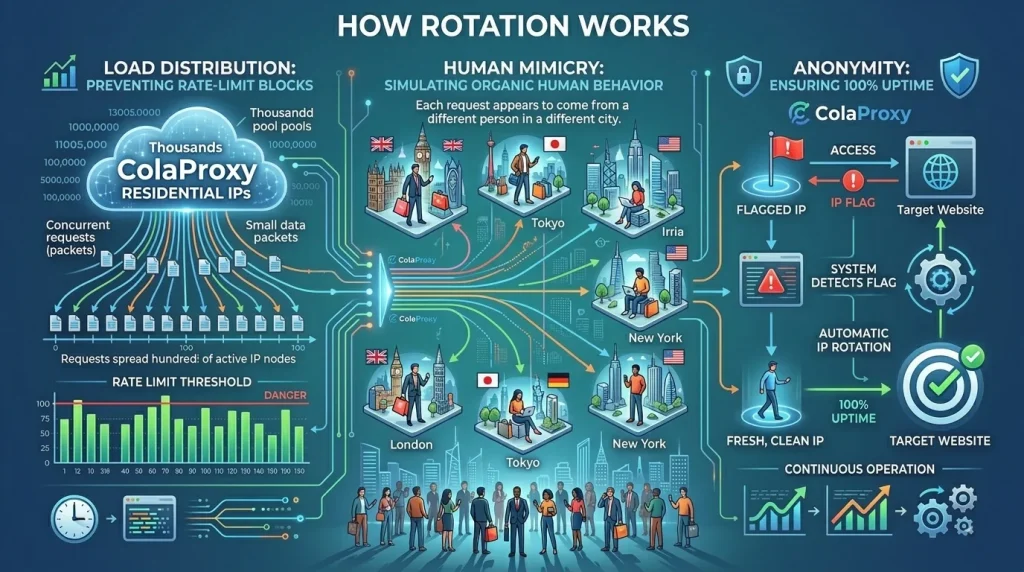
Instead of sending all traffic through one “pipe,” a rotating residential IP system spreads traffic across a vast pool of real household connections.
- Load Distribution: No single IP ever reaches the rate-limit threshold.
- Human Mimicry: Each request appears to come from a different person in a different city.
- Anonymity: Even if one IP is flagged, the system rotates to a fresh one, ensuring 100% uptime for your scraper or bot.
ColaProxy Takeaway: Rotation is not just about changing numbers; it’s about changing your entire digital identity every few seconds to stay invisible.
Comparison: Static vs. Rotating Residential Proxies
| Feature | Static Residential Proxies | Rotating Residential Proxies |
| IP Address Change | Never (Same IP for weeks/months) | Every request or set interval |
| Detection Risk | High for bulk tasks | Extremely Low |
| Best Use Case | Maintaining Social Media Accounts | Web Scraping & Sneaker Drops |
| Success Rate | High for session persistence | High for bypassing firewalls |
| Anonymity | Limited | Maximum |
Why some sites are accessible with rotating IPs but not with Static Residential IPs?
Many of our clients at ColaProxy notice that they can scrape a site easily with rotation, but get blocked instantly when switching to a static residential IP. This happens because of “Subnet Blocking” and “Behavioral Profiling.”
When a site sees a surge of traffic from a specific ISP’s static range, it may temporarily “grey-list” that entire range. However, rotating residential proxies pull from such a diverse array of providers and geographic locations that it is impossible for a site to block them all without accidentally blocking thousands of legitimate customers.
When to Use Static Residential Proxies (ISP Proxies)
Despite the banning risks for high-volume tasks, static residential proxies (also known as static ISP proxies) are vital for “trust-based” tasks.
- Account Management: Using a different IP every time you log into an Amazon Seller account will get you banned for “suspicious login.” You need a consistent static residential IP.
- Payment Processing: To avoid “fraud flags,” the IP used to submit a payment should ideally be the same one that added the item to the cart.
Real-World Experience: The ColaProxy Methodology
At ColaProxy, we have developed a “Hybrid Strategy” for our clients to ensure they never face the frustration of seeing static IPs get banned on retail sites.
The 3-Step Success Checklist:
- Phase 1: Discovery (Use Rotation): Use rotating residential proxies to scrape prices, monitor inventory, and “find” the product. This keeps your main accounts safe.
- Phase 2: The Cart (Use Sticky Sessions): Set your rotating residential IP to a “Sticky Session” (up to 30 minutes). This ensures the site sees the same user through the browsing process.
- Phase 3: The Purchase (Use Static ISP): For the final checkout, many pros switch to a high-quality static ISP proxy to simulate a dedicated, loyal shopper.
Frequently Asked Questions (FAQ)
What is the difference between a Data Center IP and a Static Residential IP?
Data Center IPs are owned by cloud providers (like AWS). Retail sites know these are used by bots and block them aggressively. A Static Residential IP is owned by an ISP (like Comcast or Verizon), making it look like a real home user.
Why do I see a 403 Forbidden error?
This usually means your static IPs get banned on retail sites because of rate-limiting. The site has recognized your automated pattern and blocked your IP. Switching to rotating residential proxies usually fixes this immediately.
How many IPs are in the ColaProxy rotating pool?
We offer access to millions of unique residential nodes across 190+ countries, ensuring you always have a fresh rotating residential IP available.
Can I use static IPs for sneaker drops?
It is risky. For drops, we highly recommend rotating residential proxies because the volume of requests needed to “win” the drop will almost certainly trigger a ban on a static IP.
Internal Resources for Proxy Mastery
To further optimize your workflow and prevent your static IPs get banned on retail sites, explore our expert guides:
- Why Data Center Proxies Fail Where Rotating Residential Proxies Win?
- The Difference Between “Clipped” and “Shipped”: The Power of Rotation
- How to Avoid “Ghost Checkouts” on Supreme Using Residential IPs?
- How to Dominate Shopify Drops with a Rotating Residential Pool
- 5 Reasons Rotating Residential Proxies Stop Costly Proxy Crashes
Final Takeaways for SEO and Performance
The landscape of retail security is always evolving. To ensure your business stays ahead of the curve, remember these three rules:
- Rotation is for Scale: If you are making more than 10 requests per minute, you need rotating residential proxies.
- Static is for Identity: If you are logging into a sensitive account, use a static residential IP.
- Quality Over Price: Cheap proxies are often “recycled” and already banned. Investing in premium providers like ColaProxy ensures higher success rates and faster speeds.
By understanding why static IPs get banned on retail sites, you can build a more resilient automation strategy. Don’t let a “403 Forbidden” error stop your growth—leverage the power of rotation.
Ready to upgrade your proxy strategy?
Check out ColaProxy’s Rotating Residential Pool and get started with a solution that actually works on high-security retail sites.