Executive Summary
Proxy crashes and IP bans are the silent killers of automated workflows. Static and data center proxies often fail under the weight of sophisticated anti-bot systems. The solution? Rotating residential proxies. By mimicking real human behavior through a vast pool of authentic user IPs, residential rotation ensures high success rates, undetected scraping, and seamless scalability. For businesses seeking reliability, ColaProxy’s rotating residential network offers the ultimate stability to turn proxy failures into operational excellence.
Don’t Let One Bad IP Ruin Your Operation
The digital landscape is no longer a welcoming space for basic automation. If you have ever managed a large-scale web scraping project or an automated ad verification campaign, you know the frustration of a sudden “403 Forbidden” or “503 Service Unavailable” error. Traditionally, many users relied on static data center IPs, but as websites evolve, these rigid infrastructures are crumbling.
At ColaProxy, we’ve observed a 45% increase in clients migrating from static setups to rotating residential proxies over the past year. Why? Because the modern web is a fortified digital fortress that identifies and blocks repetitive, non-human patterns instantly. To survive, your connection must look like a real person.
What Does Rotating Residential Proxy Mean?
Before we dive into the technical advantages, let’s define the core concept. What does rotating residential proxy mean? A rotating residential proxy is a sophisticated proxy server that assigns a new IP address from a pool of genuine home devices for every new connection request or after a specific time interval. Unlike data center IPs—which are created in bulk on servers—residential IPs are assigned by Internet Service Providers (ISPs) to actual households.
When you implement Residential Rotation, your requests appear to come from thousands of different users across various cities. This makes it virtually impossible for target servers to link the requests to a single bot or scraper.
The Anatomy of a Proxy Crash
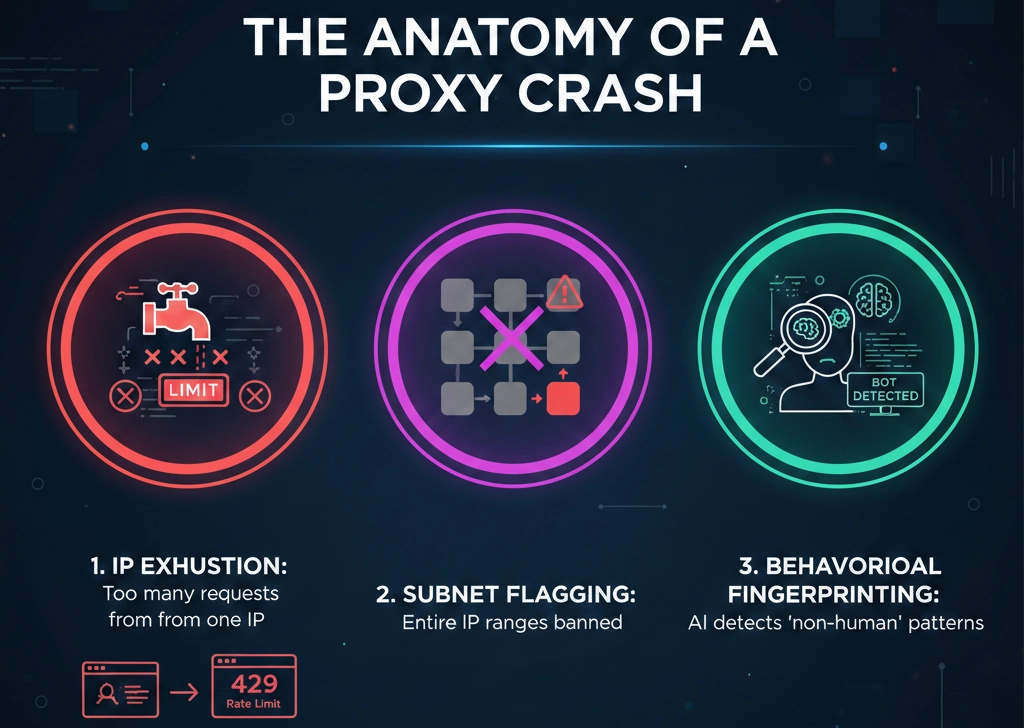
Why do traditional proxies fail while rotating residential proxies succeed? Most “crashes” aren’t actually technical server failures; they are defensive blocks.
- IP Exhaustion: Using the same IP for too many requests triggers rate limits.
- Subnet Flagging: Data center IPs often belong to the same range; if one is caught, the whole block is banned.
- Behavioral Fingerprinting: Modern sites use AI to detect “non-human” timing and header patterns.
Why Residential Rotation Is the Industry Standard
Industry leaders no longer ask if they should rotate; they ask how fast. Here is why rotating residential proxies have become the non-negotiable standard for professional operations.
1. Bypassing Sophisticated Anti-Bot Systems
Websites like Amazon, Google, and social media platforms use advanced AI to detect scraping. They prioritize traffic from “trusted” ISP ranges.
- The ColaProxy Edge: Our residential pool consists of millions of peer-to-peer IPs. Because these IPs carry high “Trust Scores,” they bypass CAPTCHAs that would stop a data center IP instantly.
2. Global Geo-Targeting Without Borders
For ad verification and price monitoring, you need to see the web as local users do. Static IPs are tied to one location. Rotating IPs allow you to hop from London to Tokyo in milliseconds.
- Checklist for Effective Geo-Targeting:
- Access to city-level and ISP-level targeting.
- Low latency through local ISP routing.
- Ability to switch regions via API parameters.
3. Infinite Scalability
With static IPs, your scale is limited by the number of IPs you buy. With rotating residential proxies, your scale is limited only by the size of the provider’s pool. You can send 10,000 concurrent requests, and each will likely exit through a unique IP.
Should I Turn On Rotating IP?
A common question we receive at ColaProxy is: “Should I turn on rotating IP?” The answer depends on your goal, but for 90% of professional use cases, the answer is a resounding YES.
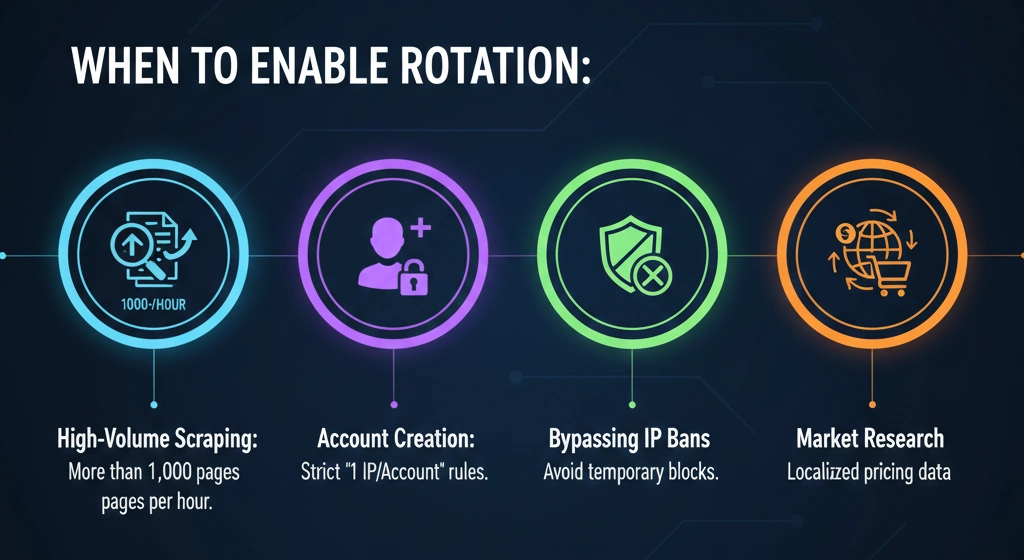
When to Enable Rotation:
- High-Volume Scraping: If you are scraping more than 1,000 pages per hour.
- Account Creation: When accessing sites with strict “1 IP per account” rules.
- Bypassing IP Bans: If you want to avoid the “cool-down” periods associated with temporary blocks.
- Market Research: When you need to gather data from different geographical locations simultaneously to see localized pricing.
Comparing Proxy Architectures
To understand why rotating residential proxies are superior, we must look at the data.
| Feature | Static Data Center Proxies | Rotating Residential Proxies (ColaProxy) |
| Detection Risk | Very High | Extremely Low |
| Anonymity Level | Moderate | Maximum |
| IP Source | Cloud Servers (AWS/DigitalOcean) | Real ISP Households |
| Success Rate | 40-60% on protected sites | 98% + |
| Primary Use Case | Basic browsing/Streaming | Enterprise Scraping / SEO / E-commerce |
ColaProxy’s Expertise: Lessons from the Field
At ColaProxy, we don’t just provide IPs; we provide infrastructure. Based on our experience helping thousands of clients, we’ve developed a methodology for “Smart Rotation.”
Real-World Instance: E-commerce Price Intelligence
A major retail client was losing 30% of their data to proxy crashes using a competitor’s static residential service. They were being “shadow-banned”—receiving fake data without realizing it. When they switched to ColaProxy’s rotating residential proxy network, the results were immediate:
- Success Rate: Jumped from 68% to 99.2%.
- Cost Efficiency: They stopped paying for “dead” IPs and started paying only for successful data transmission (GB-based).
- Speed: Our optimized routing reduced latency by 200ms by selecting nodes closer to the target server.
How to Use Rotating Residential Proxies Effectively
Simply having access to a pool isn’t enough. You need a strategy to avoid detection.
Strategic Sticky Sessions vs. Per-Request Rotation
Most high-quality providers, including ColaProxy, offer two types of rotation:
- Per-Request (Random) Rotation: Every single request gets a new IP. This is perfect for massive web crawling where every page is independent.
- Sticky Sessions: You keep the same IP for a set duration (e.g., 5, 10, or 30 minutes). This is essential for social media management or checkout processes where a changing IP mid-session would trigger a security alert.
Avoiding Common Pitfalls
- DNS Leaks: Ensure your proxy provider handles DNS requests at the ISP level so your real location isn’t leaked.
- Over-Rotation: Rotating too fast on a single logged-in account can sometimes look suspicious. Match your rotation to “human” speeds when accounts are involved.
Integrating ColaProxy into Your Workflow
ColaProxy was built by developers, for developers. Our rotating residential proxies are designed to be “plug and play” with any software that supports standard proxy protocols (HTTP/HTTPS/SOCKS5).
Why Professionals Choose ColaProxy:
- Millions of Active IPs: Our pool is refreshed constantly to ensure high reputation scores.
- 99.9% Uptime: We eliminate the “Proxy Crash” headache with redundant server architecture.
- Global Coverage: IPs in over 190 countries, including city-level targeting in the US, UK, China, and Germany.
- Easy API Integration: Fully compatible with Python, Puppeteer, Selenium, and Scrapy.
Frequently Asked Questions (FAQ)
What is the primary benefit of rotating residential proxies?
The main benefit is the ability to scrape data at scale without being detected or blocked. Because the IPs are from real households, websites trust them more than data center IPs.
Are rotating residential proxies safe to use?
Yes, they are the safest form of proxy. They provide the highest level of anonymity. ColaProxy follows strict ethical sourcing guidelines to ensure all IPs in our pool are used with consent, aligning with global standards like those found at IETF.
Can I choose a specific country for my rotating IP?
Absolutely. With ColaProxy, you can specify the country, region, and even the ISP in your proxy settings to bypass geo-restrictions and see localized content.
Why are my proxies still crashing?
If you are using rotating residential proxies and still experiencing issues, it may be due to your “browser fingerprint.” Websites look at more than just your IP; they check your cookies, screen resolution, and fonts. Combining our proxies with an anti-detect browser is often the final piece of the puzzle.
Final Takeaway: The Future of Residential Rotation
The “cat and mouse” game between bots and websites is only getting more complex. Relying on outdated proxy technology is a risk your business can’t afford. Residential Rotation isn’t just a luxury; it is the industry standard for anyone serious about data accuracy, security, and scalability.
By choosing ColaProxy, you aren’t just buying a proxy; you’re investing in a robust, crash-proof infrastructure designed to keep your business moving forward.
Summary Checklist for Success
- Audit Your Current Success Rate: If it’s below 90%, you need rotation.
- Choose Residential over Data Center: For high-security targets like Google or Amazon.
- Configure Sticky Sessions: If you need to stay logged into an account.
- Use Geo-Targeting: To avoid “impossible travel” flags by staying in one region.
- Partner with ColaProxy: Access a massive, ethically-sourced pool of rotating residential proxies.
Ready to stop the crashes? Explore ColaProxy’s Rotating Residential Solutions today.