
HTTP Proxy vs HTTPS Proxy is one of the most important comparisons in modern web scraping, browser automation, cybersecurity, and online data collection. As anti-bot systems continue becoming more advanced in 2026, businesses and developers increasingly depend on reliable proxy infrastructure to maintain stable, secure, and scalable internet operations.
Proxy servers now play a critical role in web scraping, SEO monitoring, social media automation, ad verification, e-commerce intelligence gathering, multi-account management, anonymous browsing, and enterprise traffic routing. However, choosing the wrong proxy protocol can lead to security risks, unstable sessions, poor scraping performance, and higher detection rates.
Among the most widely used proxy protocols, HTTP proxies and HTTPS proxies remain the industry standard for routing internet traffic. While many users assume the two technologies are nearly identical, there are major differences in encryption, privacy, browser compatibility, anti-bot performance, authentication security, and real-world automation capabilities.
Understanding the differences between HTTP Proxy vs HTTPS Proxy is essential if you want to build efficient scraping systems, manage multiple accounts safely, collect data at scale, or operate modern browser automation tools such as Playwright, Puppeteer, and Selenium.
In this guide, we will explain how HTTP and HTTPS proxies work, compare their security and performance differences, explore their best use cases, and help you determine which proxy type is best for web scraping, automation, SEO intelligence gathering, and enterprise-level online operations in 2026.
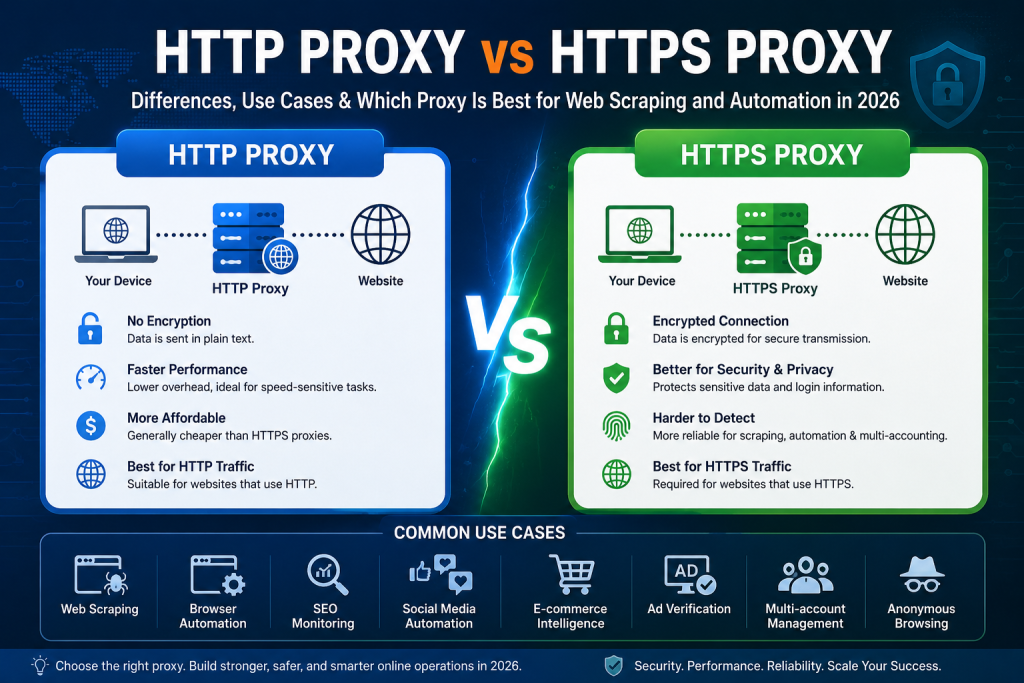
What Is an HTTP Proxy?
An HTTP proxy is a proxy server designed to handle standard HTTP traffic between a client and a target website. When a user sends a request through an HTTP proxy, the proxy server forwards the request to the destination website and returns the response back to the user.
HTTP proxies primarily work with websites using the HTTP protocol rather than encrypted HTTPS connections.
The process typically works like this:
- The user sends a request to the proxy server.
- The proxy server forwards the request to the target website.
- The website responds to the proxy.
- The proxy returns the data to the user.
Because HTTP traffic is not encrypted, HTTP proxies can inspect, cache, filter, and modify traffic more easily than encrypted connections.
HTTP proxies have traditionally been used for:
- Website caching
- Content filtering
- Corporate network management
- Basic web scraping
- Traffic routing
- Access control
- Anonymous browsing
However, the modern internet has shifted heavily toward HTTPS encryption, which changes the role and limitations of HTTP proxies significantly.
What Is an HTTPS Proxy?
An HTTPS proxy is a proxy server that supports encrypted HTTPS traffic using SSL/TLS encryption. HTTPS proxies establish secure encrypted tunnels between users and websites, protecting sensitive information from interception.
Unlike standard HTTP proxies, HTTPS proxies can securely transmit:
- Login credentials
- Session cookies
- Payment information
- Authentication tokens
- Private browsing activity
- API requests
- Enterprise data
HTTPS proxies are widely used in:
- Secure web scraping
- Browser automation
- Social media management
- E-commerce monitoring
- Sneaker copping
- Ad verification
- Multi-account operations
- Secure enterprise traffic routing
- Bypassing geo-restrictions
- Cloud-based automation systems
In 2026, HTTPS traffic dominates the global internet ecosystem. Most major websites, including Google, Amazon, TikTok, YouTube, Facebook, Instagram, LinkedIn, X, and Shopify, require encrypted HTTPS connections by default.
As a result, HTTPS proxies have become the industry standard for most modern proxy use cases.
HTTP Proxy vs HTTPS Proxy: Core Differences
Although HTTP and HTTPS proxies may appear similar at first glance, the underlying differences are extremely important.
Below is a detailed comparison table.
| Feature | HTTP Proxy | HTTPS Proxy |
|---|---|---|
| Encryption | No encryption | SSL/TLS encrypted |
| Security Level | Lower | Much higher |
| Data Privacy | Vulnerable to interception | Protected from interception |
| Browser Compatibility | Limited modern compatibility | Fully compatible |
| Modern Website Support | Limited | Excellent |
| API Compatibility | Basic | Advanced |
| Authentication Security | Weak | Strong |
| Web Scraping Reliability | Moderate | High |
| Anti-Bot Bypass Capability | Limited | Better |
| Session Protection | Weak | Strong |
| Use for Login Systems | Not recommended | Recommended |
| Suitable for Enterprise Use | Limited | Yes |
| Performance Overhead | Slightly lower | Slightly higher |
| SEO Data Collection | Basic | Excellent |
| Social Media Automation | Poor | Strong |
How HTTP Proxies Work
HTTP proxies operate at the application layer and process requests using the HTTP protocol.
When a client sends an HTTP request:
GET http://example.com/page HTTP/1.1
Host: example.com
The proxy receives the request, interprets it, forwards it to the destination server, and then returns the response.
Because HTTP traffic is transmitted in plaintext, the proxy can directly inspect and manipulate the contents of the request. This architecture allows HTTP proxies to perform functions such as content filtering, caching, request logging, header modification, and traffic analysis.
For example, many corporate networks historically used HTTP proxies to restrict employee access to certain websites or monitor internet activity. Similarly, caching systems often relied on HTTP proxies to reduce bandwidth consumption and improve loading speed for frequently accessed content.
However, plaintext communication also introduces major security risks. Attackers, internet providers, public WiFi operators, or malicious intermediaries may intercept traffic during transmission. Sensitive information such as usernames, passwords, cookies, and authentication tokens can potentially be exposed if transmitted through unsecured HTTP connections.
As encrypted browsing has become the global standard, HTTP proxies now appear increasingly outdated in many professional environments.oming less common for sensitive modern applications.
How HTTPS Proxies Work
HTTPS proxies establish encrypted SSL/TLS tunnels between the client and the destination website. Instead of transmitting readable plaintext traffic, all communication is encrypted before being forwarded through the proxy server.
This encrypted architecture significantly improves security and privacy because third parties cannot easily inspect or manipulate the transmitted data. HTTPS proxies therefore provide safer login sessions, more secure API communication, reduced interception risks, and stronger privacy protection.
In modern automation environments, HTTPS proxies also improve compatibility with browser-based applications and anti-bot systems. Since encrypted HTTPS traffic now represents standard user behavior across the internet, HTTPS proxy traffic blends more naturally into legitimate browsing patterns.
This is particularly important for businesses operating large-scale scraping systems, social media automation platforms, AI training pipelines, and multi-account management infrastructure. Secure encrypted traffic helps reduce detection risks while improving session stability and account trust.
Why HTTPS Proxies Are Dominating the Proxy Industry in 2026
The internet in 2026 is heavily focused on security, identity verification, and behavioral analysis. Websites no longer rely only on simple IP blocking to detect bots. Instead, they analyze browser fingerprints, TLS signatures, behavioral patterns, device consistency, and session quality.
Because encrypted traffic is now the standard behavior for real users, HTTPS proxies naturally blend into modern internet traffic much more effectively than traditional HTTP proxies. This is especially important for businesses conducting large-scale web scraping or social media automation.
For example, companies scraping Google search results, Amazon pricing data, TikTok analytics, or LinkedIn profiles often require stable encrypted sessions to avoid triggering anti-bot systems. HTTPS residential proxies help these systems appear more legitimate by combining secure encrypted traffic with real residential IP addresses.
Another reason HTTPS proxies dominate the industry is browser compatibility. Most modern browsers prioritize HTTPS websites and may even warn users before loading insecure content. As web standards continue evolving, insecure HTTP communication is becoming increasingly outdated.
HTTP Proxy Use Cases
Although HTTPS proxies dominate most professional automation environments, HTTP proxies still retain value in several lightweight scenarios.
For example, HTTP proxies may still be used for scraping simple public websites that do not deploy advanced anti-bot systems or require secure authentication. Small educational scraping projects, open news sites, public directories, and lightweight HTML-based websites can sometimes function adequately through HTTP proxy infrastructure.
HTTP proxies also remain useful for internal network management. Some organizations still use them for content filtering, traffic monitoring, website restrictions, and access control because administrators can directly inspect unencrypted traffic.
Additionally, development teams occasionally use HTTP proxies within isolated testing environments for local debugging, API testing, or traffic analysis. In these controlled internal systems, the security limitations of HTTP traffic are less problematic because exposure to public internet threats is minimized.
Despite these remaining use cases, HTTP proxies are becoming increasingly rare in large-scale commercial automation environments.
HTTPS Proxy Use Cases
HTTPS proxies support a much broader range of advanced use cases and have become essential for modern internet operations.
In web scraping, HTTPS proxies are widely used for collecting search engine results, monitoring e-commerce pricing, aggregating travel data, scraping real estate listings, gathering AI training datasets, and extracting social media information. Encrypted communication helps maintain stable sessions and reduces the likelihood of triggering anti-bot systems.
Social media automation platforms also rely heavily on HTTPS proxies because platforms such as TikTok, Instagram, Facebook, LinkedIn, and X operate entirely through encrypted traffic. HTTPS proxies help maintain account stability, geographic consistency, and browser trust across multiple sessions.
In multi-account management environments, HTTPS residential proxies are commonly used to separate identities, reduce account bans, and simulate realistic user behavior. This is especially important for affiliate marketing, marketplace management, influencer operations, and advertising campaigns.
Advertising companies use HTTPS proxies for ad verification, geo-targeted campaign testing, localized search monitoring, and fraud detection. Meanwhile, cybersecurity professionals use encrypted proxies for secure traffic routing, penetration testing, anonymous research, and threat intelligence gathering.
The versatility and compatibility of HTTPS proxies make them the preferred solution for nearly every modern proxy use case.
Security Comparison: HTTP vs HTTPS Proxies
Security is one of the biggest differences between the two protocols.
HTTP Proxy Security Risks
HTTP proxies transmit data without encryption.
Potential risks include:
- Credential theft
- Session hijacking
- Packet sniffing
- Man-in-the-middle attacks
- Traffic interception
- Cookie leakage
- Data manipulation
Public HTTP proxies are especially risky because users often have no visibility into how traffic is handled.
HTTPS Proxy Security Advantages
HTTPS proxies provide encrypted communication using SSL/TLS.
Benefits include:
- Encrypted traffic protection
- Safer login sessions
- Secure API communication
- Reduced interception risks
- Better anonymity
- Stronger enterprise compliance
For businesses handling sensitive information, HTTPS proxies are now considered mandatory.
Performance Comparison
Many users wonder whether HTTPS proxies are slower than HTTP proxies.
Technically, HTTPS encryption introduces slight processing overhead.
However, in real-world environments, the difference is usually minimal because:
- Modern CPUs handle encryption efficiently
- High-performance proxy networks optimize routing
- CDN systems reduce latency
- HTTP/2 and HTTP/3 improve encrypted traffic performance
In practice, network quality and proxy provider infrastructure matter far more than protocol overhead.
A premium residential proxy provider with optimized HTTPS routing will usually outperform cheap HTTP proxy networks.
HTTP vs HTTPS Proxies for Web Scraping
Web scraping remains one of the largest sectors within the proxy industry, and proxy protocol choice directly affects scraping performance.
HTTP proxies may still function adequately for small scraping projects targeting low-security websites with minimal anti-bot protection. However, modern scraping environments have become far more complex. Many websites now deploy advanced protection systems such as Cloudflare, DataDome, Akamai, PerimeterX, and Kasada to detect automated traffic.
HTTPS proxies provide much better compatibility with modern scraping frameworks such as Playwright, Puppeteer, Selenium, and headless browser environments. They also work more effectively with CAPTCHA-solving workflows, JavaScript rendering systems, and session persistence infrastructure.
For platforms such as Google, Amazon, Walmart, Shopify, TikTok, LinkedIn, and YouTube, encrypted HTTPS traffic is now essential for maintaining stable scraping sessions and reducing detection risks.
Below is a simple Playwright example using an HTTPS proxy configuration:
from playwright.sync_api import sync_playwright

proxy = {
    "server": "http://proxy.colaproxy.io:9000",
    "username": "USERNAME",
    "password": "PASSWORD"
}

with sync_playwright() as p:
    browser = p.chromium.launch(
        headless=True,
        proxy=proxy
    )

    page = browser.new_page()

    page.goto("https://www.google.com")

    print(page.title())

    browser.close()
For users running larger scraping operations, rotating HTTPS residential proxies are commonly used to reduce IP bans and improve request success rates. These proxies help distribute traffic across multiple real residential IP addresses while maintaining encrypted communication with target websites.
In advanced scraping environments, HTTPS residential proxies are often paired with browser fingerprint management tools, CAPTCHA-solving services, and AI-based traffic simulation systems to further reduce detection risks and improve automation stability.
Because modern anti-bot systems increasingly analyze encrypted traffic behavior and browser consistency, HTTPS proxies have become the preferred infrastructure for scalable web scraping in 2026.
Why Residential HTTPS Proxies Perform Better
Residential proxies route traffic through real household internet connections, making requests appear more authentic to websites. When combined with HTTPS encryption, residential proxy infrastructure provides significantly better trust signals than standard datacenter HTTP proxies.
HTTPS residential proxies offer improved anonymity, stronger geo-targeting capabilities, lower detection rates, and more stable session persistence. Because websites recognize residential IPs as legitimate consumer traffic, automation systems using residential HTTPS proxies are far less likely to trigger aggressive anti-bot defenses.
This combination of encrypted communication and realistic IP reputation has made HTTPS residential proxies the preferred infrastructure for modern web scraping, SEO intelligence gathering, browser automation, and multi-account operations.
Premium providers such as ColaProxy increasingly focus on secure HTTPS residential proxy networks because they align more effectively with modern anti-bot systems and enterprise automation requirements.
Common Misconceptions About HTTP and HTTPS Proxies
Myth 1: HTTP Proxies Are Completely Obsolete
Not entirely.
HTTP proxies still work for some lightweight and non-sensitive applications.
However, their use cases are shrinking rapidly.
Myth 2: HTTPS Proxies Guarantee Anonymity
HTTPS encryption protects traffic but does not automatically guarantee full anonymity.
Other factors still matter:
- Browser fingerprinting
- Cookies
- Device identification
- DNS leaks
- Behavioral tracking
Myth 3: HTTPS Proxies Are Always Slow
Modern HTTPS proxy infrastructure is highly optimized.
Premium providers often deliver excellent speeds even with encrypted traffic.
Future Trends in Proxy Technology
The proxy industry continues evolving rapidly.
Emerging trends include:
AI-Driven Traffic Simulation
Automation systems increasingly mimic real human behavior using:
- Mouse movement simulation
- Natural typing patterns
- Adaptive browsing behavior
- AI-generated session activity
TLS Fingerprint Rotation
Advanced anti-bot systems analyze TLS signatures.
Modern proxy providers now optimize TLS fingerprint consistency to reduce detection.
Residential Proxy Expansion
Residential proxy networks continue growing as businesses seek higher trust scores.
HTTP/3 Adoption
HTTP/3 and QUIC protocols are becoming more important for modern encrypted traffic routing.
Integrated Browser Infrastructure
Proxy providers increasingly bundle:
- Anti-detect browsers
- Browser fingerprint management
- CAPTCHA solving
- AI scraping tools
- Automation APIs
Why Businesses Prefer HTTPS Residential Proxies in 2026
Businesses increasingly prefer HTTPS residential proxies because they provide stronger security, better compatibility with modern websites, improved anonymity, and significantly higher automation success rates.
Encrypted residential traffic aligns naturally with legitimate user behavior, helping businesses maintain stable sessions while reducing detection risks across search engines, e-commerce platforms, social media networks, and enterprise websites.
For companies operating large-scale scraping systems, AI training pipelines, advertising infrastructure, or global automation environments, HTTPS residential proxies have become an essential part of core infrastructure rather than an optional enhancement.
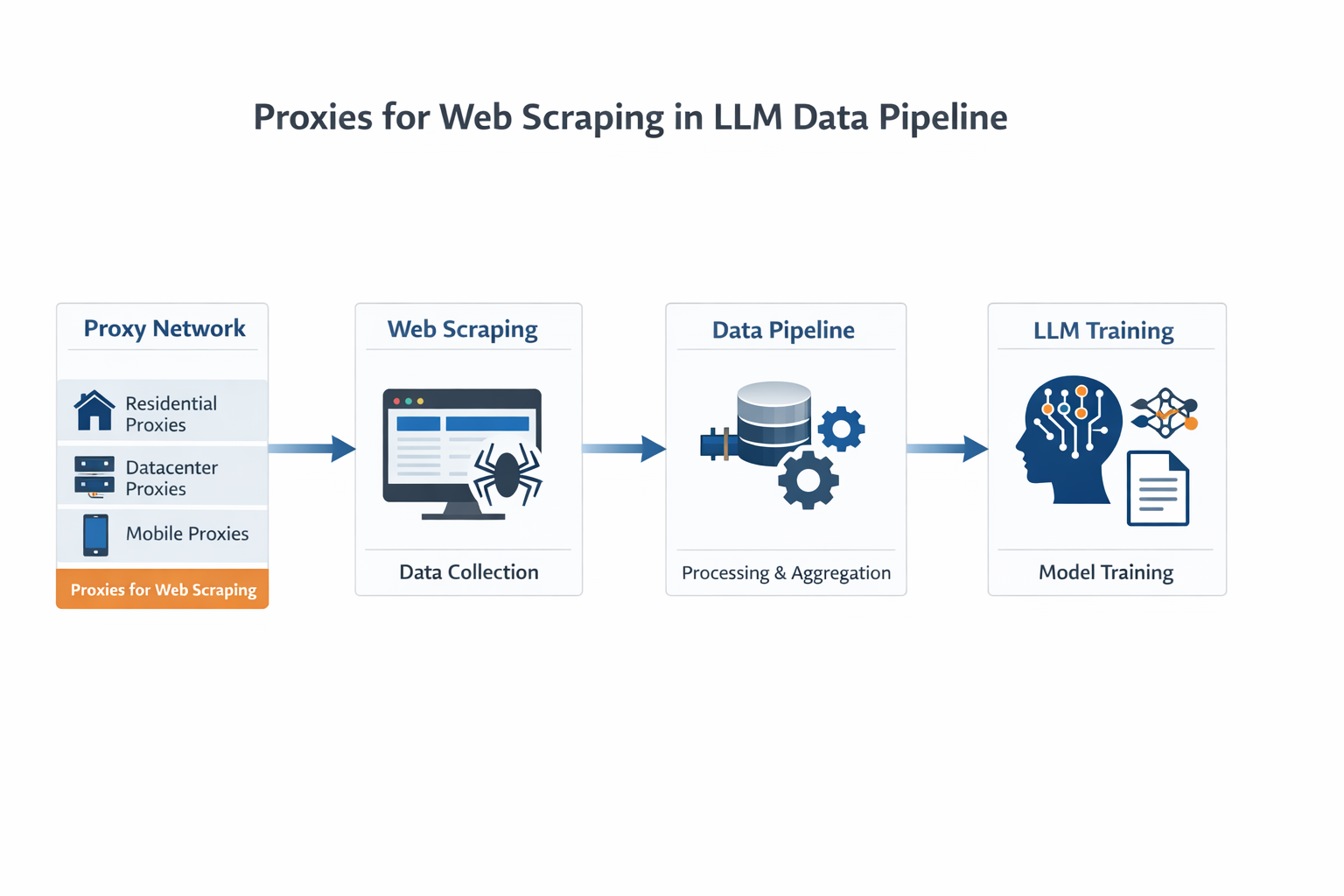
As anti-bot systems continue evolving, businesses investing in reliable HTTPS proxy infrastructure will be far better positioned to maintain stable long-term automation performance.
ColaProxy HTTPS Residential Proxy Solutions
ColaProxy provides enterprise-grade residential proxy infrastructure designed for modern internet operations. The platform supports secure HTTPS proxy connections optimized for web scraping, browser automation, SEO intelligence, social media management, and large-scale data collection.
With access to a large global residential IP pool, rotating proxy support, sticky sessions, and advanced geo-targeting capabilities, ColaProxy helps businesses maintain stable access to modern websites while reducing detection risks.
The infrastructure is built to support high-performance automation workflows that require encrypted traffic, realistic user behavior simulation, and compatibility with modern anti-bot systems.
For businesses operating in highly competitive online environments, reliable HTTPS residential proxies are now an essential part of scalable automation infrastructure.
Final Thoughts
The difference between HTTP proxies and HTTPS proxies extends far beyond simple encryption. In 2026, modern websites expect secure traffic, realistic browsing behavior, and consistent session quality.
Although HTTP proxies still have limited applications in lightweight environments, they are no longer ideal for most professional use cases. Advanced anti-bot systems, browser fingerprint analysis, and encrypted web standards have made HTTPS proxies the preferred solution for modern web scraping, SEO monitoring, social media automation, and enterprise traffic management.
HTTPS residential proxies provide stronger privacy, better compatibility, improved session stability, and significantly higher success rates when interacting with modern websites.
As the proxy industry continues evolving, businesses investing in high-quality HTTPS proxy infrastructure will be far better positioned to handle future challenges in automation, AI data collection, and large-scale online operations.
For companies seeking secure and scalable residential proxy solutions, ColaProxy provides modern HTTPS proxy infrastructure designed for the next generation of internet automation.