
Wikipedia is one of the most important open knowledge databases on the internet. It powers search engines, AI training datasets, knowledge graphs, and countless data-driven applications.
With millions of structured pages covering entities such as people, companies, technologies, and events, Wikipedia is a primary source for large-scale information extraction.
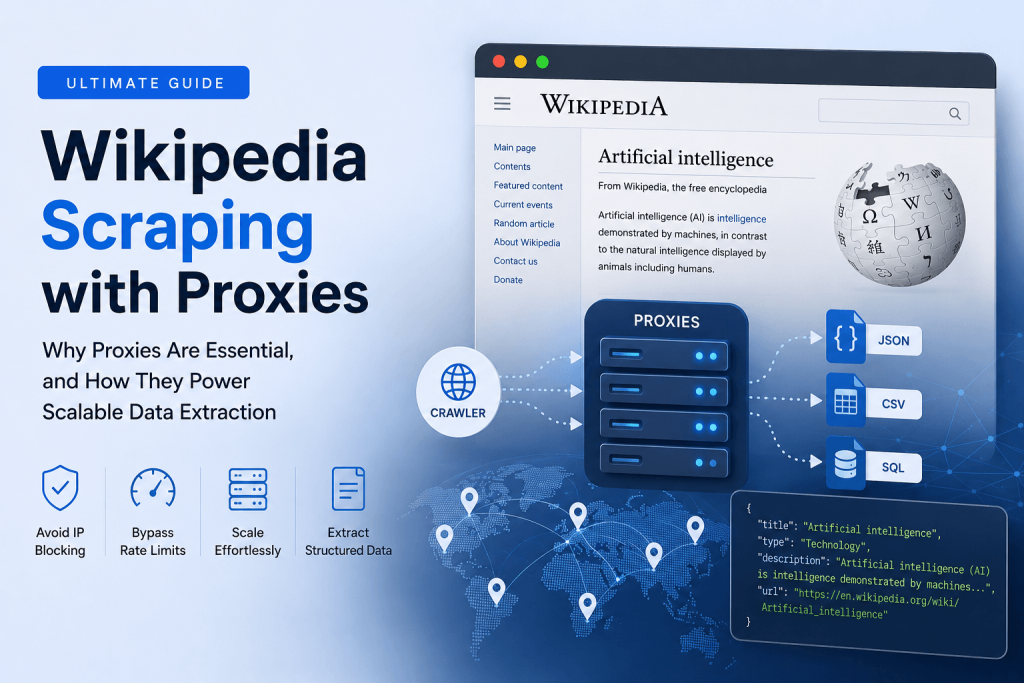
However, scraping Wikipedia at scale introduces technical limitations such as rate limiting, IP blocking, and inconsistent responses. This is why proxy infrastructure is a core requirement for any serious scraping system.
In this ultimate guide, we explain why proxies are necessary for Wikipedia scraping, how they compare with APIs, and how ColaProxy enables scalable data extraction workflows.
Wikipedia scraping is the automated process of extracting structured data from Wikipedia using crawlers and proxy-enabled systems.
Why Wikipedia Is a High-Value Data Source
Wikipedia is not just an encyclopedia. It is a large-scale structured semantic dataset that reflects real-world entities, attributes, and relationships across millions of interconnected articles. Each page contains consistent formatting elements such as infoboxes, categories, references, and internal links, which make the data highly suitable for automated extraction and transformation into machine-readable formats.
This structure allows Wikipedia content to be used directly in downstream systems such as entity recognition models, knowledge graphs, and semantic search engines. Because entities are clearly defined and interconnected, Wikipedia plays a foundational role in how modern search engines interpret content relevance, topical authority, and contextual relationships between different subjects.
In AI and data engineering workflows, Wikipedia datasets are commonly used for training large language models, building structured knowledge bases, and enriching entity-level understanding in NLP systems. Its multilingual coverage and editorial consistency also make it one of the most reliable open datasets for global-scale applications.
Because of this, Wikipedia scraping is widely integrated into data pipelines across SEO platforms, AI systems, and analytics infrastructures. However, at scale, it must be handled carefully to avoid triggering anti-bot systems, rate limiting mechanisms, and request throttling policies.
Why Wikipedia Scraping Fails Without Proxies
When scraping Wikipedia without proxies, all requests originate from a single IP address. This creates a highly predictable traffic pattern that can be easily detected by rate-limiting systems and automated bot protection mechanisms. Repeated requests from the same IP often signal non-human behavior, especially when they occur at consistent intervals or high frequency.
As request volume increases, Wikipedia’s infrastructure may begin to throttle traffic, introduce delayed responses, or temporarily block the originating IP address. In some cases, the server may return partial content or inconsistent responses, which directly affects data quality.
From a data engineering perspective, this leads to incomplete datasets, increased error rates, and unstable pipeline execution. Downstream systems such as analytics engines, SEO tools, or AI training workflows may receive fragmented or unreliable data, reducing overall system performance.
At scale, this makes single-IP scraping unsuitable for production-grade environments where stability, consistency, and throughput are required.
How Proxies Enable Scalable Wikipedia Scraping
Proxies solve this limitation by distributing requests across multiple IP addresses. Instead of sending all traffic from a single source, requests are rotated through a large pool of residential or datacenter IPs. This prevents predictable traffic patterns and significantly reduces the risk of rate limiting or temporary blocks.
By rotating IPs and balancing request loads, proxy systems allow scraping tools to simulate natural user behavior across different geographic locations and network environments. This makes the traffic appear more human-like and less automated, which improves request success rates.
In addition, modern proxy infrastructure supports session control, geo-targeting, and concurrency management, which further enhances scraping efficiency when dealing with large-scale datasets such as Wikipedia.
With proper proxy architecture in place, Wikipedia scraping becomes stable, scalable, and suitable for continuous data pipelines used in AI training, SEO analysis, and knowledge graph construction.
Wikipedia API vs Web Scraping with Proxies
Many developers consider using the Wikipedia API instead of scraping. While the API is useful for small-scale or structured queries, it has limitations in flexibility and scalability.
The Wikipedia API restricts request types, limits data customization, and may not provide full page-level HTML structure required for advanced parsing tasks.
In contrast, web scraping with proxies provides full control over data extraction, including raw HTML, structured sections, and contextual metadata.
For large-scale systems such as SEO intelligence platforms or AI training pipelines, proxy-based scraping is significantly more flexible than API-based extraction.
Choosing the Right Proxy Strategy for Wikipedia Scraping
The effectiveness of a Wikipedia scraping system depends heavily on the proxy strategy used, as different proxy types directly impact success rate, stability, and data quality. Selecting the right configuration is not only about speed or anonymity, but also about ensuring long-term reliability in large-scale data collection workflows.
Residential proxies are typically used for high-anonymity scraping because they closely resemble real user traffic and significantly reduce detection risk. They are particularly effective in scenarios where consistent access and lower block rates are more important than raw request speed. Datacenter proxies, on the other hand, provide higher performance and lower latency, making them suitable for large-scale data extraction tasks where speed and throughput are the primary focus.
In most production environments, a hybrid proxy strategy is adopted to balance performance and anonymity. This allows systems to dynamically allocate requests based on workload sensitivity and target behavior. In addition, IP rotation is a critical component of any modern scraping architecture, as it prevents pattern detection, distributes request load evenly, and ensures long-term scraping stability across continuous data pipelines.
Without a properly designed proxy strategy, scraping systems are more likely to experience inconsistent response rates, increased blocking frequency, and degraded data reliability at scale.
ColaProxy for Wikipedia Scraping at Scale
ColaProxy provides infrastructure designed specifically for scalable data extraction, including Wikipedia scraping, SERP tracking, and AI data collection pipelines.
Unlike generic proxy providers, it focuses on stable rotation, high concurrency support, and scraping-optimized IP distribution.
This makes it suitable for long-running systems where reliability and success rate are more important than occasional burst performance.
For SEO teams, AI developers, and data engineers, this type of infrastructure reduces complexity while improving scraping efficiency and consistency.
Comparison: ColaProxy vs Bright Data vs Oxylabs
In the proxy industry, Bright Data and Oxylabs are widely recognized enterprise-grade providers.
Bright Data offers one of the largest proxy networks globally and is often used in enterprise data collection systems requiring full-stack scraping infrastructure.
Oxylabs is known for high reliability and compliance-focused proxy services, making it a strong choice for enterprise intelligence platforms.
While both providers are powerful, they are often designed for broader enterprise use cases. For focused workflows such as Wikipedia scraping, SEO data extraction, and lightweight automation pipelines, a more streamlined proxy infrastructure can offer better operational efficiency and simpler integration.
Proxy Providers Comparison for Wikipedia Scraping
| Provider | Best For | Strength | Limitation | Ideal Use Case |
|---|---|---|---|---|
| ColaProxy | Wikipedia scraping, SEO data extraction, automation | High concurrency, stable IP rotation, simple integration | Not a full enterprise data platform | Focused scraping workflows and SEO systems |
| Bright Data | Enterprise-scale data infrastructure | Largest proxy network, full scraping ecosystem | Complex setup, higher cost | Large enterprise data operations |
| Oxylabs | Compliance-focused web intelligence | Highly reliable residential proxies, strong support | Less flexible for lightweight use cases | Enterprise analytics and structured data |
| DIY / Free Proxies | Small-scale testing | No cost | Unstable, high block rate | Learning or non-production use only |
Use Cases of Wikipedia Scraping with Proxy Infrastructure
Wikipedia scraping is widely used across multiple industries where structured, large-scale, and entity-rich data is required. In SEO, it is commonly used to build entity-based content structures, improve topical authority modeling, and enhance semantic keyword mapping across entire websites and content networks.
In artificial intelligence, Wikipedia data serves as a foundational dataset for training large language models, improving entity recognition systems, and constructing knowledge graphs that represent real-world relationships between people, organizations, and concepts. Its structured and multilingual nature makes it particularly valuable for global-scale NLP applications.
In business intelligence and market research, Wikipedia scraping is used to map industry landscapes, analyze competitors, and understand relationships between companies, technologies, and market segments. This enables data-driven decision-making based on structured public information rather than unstructured web sources.
In academic and linguistic research, Wikipedia provides large-scale, well-organized datasets for historical analysis, semantic studies, and cross-language comparison tasks.
Across all of these use cases, proxy infrastructure plays a critical role in ensuring stable, scalable, and uninterrupted data collection, especially when handling high-volume requests or long-running scraping pipelines.
Faq
Is it legal to scrape Wikipedia?
Wikipedia content is publicly accessible, but scraping must follow usage policies and avoid excessive server load or abusive behavior.
Why do scrapers get blocked on Wikipedia?
Scrapers are blocked due to rate limiting, repeated automated requests, and traffic patterns that resemble bots.
What is the best proxy for Wikipedia scraping?
Residential rotating proxies are generally the most effective for avoiding detection and maintaining stable scraping performance.
Can I use the Wikipedia API instead of scraping?
Yes, but the API is limited in flexibility and may not support full-page extraction or complex data structures needed for advanced use cases.
Conclusion
Wikipedia is one of the most valuable structured data sources on the internet, but extracting it at scale requires proper infrastructure. Without proxies, scraping systems quickly encounter rate limits, IP blocks, and unstable data quality.
By using a reliable proxy network such as ColaProxy, developers can build scalable Wikipedia data pipelines for SEO, AI training, and business intelligence applications.
In modern data systems, proxies are not optional—they are a foundational component of scalable web scraping.