Summary:
When choosing between a Residential VPN vs Residential Proxy, the decision hinges on your specific use case. Residential Proxies are the ultimate choice for high-scale automation, web scraping, and bypassing aggressive anti-bot systems because they offer granular rotation and lack the detectable “VPN signature.” Conversely, a residential ip vpn is superior for individual privacy, encrypting your entire device’s traffic for secure browsing.
If you are managing multiple accounts or scraping data, ColaProxy’s rotating and static residential solutions provide the high trust scores needed to stay undetected.
What is the Real Difference Between a Residential VPN vs Residential Proxy?
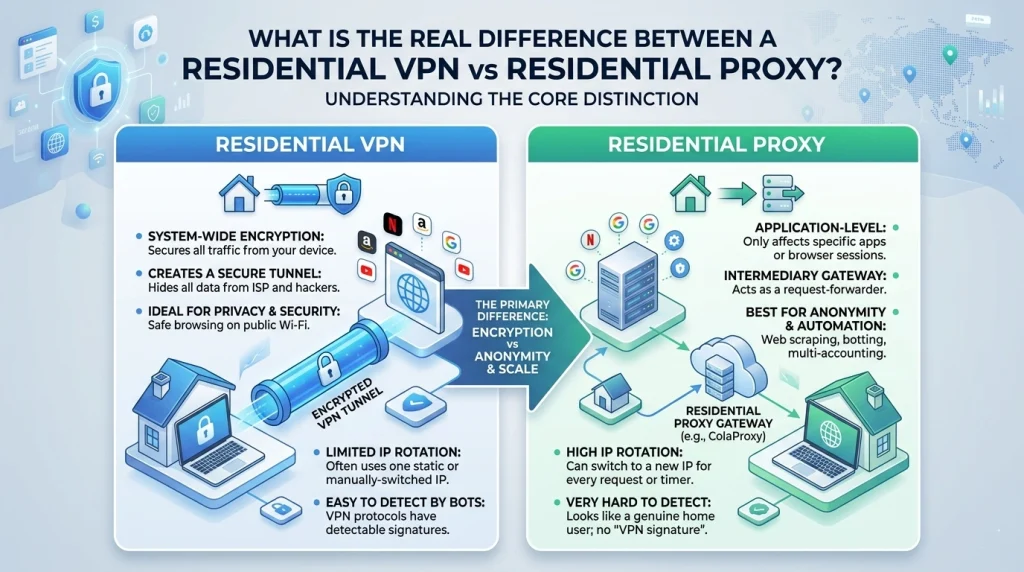
In the evolving landscape of 2026, the battle for online anonymity has moved beyond simple IP masking. Whether you are a digital marketer, a data scientist, or a privacy enthusiast, you’ve likely asked: What is better, a VPN or a proxy? To understand the Residential VPN vs Residential Proxy debate, we first have to look at their common foundation: the Residential IP. Unlike datacenter IPs—which originate from secondary servers and are easily flagged by platforms like Netflix or Amazon—residential IPs are assigned by legitimate ISPs (Comcast, AT&T, etc.) to home users.
However, how these tools deliver that IP changes everything:
- Residential VPN: Creates an encrypted tunnel for your entire system.
- Residential Proxy: Acts as a gateway for specific applications, often allowing for massive rotation and higher speeds.
1. Security and Encryption: The “Tunnel” vs. The “Gate”
One of the most significant factors in the Residential VPN vs Residential Proxy comparison is how they handle your data.
The VPN Approach
A vpn with residential ip uses protocols like WireGuard or OpenVPN to encrypt every packet of data leaving your device. This makes it the best residential vpn choice for users on public Wi-Fi or those who want to hide their activity from their ISP.
The Proxy Approach
Proxies, such as ColaProxy’s rotating residential proxies, generally do not encrypt data at the protocol level. While this sounds like a drawback, it is actually a massive advantage for performance. Without the “encryption tax,” proxies offer much lower latency, which is vital for time-sensitive tasks like sneaker copping or high-frequency scraping.
2. Detection and Bypassing Bans: Why Sites Block VPNs
Websites have become incredibly “smart.” They use best tools to detect residential vpn and proxy connections by looking for specific fingerprints.
- MTU Size: VPNs often change the Maximum Transmission Unit size, which is a dead giveaway to firewalls.
- Virtual Headers: Many resi vpn services leak headers that indicate an encrypted tunnel is in use.
- IP Consistency: If a “residential” IP is suddenly sending 1,000 requests per minute, it gets flagged.
At ColaProxy, we’ve found that static ISP proxies and rotating mobile proxies are much harder to detect. Because they don’t use VPN protocols, they look identical to a standard home or mobile user browsing from their living room.
3. Comparison Table: Residential VPN vs Residential Proxy
| Feature | Residential VPN | Residential Proxy (ColaProxy) |
| Primary Focus | Personal Privacy & Security | Data Collection & Anonymity |
| Encryption | Full System (AES-256) | Application Level (None/SOCKS5) |
| Rotation | Static or Manual | Automatic (Per-request) |
| Speed/Latency | Higher Latency (due to encryption) | Lower Latency (Direct connection) |
| Best For | Streaming, Individual Browsing | Scraping, Multi-accounting, Ads |
4. Why You Might Need a Residential IP VPN
Despite the power of proxies, the best residential vpn reddit community often highlights specific scenarios where a VPN is indispensable:
- US Residential IP VPN for Streaming: If you need to access geo-locked content on a smart TV or iPhone, a residential vpn for iphone or us residential vpn is the easiest “plug-and-play” solution.
- Bypassing ISP Throttling: If your provider slows down your connection based on your traffic type, a private residential vpn can hide that activity.
- Global Access: Services like a Turkey residential vpn or Japan residential vpn allow users to access regional pricing or content libraries with a single click.
5. Why Businesses Prefer Residential Proxies
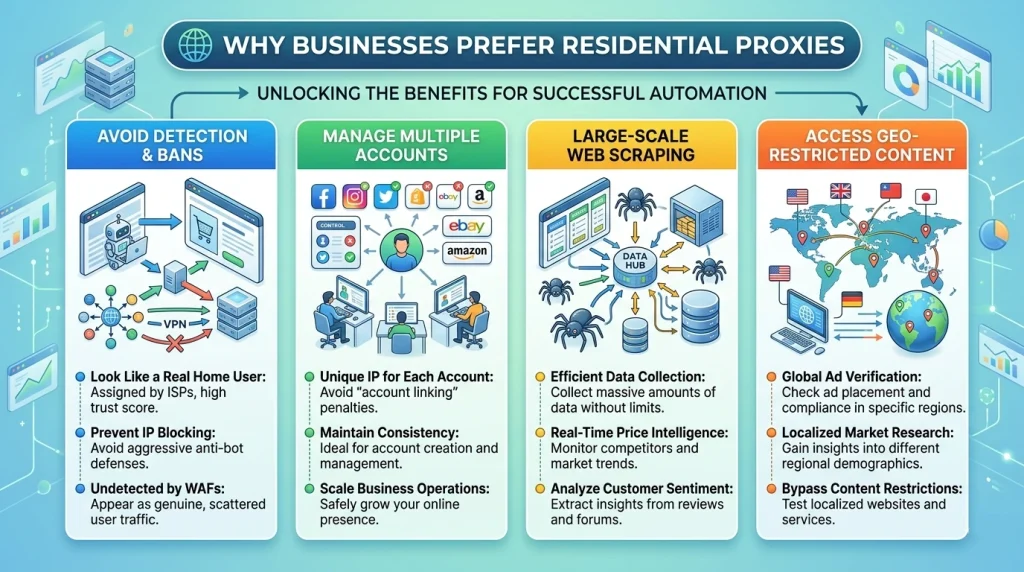
For professional use cases, the Residential VPN vs Residential Proxy debate is usually won by proxies. Here’s why:
Web Scraping and Automation
If you try to scrape Google or Amazon using a residential vpn service, you will likely be hit with a CAPTCHA within minutes. This is because a VPN typically uses one IP at a time. With ColaProxy’s rotating residential proxies, you can cycle through millions of IPs, ensuring no single address ever hits a rate limit.
Multi-Account Management
Managing multiple social media profiles requires “Sticky Sessions.” Our static ISP proxies allow you to keep the same residential IP for as long as you need, preventing “account linking” bans.
Expert Insight: “We’ve seen clients struggle with vpn residential ip bans on Instagram. The moment they switched to static mobile proxies, their trust scores skyrocketed because mobile IPs are naturally shared by thousands of users, making platforms hesitant to block them.” — The ColaProxy Technical Team.
6. How to Detect Residential VPN and Proxy Connections
If you are on the other side of the fence—protecting your own site—you might wonder about the best tools to detect residential vpn and proxy connections.
- IP Quality Score: Services that check the “Velocity” of an IP.
- WebRTC Leak Test: Checking if the real IP is visible behind the residential vpn chrome extension.
- ISP Database Checks: Confirming if the IP belongs to a residential consumer range or a known VPN provider.
To stay ahead of these tools, users often seek a dedicated residential ip vpn or a high-quality dedicated virgin residential proxy.
7. Deep Dive: ColaProxy Solutions
To truly master your online presence, you need the right tool for the job. ColaProxy offers a comprehensive suite of services tailored to overcome the limitations of standard VPNs:
- Rotating Residential Proxies: Best for large-scale data harvesting.
- Static ISP Proxies: Perfect for long-term account management without the risk of a vpn ban targets residential ipaddresses.
- Rotating Mobile Proxies: The highest level of trust available on the market (4G/5G).
- Static Mobile Proxies: Ideal for bypassing the most sophisticated anti-bot systems like Akamai or Cloudflare.
- Rotating Datacenter Proxies: High-speed, cost-effective solutions for less restrictive targets.
FAQ: Residential VPN vs Residential Proxy
What is a residential VPN?
A residential vpn is a service that routes your traffic through an encrypted tunnel to an IP address assigned to a physical home, rather than a data center.
Is there a free residential VPN?
While you can find a free residential vpn or a free residential vpn extension, they are often slow and unsafe. Many “free” services turn your computer into a proxy node for other users. We recommend a cheap residential vpn or a residential vpn free trial from a reputable provider instead.
Can I use a residential VPN for iPhone or Android?
Yes, most best residential vpn service providers offer apps for mobile. If you need a free residential vpn for android, ensure it’s from a trusted source to avoid a residential vpn mod apk which might contain malware.
Which VPN has residential IP?
Not all major VPNs offer them. Most use datacenter IPs. You specifically need to look for a residential ip vpn service or use a dedicated proxy provider like ColaProxy for true residential coverage.
Checklist: Which One Should You Use?
Use this checklist to settle the Residential VPN vs Residential Proxy dilemma for your project:
- Task: Browsing on public Wi-Fi? -> Choose Residential VPN.
- Task: Scraping 10,000 product pages? -> Choose Rotating Residential Proxy.
- Task: Managing 10 Facebook Ads accounts? -> Choose Static ISP Proxy.
- Task: Accessing Netflix from another country? -> Choose Residential VPN.
- Task: Avoiding aggressive anti-bot detection? -> Choose Mobile Proxy.
Final Takeaway: The Hybrid Approach
The debate of Residential VPN vs Residential Proxy doesn’t always have to have a single winner. Many of our most successful clients use a hybrid approach. They use a best residential vpn for their daily secure browsing and integrate ColaProxy’s high-performance proxies into their automation scripts and stealth browsers.
By understanding that a residential ip vpn is for security and a residential proxy is for scale, you can choose the tool that actually works for your specific needs.
Looking for the best residential tools? Explore ColaProxy’s range of high-trust IPs and start scaling your projects today without the fear of being blocked.
Reference Standards: We adhere to the transparency standards set by the Internet Engineering Task Force (IETF) regarding proxy protocols and the ethical data collection guidelines provided by Project Honeypot.