
Digital advertising fraud is no longer a minor operational issue. In 2026, brands lose billions of dollars annually due to fake impressions, geo-targeting errors, ad injection, domain spoofing, and unauthorized placements. As advertising ecosystems become more automated and globally distributed, ad verification has become an essential layer of every serious marketing operation.
Whether you are managing Google Ads campaigns, running programmatic media buying, monitoring affiliate traffic, or protecting brand reputation, reliable proxy infrastructure is now one of the most important technical requirements behind accurate ad verification.
In this guide, we tested and reviewed the best proxies for ad verification in 2026, focusing on performance, geo-accuracy, stealth capabilities, scalability, and enterprise usability.
What Is Ad Verification?
Ad verification is the process of ensuring that digital advertisements are displayed correctly, safely, and to the intended audience across different platforms, devices, and geographic regions. It involves validating factors such as geo-targeting accuracy, ad placement legitimacy, brand safety, device-specific rendering, search engine ad visibility, affiliate compliance, ad viewability, and fraud detection.
As digital advertising becomes more global and automated, advertisers often lack visibility into what users actually see across different countries, ISPs, browsers, and network environments. Without proper verification systems, issues such as incorrect targeting, unsafe placements, fraudulent traffic, or hidden ads may go undetected, negatively affecting campaign performance and brand reputation.
To address these challenges, modern ad verification platforms rely heavily on proxy infrastructure to simulate real user environments worldwide. By using residential and ISP-based proxy networks, advertisers can verify how ads appear under real-world conditions across multiple locations and devices.late real user environments from around the world.
Why Proxies Are Essential for Ad Verification
Modern advertising platforms dynamically adjust content and ad delivery based on multiple environmental signals, including IP location, ISP reputation, browser fingerprints, session history, language settings, device behavior, and network type. This means that the same advertisement may appear differently depending on the user’s region, device, or browsing environment.
If all verification traffic originates from a single datacenter IP or highly repetitive environment, advertising platforms can quickly identify the activity as automated, resulting in inaccurate verification results, restricted visibility, or blocked access altogether.
Proxy infrastructure solves this problem by distributing requests across large pools of real IP addresses, allowing verification systems to simulate authentic user environments at scale. With high-quality residential or mobile proxy networks, advertisers can accurately view ads from different countries, monitor localized campaigns, simulate real residential users, detect cloaking behavior, avoid rate limits, and perform automated checks across global markets more reliably.
In 2026, enterprise-grade ad verification systems are no longer built around simple monitoring tools. Instead, they typically combine residential and mobile proxy networks, browser automation frameworks, fingerprint management systems, AI-based fraud detection, and real-time scraping infrastructure to create scalable and resilient verification environments.
Types of Proxies Used for Ad Verification
Not all proxies perform equally well for ad verification tasks.
Different proxy types have different strengths, limitations, and detection risks.
Residential Proxies
Residential proxies use IP addresses assigned by real internet service providers (ISPs). Traffic appears to originate from actual household devices, making these proxies highly trusted by advertising platforms.
Advantages:
- High anonymity
- Lower detection rates
- Accurate geo-targeting
- Better ad rendering consistency
- Strong session reliability
Residential proxies are currently the preferred option for most production-grade ad verification systems.
ISP Proxies
ISP proxies combine data center speed with residential IP reputation.
These proxies are hosted on high-speed servers but registered under ISP networks, offering a balance between stability and legitimacy.
Advantages:
- Faster response times
- Stable sessions
- Good reputation scores
- Suitable for long verification sessions
ISP proxies are commonly used for continuous monitoring and account-based verification tasks.
Mobile Proxies
Mobile proxies route traffic through real mobile carrier networks.
Because mobile IPs are naturally shared among many users, they tend to have extremely high trust scores.
Advantages:
- Very low block rates
- Strong reputation
- Useful for mobile ad verification
- Effective against advanced anti-bot systems
However, mobile proxies are usually more expensive and slower than residential solutions.
Datacenter Proxies
Datacenter proxies are hosted on cloud servers rather than residential networks.
Advantages:
- Fast
- Affordable
- Easy to scale
Disadvantages:
- Higher detection risk
- Lower trust scores
- More CAPTCHA triggers
In 2026, datacenter proxies are increasingly ineffective for sensitive ad verification tasks involving Google Ads, Meta Ads, TikTok Ads, and programmatic platforms.
How We Tested These Proxy Providers
To evaluate the best proxy providers for ad verification in 2026, we tested each platform across several critical metrics:
| Evaluation Factor | Importance |
|---|---|
| Geo-targeting accuracy | Critical |
| Detection resistance | Critical |
| IP pool quality | High |
| Speed & stability | High |
| Mobile support | Medium |
| API integration | High |
| Session management | High |
| Scalability | High |
| Pricing efficiency | Medium |
| Dashboard usability | Medium |
We simulated ad verification tasks across:
- Google Ads
- YouTube Ads
- TikTok Ads
- Facebook Ads
- Programmatic DSP campaigns
- Native advertising networks
Testing regions included:
- United States
- United Kingdom
- Germany
- Japan
- Brazil
- India
Best Proxies for Ad Verification in 2026
1. ColaProxy — Best Overall for Ad Verification
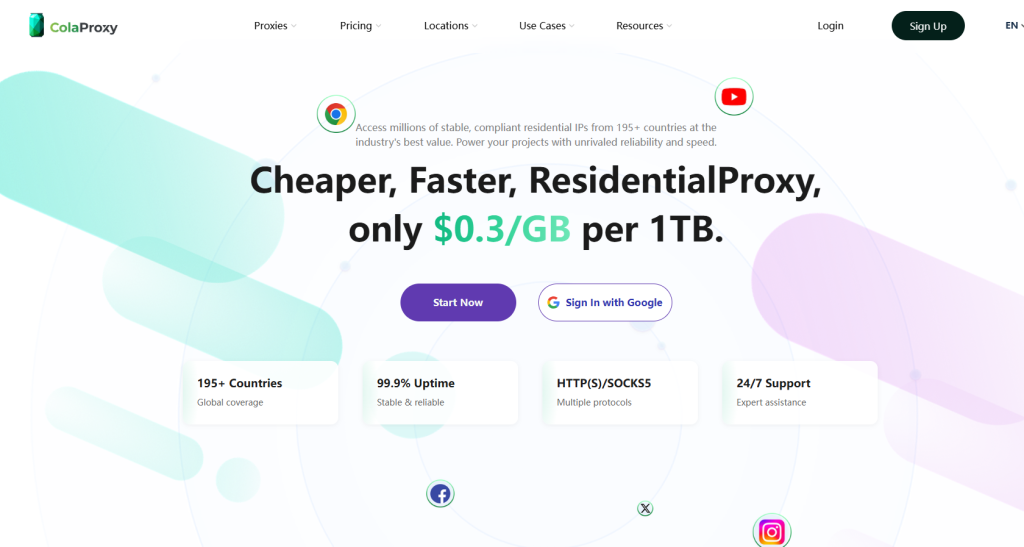
ColaProxy stands out in 2026 as one of the most balanced proxy providers for advertising verification and enterprise scraping operations.
Its residential proxy infrastructure delivers strong geo-targeting precision with reliable session persistence, making it highly effective for viewing localized ads exactly as real users see them.
Key Features
- Massive rotating residential IP pool
- City-level and ISP-level targeting
- Sticky session support
- High success rates for Google Ads verification
- Stable browser automation compatibility
- Fast response times globally
- SOCKS5 and HTTP(S) support
- API-friendly infrastructure
Why It Works Well for Ad Verification
ColaProxy performs particularly well against modern anti-bot systems because its residential traffic closely resembles authentic consumer behavior.
This is important when verifying:
- Search ads
- Dynamic localized campaigns
- Mobile-first advertising funnels
- Regional affiliate promotions
For agencies running large-scale monitoring systems, the balance between pricing and reliability is especially competitive.
Best Use Cases
- Google Ads verification
- SERP monitoring
- Affiliate compliance checks
- Programmatic ad auditing
- Multi-region campaign validation
2. Bright Data — Best Enterprise Network
Bright Data remains one of the most advanced enterprise proxy providers in the industry. Its infrastructure supports residential proxies, mobile proxies, ISP proxies, and web unlocking solutions, making it highly suitable for large-scale advertising intelligence and verification systems.
The platform is particularly strong in geo-targeting precision, automation support, and enterprise scalability. With its massive IP pool and advanced traffic management capabilities, Bright Data is widely used by large ad-tech companies, fraud detection platforms, and businesses running complex programmatic advertising verification workflows.
In addition, Bright Data offers powerful developer tools and API integrations, allowing teams to build highly customized monitoring systems across global advertising environments.
However, the platform comes with higher pricing compared to many competitors, and its advanced dashboard and configuration options may feel more complex for smaller teams or beginners.
3. Oxylabs — Best for Large-Scale Automation
Oxylabs is widely used in large-scale data extraction and advertising intelligence systems.
Its infrastructure is optimized for automation-heavy environments.
Advantages
- Excellent request success rates
- Reliable session handling
- Strong scraping compatibility
- Enterprise-level support
Best For
- Automated ad crawling
- Large campaign monitoring
- Search engine ad intelligence
4. SOAX — Best Geo-Targeting Precision
SOAX is widely recognized for its strong geo-targeting capabilities, making it a reliable choice for advertising verification tasks that require highly accurate regional simulation. The platform supports targeting by country, region, city, ASN, and ISP, allowing advertisers to view campaigns from very specific network environments and geographic locations.
This level of targeting precision is especially valuable for businesses running hyper-local advertising campaigns, regional SEO monitoring, localized affiliate promotions, and location-sensitive ad verification workflows. For teams that need to analyze how ads appear across different cities, carriers, or ISP environments, SOAX provides a more granular level of control than many standard proxy providers.
5. Smartproxy (Now Rebranded as Decodo) — A Cost-Effective Option for Ad Verification

Smartproxy, now rebranded as Decodo, remains a popular proxy provider among small and mid-sized advertising teams. The platform offers a strong balance between affordability, ease of use, and global residential coverage, making it suitable for SEO teams, affiliate marketers, independent advertisers, and smaller agencies running ad verification tasks.
Its user-friendly dashboard, reliable residential IP network, and support for browser automation tools make it a practical choice for multi-region ad monitoring and basic automation workflows.
However, compared to enterprise-focused providers like Bright Data and Oxylabs, Smartproxy has a smaller infrastructure scale and fewer advanced enterprise-level features, making it better suited for small to medium-sized verification operations.
Residential vs Mobile Proxies for Ad Verification
Many marketers ask whether residential or mobile proxies are better.
The answer depends on the platform being verified.
| Use Case | Best Proxy Type |
|---|---|
| Google Ads | Residential |
| TikTok Ads | Mobile |
| Facebook Ads | Mobile + Residential |
| YouTube Ads | Residential |
| App install campaigns | Mobile |
| Affiliate compliance | Residential |
| Programmatic DSP monitoring | Residential |
In practice, most advanced teams combine both.
Important Features to Look for in 2026
Real Residential IP Quality
In 2026, proxy quality matters far more than simply having a large IP pool. Many low-end providers use recycled, inactive, or previously flagged IPs, which often lead to CAPTCHA triggers, unstable sessions, and inaccurate ad rendering.
High-quality providers maintain clean residential IPs sourced from real ISP networks, helping verification traffic appear more like genuine user activity. This significantly improves request success rates and long-term monitoring stability.
Sticky Session Support
Some ad verification tasks require maintaining the same browsing identity across multiple pages and requests. This is especially important when validating redirect chains, conversion funnels, affiliate landing pages, or logged-in sessions.
Reliable sticky sessions help maintain session consistency and reduce interruptions during longer verification workflows.
ISP and ASN Targeting
Modern advertising platforms increasingly personalize ad delivery based on ISP networks and carrier routing. ISP and ASN targeting allow advertisers to verify campaigns more accurately across specific internet providers and mobile carriers.
This helps identify regional delivery inconsistencies, carrier-specific ad behavior, and CDN routing differences that basic country targeting may miss.
Browser Automation Compatibility
Modern ad verification heavily depends on browser automation frameworks such as Playwright, Puppeteer, and Selenium.
Proxy infrastructure must integrate smoothly with automated browsers while maintaining stable sessions and low detection rates. Strong automation compatibility improves rendering accuracy and helps large-scale monitoring systems operate more reliably. automated browsers.
Common Ad Verification Challenges in 2026
Anti-Bot Detection Systems
Modern advertising platforms now use highly advanced anti-bot systems capable of analyzing TLS fingerprints, browser entropy, behavioral patterns, and AI-driven anomaly signals. Because of this, proxies alone are no longer enough for stable ad verification.
Successful verification systems now combine residential proxies, anti-detect browsers, human-like automation behavior, and fingerprint management techniques to reduce detection risk and maintain consistent monitoring environments.
Geo-Cloaking
Geo-cloaking has become increasingly common in affiliate marketing and fraudulent advertising campaigns. In many cases, advertisers display legitimate content to moderators while serving completely different landing pages or malicious ads to real users in specific regions.
Residential proxies help uncover hidden cloaked content by simulating authentic user traffic from targeted geographic locations, making verification results more accurate.
Dynamic Ad Personalization
Modern advertisements are heavily personalized based on user interests, device type, browsing history, session behavior, and geographic location. Two users in different environments may see completely different campaigns even when visiting the same page.
Because of this, modern ad verification systems require more advanced behavioral simulation and stable browsing environments to accurately reproduce real user experiences.
Recommended Proxy Stack for Modern Ad Verification
A modern 2026 verification architecture typically includes:
| Layer | Technology |
|---|---|
| Proxy Layer | Residential + Mobile Proxies |
| Browser Layer | Playwright / Puppeteer |
| Fingerprint Layer | Anti-detect browser |
| Data Layer | Scraping pipeline |
| Analytics Layer | Fraud detection AI |
| Monitoring Layer | Real-time dashboards |
This multi-layer approach is now standard among enterprise ad-tech teams.
Final Verdict
The best proxy for ad verification depends on your scale, automation level, and targeting requirements.
Here is the short summary:
| Provider | Best For |
|---|---|
| ColaProxy | Best overall balance |
| Bright Data | Enterprise infrastructure |
| Oxylabs | Large automation systems |
| SOAX | Precise geo-targeting |
| Decodo | Budget-friendly operations |
For most agencies, affiliate teams, media buyers, and advertising intelligence platforms, ColaProxy currently offers one of the strongest combinations of affordability, residential IP quality, geo-targeting accuracy, session stability, and browser automation compatibility.
As advertising fraud and anti-bot systems continue evolving, proxy infrastructure is becoming one of the most important technologies behind modern ad verification systems.
Businesses that invest early in scalable verification infrastructure benefit from better campaign transparency, reduced fraud exposure, more accurate analytics, stronger brand protection, and improved advertising ROI.
In today’s ad-tech ecosystem, reliable proxies are no longer optional infrastructure. They are a core requirement for accurate and scalable digital ad verification.