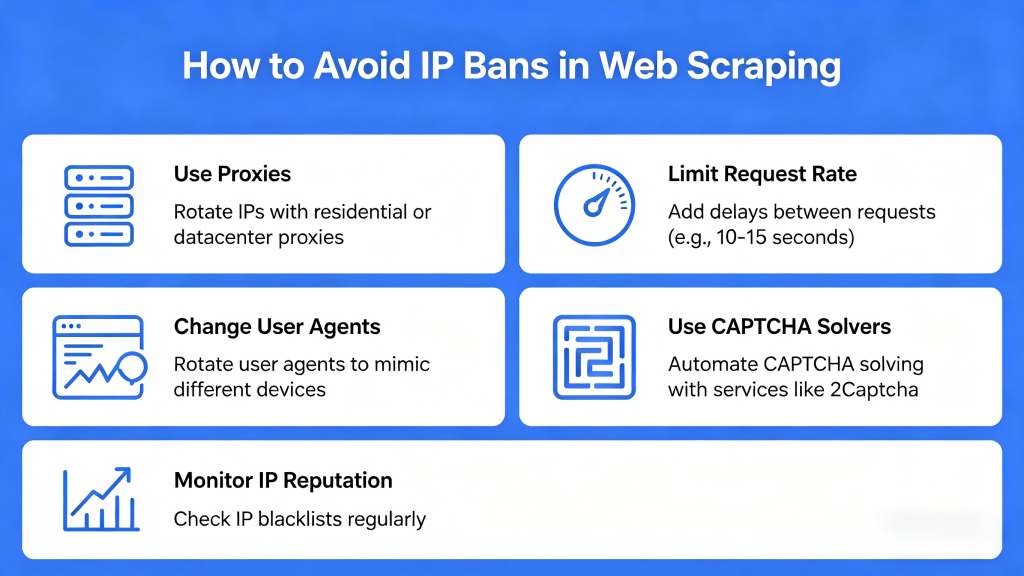
One of the most common problems in web scraping is getting blocked.
You might have a working scraper, clean code, and the right parsing logic—yet after a few requests, everything stops working. Requests fail, data becomes inconsistent, or access is completely denied.
In most cases, the issue is not your scraper. It’s how websites detect and block automated traffic.
This guide explains why IP bans happen and, more importantly, how to avoid IP bans using practical, scalable strategies.
Table of Contents
Why Websites Block Scrapers
Websites monitor traffic patterns, not just IP addresses
Modern anti-bot systems don’t rely on a single signal. Instead, they analyze multiple factors such as request frequency, behavior patterns, headers, and IP reputation.
If your scraper sends too many requests too quickly or behaves in a predictable way, it will stand out—even if the IP itself is not blacklisted.
IP reputation plays a critical role
Not all IPs are treated equally. Datacenter IPs are often flagged more aggressively, while residential and mobile IPs are considered more trustworthy.
This is why using the wrong type of proxy can lead to instant blocking, even with low request volume.
Common Reasons for IP Bans
Sending too many requests in a short time
High request frequency is one of the fastest ways to get blocked. Websites interpret rapid requests as automated behavior and apply rate limits or bans.
Using a single IP for all requests
If all your traffic comes from one IP, it becomes easy to detect patterns. Once flagged, that IP may be blocked entirely.
Lack of browser-like behavior
Scrapers that don’t mimic real user behavior—such as missing headers or not executing JavaScript—are easier to detect.
Ignoring cookies and sessions
Some websites rely on session tracking. If your scraper does not maintain cookies properly, it may trigger security systems.
Proven Strategies to Avoid IP Bans
Use proxy rotation to distribute requests
One of the most effective ways to avoid IP bans is to rotate IP addresses. Instead of sending all requests from a single IP, distribute them across a pool.
Rotating proxies make your traffic appear as if it’s coming from multiple users, reducing detection risk significantly.
Choose the right proxy type for your target
Different websites require different proxy strategies.
- Residential proxies → better for protected websites
- Datacenter proxies → suitable for low-risk targets
- Mobile proxies → ideal for highly sensitive platforms
Using the wrong proxy type can lead to unnecessary bans, even if your scraping logic is correct.
Control request frequency and add delays
Instead of sending requests as fast as possible, introduce delays between them. Randomizing request intervals makes your scraper behave more like a real user.
This simple adjustment can dramatically reduce detection.
Rotate headers and user agents
Websites analyze HTTP headers to identify bots. Using the same user agent for every request is a clear signal of automation.
By rotating user agents and headers, you make your requests appear more natural.
Handle cookies and sessions properly
Maintaining session consistency is important for accessing many websites. Reusing cookies and handling authentication correctly can improve success rates and reduce suspicion.
Advanced Techniques for Reducing Detection
Use headless browsers for dynamic websites
For JavaScript-heavy websites, using tools like headless browsers allows your scraper to fully render pages and behave more like a real user.
This is especially useful when dealing with dynamic content and advanced anti-bot systems.
Detect and handle blocks intelligently
Instead of letting your scraper fail, implement logic to detect when a request is blocked (e.g., CAPTCHA pages, HTTP 403 errors).
Once detected, you can retry with a different proxy or adjust your request strategy.
Implement retry and fallback strategies
A robust scraping system includes automatic retries, proxy switching, and error handling. This ensures your scraper continues working even when some requests fail.
Scaling Without Getting Blocked
Combine proxy rotation with smart request management
Avoiding IP bans at scale requires more than just proxies. You need a combination of:
- IP rotation
- Rate limiting
- Behavioral simulation
Together, these create a more human-like traffic pattern.
Consider using scraping APIs for complex targets
For highly protected websites, managing all these factors manually can be complex. Scraping APIs can handle proxy rotation, retries, and rendering automatically.
This simplifies your setup while maintaining high success rates.
Conclusion
Avoiding IP bans in web scraping is not about a single trick—it’s about combining multiple strategies.
By using the right proxy setup, controlling request behavior, and mimicking real users, you can significantly improve your success rate and build a stable data collection system.
If you’re running scraping tasks at scale, investing in reliable proxy infrastructure and a well-designed request strategy can make the difference between constant blocks and consistent data access.