Table of Contents
Introduction: Why Proxy Servers Have Become Core Infrastructure in 2026
In 2026, proxy servers are no longer simple tools used for IP masking or bypassing geo-restrictions. They have evolved into a critical infrastructure layer for modern data-driven systems, powering industries such as web scraping, AI data collection, ad verification, SEO monitoring, and large-scale automation.
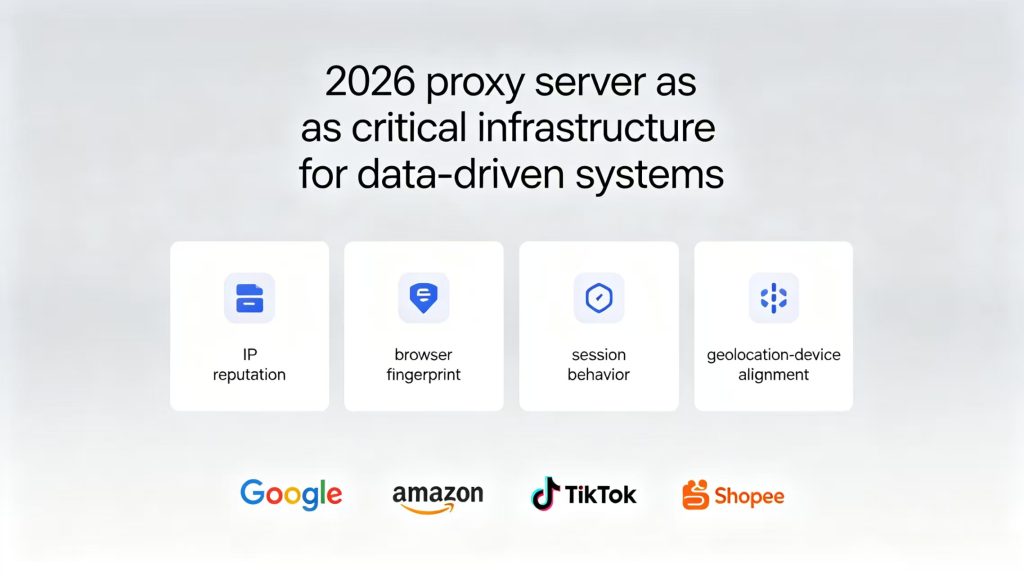
Modern platforms like Google, Amazon, TikTok, and Shopee no longer treat traffic as purely request-based. Instead, every interaction is evaluated through behavioral and trust-based systems.
These systems analyze multiple dimensions, including:
- IP reputation and ASN trust scoring
- Browser fingerprint consistency
- Session behavior patterns
- Geographic and device alignment
As a result, access is no longer simply “allowed or blocked”—it is graded through hidden trust scoring models.
This shift has made proxy infrastructure a foundational requirement for any scalable data operation.A proxy server is now a core component of modern internet infrastructure, especially in data-driven environments.
What Is a Proxy Server in Modern Web Architecture?
A proxy server acts as an intermediary between a user and a target website. Instead of sending requests directly, traffic is routed through an external IP address.
However, in modern systems, a proxy is no longer just a routing layer. It is also a trust signal carrier.
Each proxy IP contains implicit characteristics such as:
- Network origin (residential, ISP, mobile, datacenter)
- Historical usage reputation
- Behavioral consistency patterns
- Detection risk profile
Because of this, two identical requests can produce completely different results depending on the proxy used—ranging from full data access to partial filtering or silent blocking.
This makes proxy selection a core engineering decision rather than a configuration detail.
Main Types of Proxy Servers in 2026
Leading proxy infrastructure providers like ColaProxy offer a full range of residential, ISP, and mobile proxy solutions designed for high-scale data collection and automation environments.Different types of proxy servers play distinct roles in modern proxy server infrastructure systems.
1. Residential Proxies (Dynamic Residential IPs)
Residential proxies use IP addresses assigned by Internet Service Providers (ISPs) to real household users. These IPs are considered highly trustworthy because they originate from real consumer environments.
Key Characteristics:
- Real residential IP sources
- High trust level from platforms
- Dynamic IP rotation support
- Low detection probability
Best Use Cases:
- Web scraping (Google, e-commerce platforms)
- Price monitoring systems
- SERP data collection
- Market intelligence workflows
Dynamic residential proxies rotate IPs automatically, simulating natural user behavior at scale, which significantly improves success rates in data extraction tasks.
2. Static ISP Proxies
Static ISP proxies combine residential trust signals with fixed IP stability. Unlike rotating proxies, they maintain a consistent identity over time.
Key Characteristics:
- Fixed residential-based IP
- High session stability
- Low verification frequency
- Long-term identity consistency
Best Use Cases:
- SEO tracking systems
- Account management platforms
- Advertising dashboards
- Persistent login sessions
Static ISP proxies are widely used when session continuity is more important than anonymity.
3. Mobile Proxies (Dynamic Mobile IPs)
Mobile proxies use IP addresses assigned by mobile carriers (4G/5G networks). These IPs are shared across many users due to carrier-grade NAT systems, making them highly trusted.
Key Characteristics:
- Extremely high trust score
- Natural mobile traffic behavior
- Frequent IP rotation
- Strong anti-detection capability
Best Use Cases:
- TikTok automation
- Instagram workflows
- Mobile app testing
- High-restriction platforms
Mobile proxies are especially effective in environments where behavioral authenticity is critical.
4. Static Mobile Proxies
Static mobile proxies maintain a fixed mobile IP over time, combining high trust with long session stability.
Key Characteristics:
- Stable mobile network identity
- Long session persistence
- High trust environment
- Reduced login interruptions
Best Use Cases:
- Social media account management
- Long-term automation sessions
- Logged-in platform operations
They are ideal when both trust level and session stability are required simultaneously.
5. Unlimited Residential Proxies
Unlimited residential proxies are designed for high-volume data environments where bandwidth and request limits can become bottlenecks.
Key Characteristics:
- No bandwidth limitations
- High concurrency support
- Continuous data flow
- Scalable architecture
Best Use Cases:
- Large-scale web scraping
- AI dataset collection
- Continuous monitoring systems
- Enterprise automation pipelines
This model is widely used in AI-driven scraping infrastructures where data volume is the primary requirement.
Proxy Type Comparison (Engineering Decision Table)
| Proxy Type | Stability | Rotation | Trust Level | Speed | Best Use Case |
|---|---|---|---|---|---|
| Dynamic Residential | Medium | High | High | Medium | Scraping, SERP |
| Static ISP | High | None | High | High | SEO, accounts |
| Dynamic Mobile | Medium | High | Very High | Medium | Social automation |
| Static Mobile | Very High | Low | Very High | Medium | Long sessions |
| Unlimited Residential | High | High | High | High | Enterprise scraping |
Why Proxy Type Directly Impacts Scraping Success
In modern web systems, success is no longer determined only by crawler logic or request speed.
Instead, platforms evaluate:
- Behavioral consistency
- IP trust scoring
- Device fingerprint alignment
If proxy signals do not match expected behavior patterns, requests may not fail explicitly—but instead return:
- Partial data
- Delayed responses
- Filtered content
- Hidden blocking behavior
This makes proxy infrastructure a critical success factor in data accuracy and completeness.
How to Choose the Right Proxy Type
Selecting a proxy type is ultimately an architectural decision that depends on system requirements rather than preference. Systems focused on large-scale data extraction typically rely on dynamic residential or unlimited residential proxies due to their scalability and adaptability. Systems requiring long-term consistency tend to use static ISP proxies, while environments that depend on behavioral authenticity often rely on mobile proxy networks.
There is no universal best proxy type. Instead, each category serves a specific role within modern data ecosystems, and optimal performance is achieved by aligning proxy behavior with system objectives.
Choosing the correct proxy depends on the operational objective:
- Web scraping / data extraction → Dynamic Residential Proxies
- SEO tracking / account systems → Static ISP Proxies
- Social media automation → Mobile Proxies
- Large-scale AI data pipelines → Unlimited Residential Proxies
There is no universal best proxy type—only the right proxy for the specific workload.
Residential vs ISP vs Mobile Proxies: Key Differences
Modern proxy architecture is no longer about hiding identity—it is about matching behavioral expectations of target platforms.
- Residential proxies simulate home users
- ISP proxies provide stable identities
- Mobile proxies mimic real mobile traffic behavior
- Unlimited proxies enable scale-driven systems
Each type plays a distinct role in the modern data ecosystem.
Conclusion: Proxy Infrastructure as a Core Layer in 2026
In 2026, proxy infrastructure has evolved into a foundational layer of digital systems, driven by increasingly advanced behavioral and trust-based detection models. The traditional concept of a proxy server has shifted from simple IP masking to a critical component of scalable data infrastructure.
Modern data operations such as web scraping, AI training pipelines, and automation workflows now depend on whether each request can replicate real-user behavior with consistency. This includes stable IP reputation, geographic accuracy, session continuity, and network-level authenticity.
In this environment, infrastructure providers like ColaProxy are becoming essential by offering residential, ISP, and mobile proxy networks specifically designed for high-trust and high-scale use cases. These systems allow businesses to operate reliably across platforms that actively evaluate and filter automated traffic.
Ultimately, the effectiveness of any proxy server strategy in 2026 is defined not just by connectivity, but by realism, stability, and infrastructure quality. This is what separates basic tools from production-grade proxy systems.