In 2026, SeleniumBase proxy setup has become a critical requirement for scalable web automation.
Modern websites no longer rely on simple rate limiting. Instead, they use advanced anti-bot detection systems that evaluate IP reputation, browser fingerprints, behavioral signals, and geo-location consistency in real time.
Without a proper SeleniumBase proxy setup, automation scripts are highly likely to fail due to IP bans, CAPTCHA challenges, or blocked sessions—especially when running at scale.
A SeleniumBase proxy setup allows developers to route browser automation traffic through residential or rotating proxy networks, helping simulate real user behavior and bypass detection systems.
This is essential for web scraping, data extraction, SEO monitoring, and any automation task that requires stable and undetectable access to target websites.
In this guide, you will learn how to properly configure SeleniumBase proxy setup, integrate rotating residential proxies, avoid IP bans, and scale your automation workflows safely and efficiently in 2026.
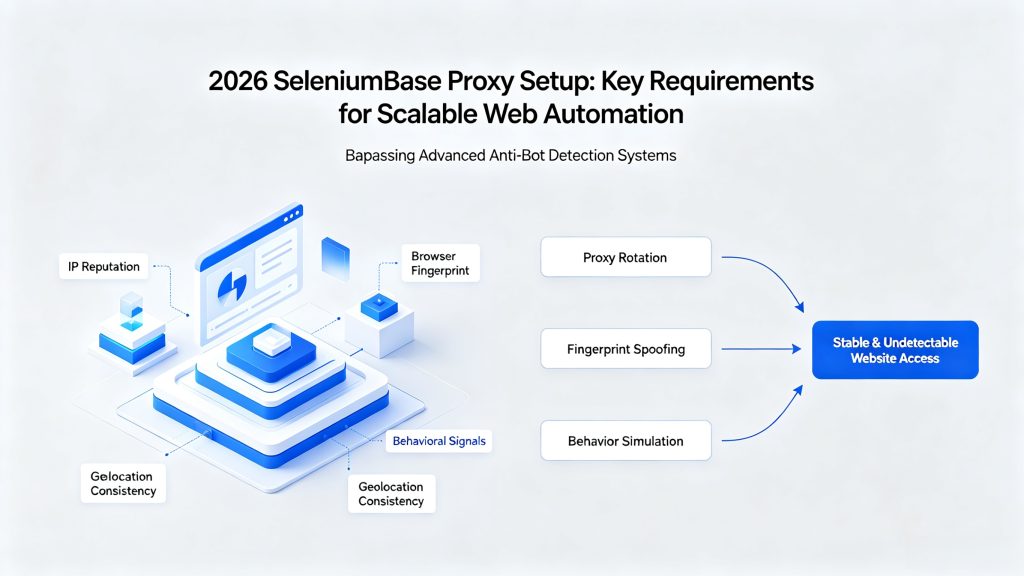
Table of Contents
Why SeleniumBase Needs Proxies in 2026
Modern websites evaluate every request using multi-layer detection systems:
- IP reputation and ASN trust scoring
- Request frequency and concurrency patterns
- Browser fingerprint matching
- Session continuity
- Geo-location consistency
If your automation sends repeated requests from the same IP—or from low-trust datacenter IP ranges—you will quickly encounter:
- CAPTCHA challenges
- IP bans
- Blocked sessions
- Incomplete or misleading data
This is why developers increasingly rely on web scraping proxies, especially residential IP networks, to distribute traffic and simulate real user behavior.
What Is SeleniumBase?
SeleniumBase is an advanced automation framework built on top of Selenium, designed to simplify browser automation while improving reliability.
Key capabilities include:
- Built-in test framework
- Headless browser automation
- Enhanced stability and error handling
- Easier integration with proxy configurations
Compared to raw Selenium, SeleniumBase is more suitable for modern automation workflows that require stealth and scalability.
Types of Proxies for SeleniumBase Automation
Not all proxies are created equal. Choosing the right type directly impacts your success rate.
Datacenter Proxies
Fast and cost-effective, but easily detected. These are often flagged by anti-bot systems due to low trust scores.
Residential Proxies
These IPs come from real user devices, making them significantly more reliable for avoiding detection. Ideal for tasks like SEO monitoring, e-commerce scraping, and social media automation.
Rotating Residential Proxies
Automatically rotate IP addresses per request or session. This is the most effective option for large-scale scraping and automation.
Static Residential Proxies
Provide a consistent IP identity with high trust levels, useful for login sessions and account-based workflows.
Basic SeleniumBase Proxy Setup
SeleniumBase allows proxy configuration through command-line arguments.
Simple Proxy Example
from seleniumbase import BaseCase

class TestProxy(BaseCase):
    def test_proxy(self):
        self.open("https://httpbin.org/ip")
Run with proxy:
pytest test_file.py --proxy=IP:PORT
With authentication:
pytest test_file.py --proxy=username:password@IP:PORT
This routes all browser traffic through your proxy server.
Advanced Setup: Rotating Proxies + Anti-Detection
Using a single proxy is not enough in 2026. To avoid IP bans, you need rotation and fingerprint alignment.
Advanced Example with User-Agent Rotation
from seleniumbase import BaseCase
import random

USER_AGENTS = [
    "Mozilla/5.0 (Windows NT 10.0; Win64; x64)...",
    "Mozilla/5.0 (Macintosh; Intel Mac OS X 10_15_7)..."
]

class AdvancedTest(BaseCase):
    def test_stealth(self):
        ua = random.choice(USER_AGENTS)
        self.open("https://httpbin.org/ip", agent=ua)
Combining rotating proxies with randomized user-agents helps reduce detection risk significantly.
Proxy-Based Automation Architecture
A scalable SeleniumBase setup typically looks like this:
User Script
   ↓
SeleniumBase Browser
   ↓
Proxy Gateway (ColaProxy)
   ↓
Rotating Residential IP Pool
   ↓
Target Website
This structure allows each request to appear as a unique user from a real-world network environment.
Real-World Test Results: With vs Without Proxies
In controlled testing environments, the difference is clear:
| Scenario | Success Rate | Block Rate | Stability |
|---|---|---|---|
| No Proxy | 30–40% | High | Unstable |
| Datacenter Proxy | 50–60% | Medium | Moderate |
| Residential Proxy | 85–92% | Low | Stable |
| Rotating Residential Proxy | 95%+ | Very Low | Highly Stable |
These results show why rotating residential proxies are considered the industry standard for scalable automation.
SeleniumBase vs Playwright with Proxies
| Feature | SeleniumBase | Playwright |
|---|---|---|
| Ease of Setup | High | Medium |
| Flexibility | Medium | High |
| Anti-Detection | Good | Very Strong |
| Proxy Integration | Simple | Advanced |
| Learning Curve | Low | Medium |
SeleniumBase is ideal for rapid deployment, while Playwright offers deeper control for advanced users.
Scaling SeleniumBase with Proxy Infrastructure
To build a scalable automation system, you need more than just a script.
Key strategies include:
- Rotating IPs per request
- Using geo-targeted proxies for localized data
- Managing session persistence when needed
- Distributing traffic across multiple IP pools
- Implementing retry logic with new IPs
A large residential proxy network enables stable performance even under high concurrency.
Common Issues and Troubleshooting
Even with proxies, misconfigurations can cause failures.
Common Problems
- Proxy authentication errors
- Connection timeouts
- Immediate IP blocking
- Frequent CAPTCHA challenges
Solutions
- Verify proxy credentials and format
- Use high-quality residential proxy providers
- Reduce request frequency
- Align browser fingerprint with IP location
- Enable IP rotation
Real-World Use Cases
SeleniumBase with proxy integration is widely used for:
- Web scraping and data extraction
- SEO rank tracking and SERP analysis
- E-commerce price monitoring
- Social media automation
- Ad verification and geo-testing
In all these scenarios, proxy for automation plays a critical role in maintaining success rates.
Why ColaProxy Fits SeleniumBase Workflows
For developers building scalable systems, proxy quality directly impacts performance.
- Access to large residential IP pools
- Global geo-targeting across 200+ regions
- Automatic IP rotation
- High uptime and stable connections
- Compatibility with SeleniumBase and other automation tools
This makes it suitable for building reliable, long-term automation infrastructure.
Best Practices for Avoiding Detection
To maintain stable scraping performance:
- Use rotating residential proxies instead of datacenter IPs
- Match proxy location with browser settings
- Randomize user behavior (scrolling, delays)
- Avoid aggressive request patterns
- Monitor IP performance and replace low-quality IPs
FAQ
Can SeleniumBase work without proxies?
Yes, but only for small-scale or low-risk tasks. Large-scale automation requires proxies.
What is the best proxy type for SeleniumBase?
Rotating residential proxies provide the best balance between stealth and scalability.
How do I avoid IP bans?
Use IP rotation, realistic behavior simulation, and high-quality proxy networks.
Are free proxies usable?
They are unreliable and often blocked. Not suitable for production use.
Final Thoughts
In 2026, successful automation is no longer defined by scripts alone—it depends on infrastructure.
SeleniumBase provides a powerful foundation for browser automation, but without proper proxy integration, even well-built systems will struggle against modern anti-bot defenses.
By combining SeleniumBase with rotating residential proxies, developers can build automation workflows that are scalable, reliable, and significantly harder to detect.
For any serious web scraping or automation project, proxies are not optional—they are essential.