Executive Summary
Investing in high-quality residential proxies isn’t just an operational cost; it’s a strategic move with a massive Return on Investment (ROI). For sneakerheads and resellers, a single successful “W” (win) on a limited release can fully offset the monthly subscription of a premium proxy pool.
By leveraging ColaProxy’s high-concurrency residential rotation and static ISP proxies, users bypass anti-bot detection and secure high-value flips. This guide breaks down the ROI of Residential Proxies, real-world case studies, and the technical methodology for turning proxy spend into pure profit.
How One Successful Drop Pays for Your Residential Proxies
In the high-stakes world of limited-edition releases—whether it’s the latest Travis Scott Jordan 1s, a Supreme drop, or specialized GPU restocks—the difference between a “sold out” screen and a confirmation email often comes down to your networking stack.
Many beginners view Residential Proxies as a recurring drain on their margins. However, professional resellers view them as an insurance policy. In this deep dive, we’ll explore how a $100 investment in data can yield a $500+ return, effectively making your infrastructure “free.”
What is a Residential Proxy and Why Does It Matter?
To understand the ROI, we must first answer: How does a residential proxy work?
A Residential Proxy is an intermediary that uses an IP address assigned by an Internet Service Provider (ISP) to a homeowner. Unlike datacenter IPs, which are easily flagged as “non-human” by security filters like Akamai or Cloudflare, a Residential IP looks like a genuine person browsing from their living room.
The Mechanics of Success: How does a residential proxy work?
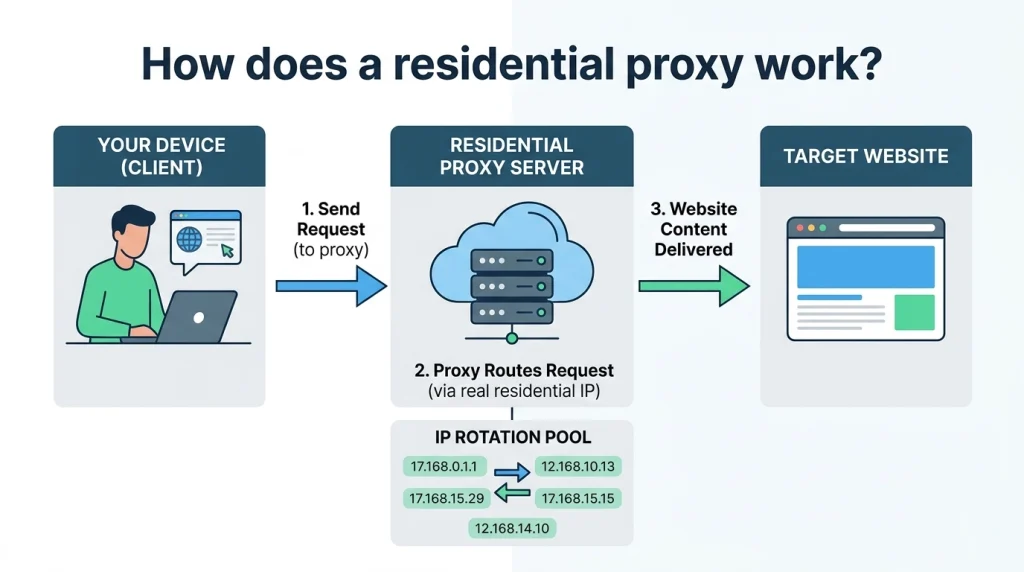
When you use a proxy, your web request travels from your bot/browser to the proxy server, which then fetches the data using a real residential address. Rotating residential proxies switch your IP for every request or after a set time, making it nearly impossible for websites to track and block your automated activity.
The Math of a “W”: Breaking Down the ROI
Let’s look at a real-world scenario involving a standard sneaker release.
| Expense/Revenue Item | Cost (USD) | Potential Profit (USD) |
| ColaProxy 10GB Residential Plan | $10.00 | – |
| Retail Price of Sneaker | $220.00 | – |
| Shipping & Tax | $25.00 | – |
| Total Investment | $255.00 | – |
| Market Resale Price | – | $550.00 |
| Net Profit (One Pair) | – | $295.00 |
The Takeaway: In this scenario, one successful checkout covers your proxy subscription 25.5 times over.
Key Takeaway
If you are running 500 tasks on a drop, your “hit rate” only needs to be 0.2% (1 pair) to make your entire month’s infrastructure profitable. Everything after that first pair is pure “gravy.”
Why Cheap Proxies Cost More in the Long Run
We often see clients come to ColaProxy after “saving money” on free or low-tier providers. The result? 403 Forbidden errors and “Access Denied” at checkout.
According to research by DataDome, modern e-commerce sites now use behavioral analysis and IP reputation scoring. Low-quality proxies often come from flagged subnets. If your proxy is blacklisted, your bot never even reaches the checkout page.
Common Pitfalls of Subpar Proxies:
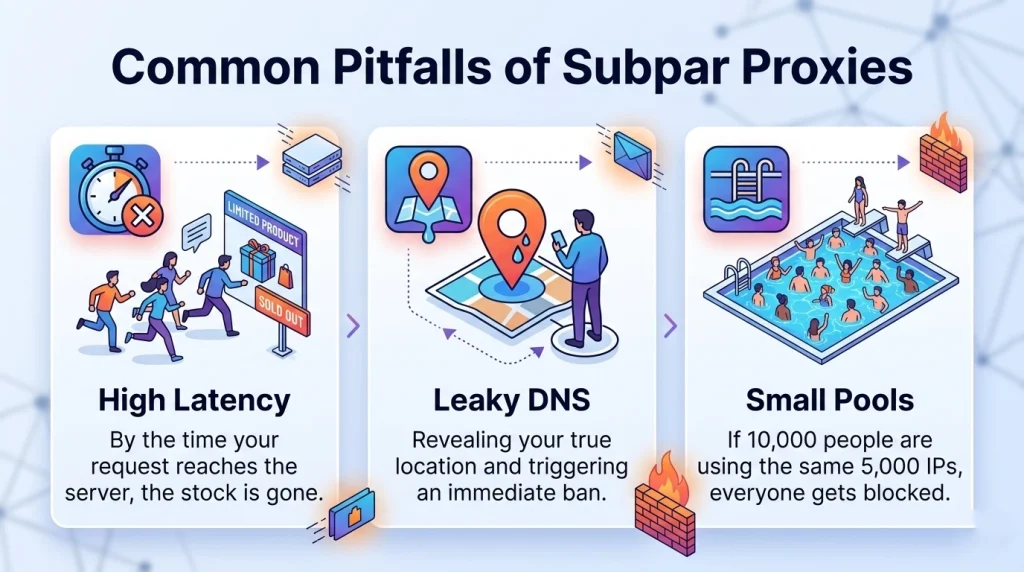
- High Latency: By the time your request reaches the server, the stock is gone.
- Leaky DNS: Revealing your true location and triggering an immediate ban.
- Small Pools: If 10,000 people are using the same 5,000 IPs, everyone gets blocked.
For those needing uncompromising speed and reputation, Static ISP Proxies (also known as “Residential Static”) offer the speed of a datacenter with the legitimacy of a residential IP.
Real-World Case Study: The “Holiday Drop” 2026
One of our long-term clients, a boutique reselling group, shared their data from a recent February release. They utilized a hybrid strategy:
- Rotating Residential Proxies: Used for initial monitoring and “scraping” stock levels across 50+ regional sites.
- Static Mobile Proxies: Used for the final checkout phase on mobile-app-only drops (e.g., SNKRS).
- Static ISP Proxies: Used for high-speed Shopify checkout.
The Result: Out of a 50GB data spend (approx. $200), they secured 14 pairs of high-heat sneakers with a total resale value of $3,500. Their infrastructure cost was less than 6% of their gross profit.
Choosing the Right Tool for the Job
Different targets require different types of Residential IPs. Here is how we recommend structuring your setup at ColaProxy:
- Rotating Residential Proxies: Best for massive task counts on sites with heavy anti-botting. The constant IP swapping keeps your footprint invisible.
- Static ISP Proxies: Best for “pre-carting” and Shopify sites where speed and IP consistency are king.
- Rotating Mobile Proxies: Essential for sites that prioritize 4G/5G traffic, as mobile IPs are rarely blocked due to “CGNAT” (where thousands of real users share one IP).
- Static Mobile Proxies: Perfect for managing social media accounts or aged “sneaker accounts” that require a consistent login location.
- Rotating Datacenter Proxies: The budget-friendly choice for scraping public data or non-protected sites.
The Proxy Success Checklist
- Pool Verification: Check your provider’s dashboard to ensure the pool is healthy (ColaProxy monitors this 24/7).
- Geo-Targeting: Set your proxies to the same region as the server (e.g., US-East for Virginia-based servers).
- Test Run: Run 5-10 tasks 15 minutes before the drop to ensure no authentication issues.
- Data Management: Ensure you have enough GBs. Nothing kills a “W” faster than running out of data mid-checkout.
- Diversify: Don’t put all your eggs in one basket. Mix Residential Proxies with mobile IPs for redundancy.
FAQ: Residential Proxies and ROI
Are residential proxies legal?
Yes, using proxies for web scraping, price comparison, and purchasing limited goods is legal. However, always adhere to the terms of service of the target website.
How much data do I need for a single drop?
Most users find that 2GB to 5GB is sufficient for a standard 30-minute release window, depending on task count.
Why should I choose ColaProxy over a cheaper provider?
We focus on IP purity. Our residential IPs are ethically sourced and regularly “cleaned” to ensure they aren’t on major blacklists. This leads to higher success rates, which is the only metric that matters for ROI.
Can I use these for other things besides sneakers?
Absolutely. Residential rotation is vital for SEO auditing, ad verification, and market research.
Conclusion: The Final Verdict on ROI
The cost of a Residential Proxy is a fraction of the potential reward. When you use a reliable service like ColaProxy, you aren’t just buying data; you are buying access. Whether you need rotating mobile proxies for app-based drops or static ISP proxies for lightning-fast checkouts, the math remains the same: One “W” pays for the month.
Stop missing out on drops due to “Access Denied” errors.
Ready to secure your next win? Explore ColaProxy’s Residential Plans and see why professional resellers trust our infrastructure.