10-Second Takeaway
To solve CAPTCHAs effectively in 2026, you must pivot from high-volume, low-trust datacenter proxies to High-Trust Residential IPs. Modern anti-bot systems like reCAPTCHA v3 and Cloudflare Turnstile analyze IP reputation and behavioral biometrics.
By using ethically sourced residential and mobile proxies from ColaProxy, you mimic real human users, achieve “one-click” solves, and eliminate the 403-forbidden loops that stall your scraping and automation projects.
5 Proven Ways to Solve CAPTCHAs with High-Trust Residential IPs
In the current landscape of web scraping and automated data collection, the biggest hurdle isn’t writing the code—it’s staying undetected. If you have ever encountered a “Please try again later” message or an endless loop of fire hydrants and traffic lights, your IP address has been flagged. To solve CAPTCHAs consistently, you need more than just a solver; you need an identity that websites trust.
Why Do You Keep Getting CAPTCHAs?
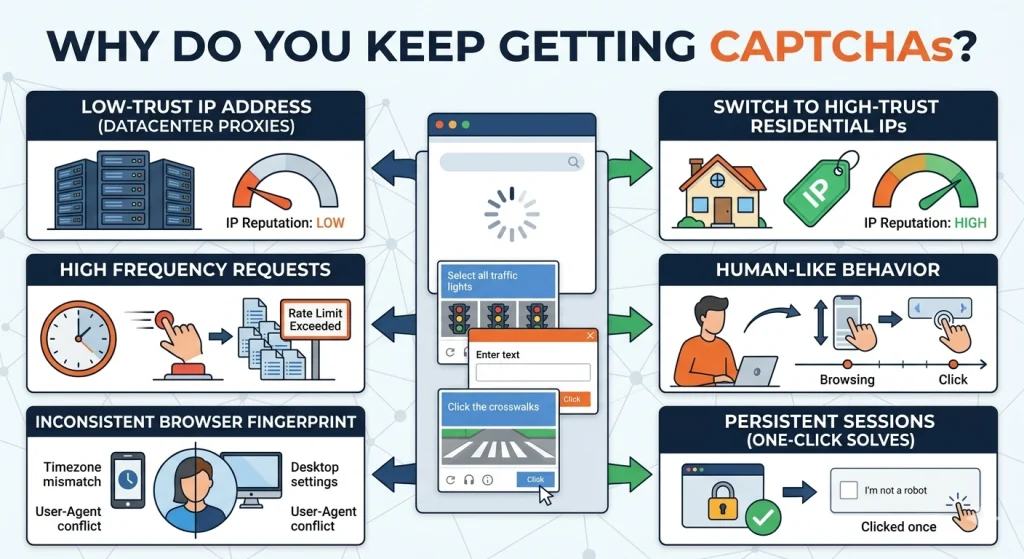
Most users start their automation journey with datacenter proxies because they are fast and cheap. However, these IPs belong to server farms (like AWS or Azure). When a website sees a thousand requests coming from a single server range, it triggers a challenge.
What are captcha proxies, and how do they differ? A “Captcha Proxy” isn’t a specific technology but a strategy: using Residential IPs that carry the digital signature of a real home internet user.
Why Proxies Trigger CAPTCHA More in the Morning
A curious phenomenon many developers face is that proxies trigger captcha more in the morning. Our research at ColaProxy suggests two primary reasons:
- Global Traffic Resets: Many security algorithms refresh their “suspicion scores” at 00:00 UTC.
- Human Baseline: In the early morning hours, there is less organic human traffic. Automated requests stick out like a sore thumb against the quiet background of a sleeping network.
The Trust Hierarchy: Choosing the Best Captcha Proxies
Not all proxies are created equal. To solve CAPTCHAs, you must understand the hierarchy of trust.
Comparison of Proxy Types for CAPTCHA Bypass
| Proxy Type | Trust Score | CAPTCHA Frequency | Best Use Case |
| Rotating Datacenter | Low | Very High | Simple sites without Cloudflare |
| Static ISP Proxies | Medium-High | Low | Social Media & Account Management |
| Rotating Residential | High | Very Low | E-commerce Scraping & SEO Audits |
| Mobile Proxies (4G/5G) | Elite | Near Zero | High-Security Apps (TikTok, Instagram) |
At ColaProxy, we provide a massive pool of residential proxies and rotating mobile proxies that allow you to bypass these challenges by appearing as a legitimate mobile or home user.
How to Solve CAPTCHAs: 5 Professional Strategies
1. Leverage Rotating Residential Proxies for Anonymity
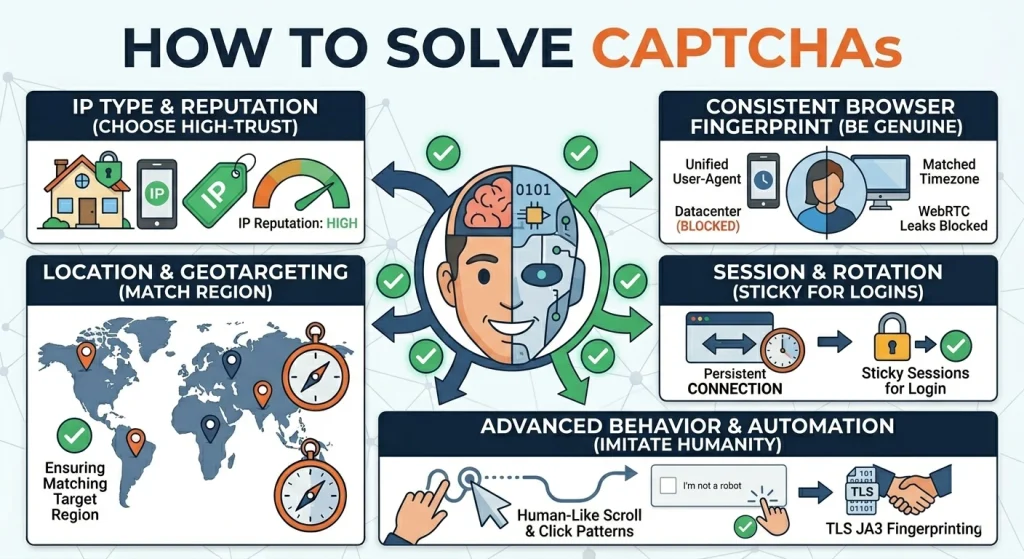
When you use rotating residential proxies, every request comes from a different household IP. This prevents “rate-limiting,” which is the #1 trigger for CAPTCHAs. If a site sees one request from a home in New York and the next from a home in London, it treats them as two different people.
Pro Tip: Set your rotation “sticky” time to 5–10 minutes if you are performing multi-step tasks like logging into a Google account. This provides session consistency.
2. Use Static ISP Proxies for “One-Click” Solves
For platforms like Google or Amazon, a shifting IP can sometimes be suspicious. This is where static ISP proxies (also known as Static Residential) shine. These IPs are hosted in datacenters but registered under consumer ISPs (Comcast, AT&T, etc.). They offer the speed of a datacenter with the trust of a residential line. This is often the best captcha proxies solution for maintaining long-term logged-in sessions.
3. Match Browser Fingerprints with Your Proxy
Simply having a residential IP isn’t enough to solve CAPTCHAs if your browser tells a different story.
- The Problem: Your proxy is in Los Angeles, but your browser’s system clock is set to Beijing.
- The Solution: Use anti-detect browsers (like AdsPower or OKBrowser) and ensure the WebRTC, Timezone, and Language headers match the proxy location exactly.
4. Optimize Request Headers and TLS Fingerprints
Websites now use “JA3 Fingerprinting” to see if your request comes from a script (like Python Requests) or a real browser (Chrome/Safari). To truly solve CAPTCHAs, your automation stack must mimic the TLS handshake of a real user.
5. Utilize Mobile Proxies for High-Stake Challenges
If you are asking, “how can I stop Omegle captcha using proxy?” or dealing with intense mobile-app blocks, rotating mobile proxies are your secret weapon. Mobile IPs are shared by thousands of real users via CGNAT. Sites are terrified of blocking a mobile IP because they might accidentally block thousands of real customers.
Checklist: Is Your Proxy Setup Ready to Solve CAPTCHAs?
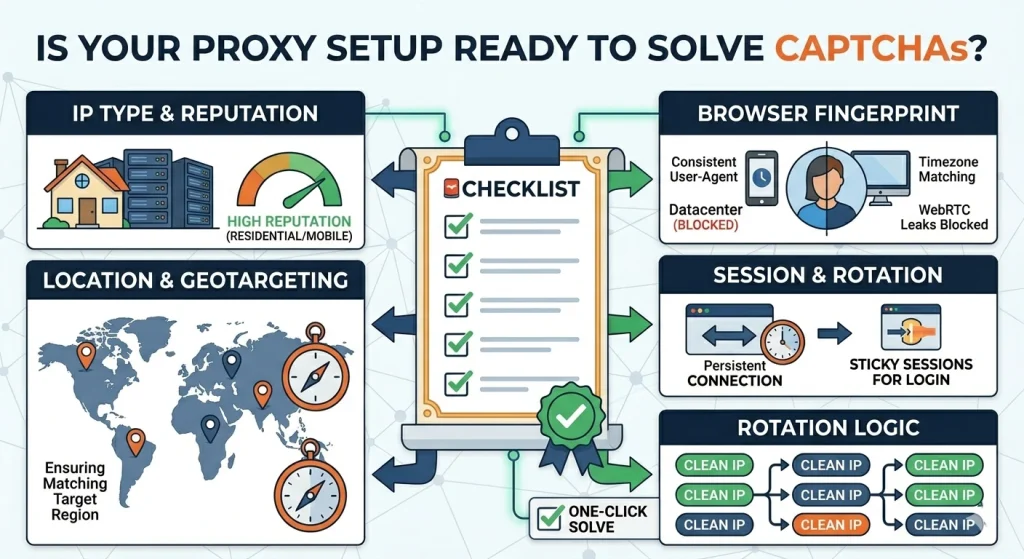
Before starting your next crawl, run through this verification list:
- IP Type: Am I using a Residential or Mobile IP? (Avoid Datacenter for high-security sites).
- Location: Does my proxy location match my target’s region?
- Rotation: Is the rotation interval long enough to finish the task?
- Headers: Is my User-Agent modern (e.g., Chrome 120+)?
- DNS: Am I using the proxy’s DNS to avoid leaks?
Real-World Case Study: Overcoming the Google Search Loop
One of our clients, an SEO agency, was struggling with google search captcha proxy errors while tracking rankings for 5,000 keywords daily.
- Initial Setup: They used “cheap” datacenter proxies.
- The Result: 70% of requests were met with a CAPTCHA. They spent $400/month just on CAPTCHA solving services.
- The ColaProxy Solution: We moved them to rotating residential proxies.
- The Outcome: Their success rate jumped to 98.5%. Because the residential IPs had such high trust, Google didn’t even trigger the challenge. They saved money by firing their CAPTCHA solving service and only paying for the proxies.
FAQ: Solving Common Proxy and CAPTCHA Issues
What are captcha proxies exactly?
What are captcha proxies? They are high-trust IPs (Residential or Mobile) that have a clean history. They are used specifically to browse sites without triggering “suspicious activity” flags.
How do captcha proxies work?
They work by providing a “clean” reputation. Sites maintain databases of IPs. Datacenter IPs are flagged as “Bot-likely,” while Residential IPs are “Human-likely.” Using a proxy that works with captcha means using an IP that the website doesn’t want to block.
Can I get a free proxy with captcha support?
While you may find a free proxy captcha list online, they are rarely effective. These IPs are usually blacklisted within minutes. For professional work, a paid service like ColaProxy is essential for reliability.
Why is my captcha not working with proxy?
If you find your captcha not working with proxy, it’s likely an IP leak. Your real IP might be visible via WebRTC, or your DNS requests are leaking. Ensure you are using a secure, high-anonymity residential proxy.
External Resources & Technical Standards
To stay ahead of the curve, we recommend following industry standards on bot detection:
- W3C Web Verification Standards: Understanding how the web defines “human” interaction.
- The Evolution of reCAPTCHA: Official documentation on how v3 scores users.
Final Thoughts: The ROI of High-Trust IPs
In the world of automated data, “cheap” usually ends up being expensive. Every time your bot fails to solve CAPTCHAs, you lose bandwidth, time, and potential revenue. Investing in ColaProxy’s suite of rotating residential proxies and static ISP proxies is the most effective way to ensure your projects run smoothly.
By switching to high-trust residential IPs, you aren’t just bypassing a challenge—you are changing the conversation between your bot and the server from “Who are you?” to “Welcome back.”
Ready to boost your success rates? Contact us today to test our residential proxies and see the difference in your one-click solve rates!