Summary
Integrating Rotating Proxies into Python scrapers is the definitive solution for bypassing sophisticated anti-bot measures in 2026. This guide provides a hands-on technical walkthrough for implementing Rotating IP logic using Requests and Scrapy, backed by ColaProxy’s high-concurrency infrastructure.
Whether you need Rotating Residential Proxies for high-trust sites or Static ISP Proxies for session persistence, this article delivers the verified methodology to scale your data extraction without blocks.
Rotating Proxies: 7 Pro Ways to Integrate into Python (2026)
In the current landscape of web data extraction, the “IP ban” is no longer a minor hurdle—it is a sophisticated wall built with AI and behavioral fingerprinting. If you are a developer, your ability to collect data hinges entirely on your Rotating Proxies strategy.
When I first started building scrapers, I thought a simple list of free IPs would suffice. I was wrong. Modern websites detect inconsistencies in milliseconds. To win, your Python script must not only change its IP but also its behavior, fingerprint, and timing. In this guide, I will share the “ColaProxy Method”—a battle-tested approach to Rotating IP management that we’ve used to help clients scrape millions of pages daily.
What are Rotating Proxies and Why Do You Need Them?
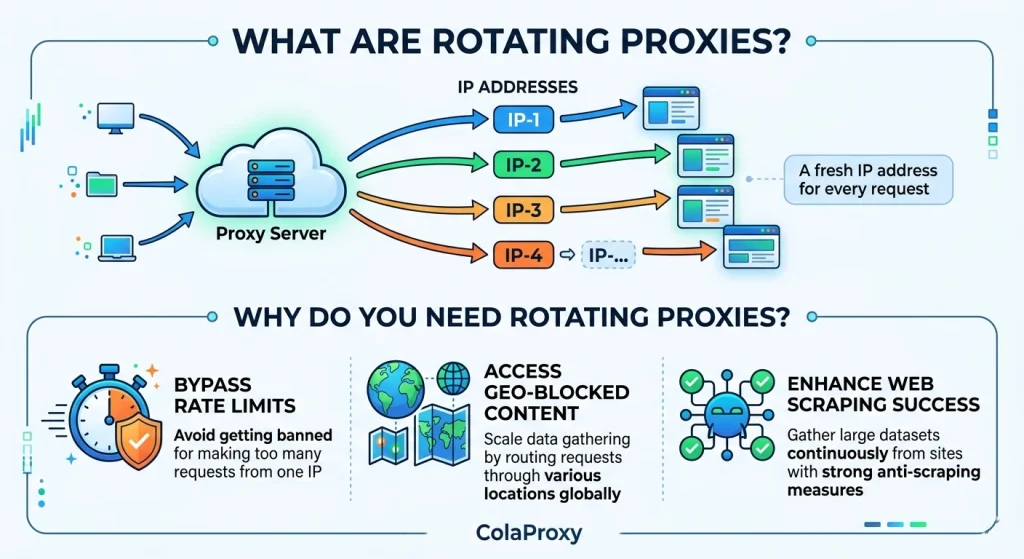
At its core, a Rotating Proxy is a proxy server that assigns a new IP address from a pool for every new request or after a set period.
Why is this non-negotiable?
- Rate Limiting: Most websites allow only X requests per minute from a single IP.
- IP Blacklisting: Frequent scraping triggers permanent bans.
- Geo-blocking: Many sites serve different content based on where they think you are.
The Developer’s Proxy Selection Matrix
Not all proxies are created equal. Choosing the wrong type is the #1 cause of failed scraper deployments.
| Proxy Category | Infrastructure | Trust Score | Best For |
| Rotating Residential Proxies | Real home devices (WiFi/Cable) | Highest | Amazon, Google, Social Media |
| Static ISP Proxies | Data center speed, Residential IP status | High | Stable login sessions, Sneakers |
| Rotating Mobile Proxies | 4G/5G Carrier IPs | Elite | Sites with high-end anti-bot (e.g., Akamai) |
| Rotating Datacenter Proxies | Cloud Server IPs | Medium | High-speed, high-volume, low-security sites |
How to Integrate Rotating Proxies with Python Requests
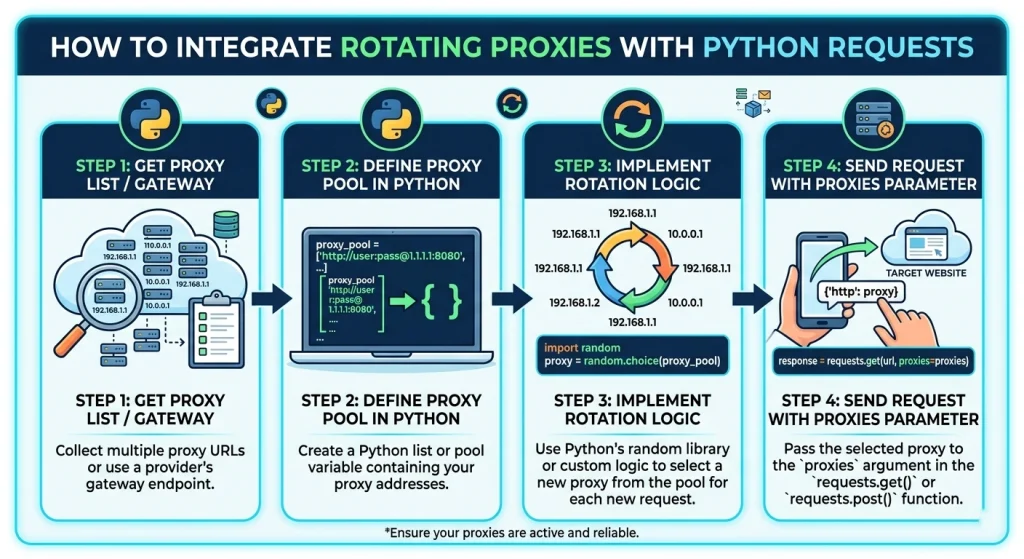
The requests library is the most popular way to fetch data in Python. However, it is “dumb” regarding rotation. You must implement the logic manually.
Step 1: Setting up the Proxy Pool
Instead of hardcoding a single IP, we create a list. But here is the professional tip: Use a single-entry gateway.
At ColaProxy, we provide a gateway address like proxy.colaproxy.com:7777. Every time your script hits this address, our backend automatically swaps the IP for you. This simplifies your Python code significantly.
Python
import requests
# Using ColaProxy’s Rotating Residential Proxies Gateway
# This single URL provides a fresh Rotating IP for every request
proxy_gateway = “http://user:password@gw.colaproxy.com:8000”
proxies = {
“http”: proxy_gateway,
“https”: proxy_gateway,
}
def scrape_with_rotation(url):
try:
# The rotation happens at the provider level
response = requests.get(url, proxies=proxies, timeout=10)
return response.status_code, response.text
except Exception as e:
return None, str(e)
# 2026 Pro-Tip: Always use ‘timeout’ to prevent hanging threads!
Step 2: Implementing Manual Rotation Logic
If you prefer managing a specific list of Static ISP Proxies, you can use the random library.
Python
import random
ip_pool = [
“http://user:pass@123.45.67.89:8080”,
“http://user:pass@98.76.54.32:8080”,
# … more Static ISP Proxies
]
def get_random_proxy():
proxy = random.choice(ip_pool)
return {“http”: proxy, “https”: proxy}
Scaling with Scrapy: Production-Grade IP Rotation
When your project grows beyond a single script, Scrapy is the industry standard. It handles concurrency effortlessly, but you must configure its middleware to use Rotating Proxies effectively.
Why use Middleware for a Rotating Proxy?
Middlewares allow you to intercept every request the spider makes. This is where we inject our Rotating IP credentials.
- Modify settings.py:
- Disable the default proxy middleware and enable your custom one (or a third-party one like scrapy-rotating-proxies).
- Custom Middleware Example:
- In middlewares.py, you can create a class that assigns a proxy to every request.meta.
Python
class ColaProxyMiddleware:
def process_request(self, request, spider):
# Assigning a Rotating IP from the ColaProxy pool
request.meta[‘proxy’] = “http://gw.colaproxy.com:8000”
# Setup basic auth if necessary
# request.headers[‘Proxy-Authorization’] = basic_auth_header(‘user’, ‘pass’)
Handling “Sticky” Sessions in Scrapy
There are times you need to maintain the same IP across multiple requests (e.g., adding an item to a cart and then checking out). For this, Static Mobile Proxies are your best friend. In Scrapy, you can pass a session_id in your proxy string to tell the ColaProxy server to keep you on the same exit IP.
How to Avoid Detection: Beyond Just Using a Rotating IP
A common mistake I see developers make is thinking that Rotating Proxies are a “silver bullet.” If your headers don’t match your IP, you will still be blocked.
1. User-Agent Rotation
Your User-Agent must change alongside your IP. If you use 100 different IPs but the same Chrome version string, it looks suspicious.
2. TLS Fingerprinting
Some sites (Cloudflare, Akamai) check the “TLS Handshake.” Python’s default requests handshake is distinct from a real browser. To solve this, consider using curl_cffi or Playwright.
3. Case Study: The E-commerce Pricing Crawl
We recently helped a client who was trying to scrape a major retailer. They were using Rotating Datacenter Proxies, but their success rate was only 15%.
- The Issue: The retailer’s anti-bot system was flagging IPs from known cloud providers (AWS, Azure).
- The Solution: We switched them to Rotating Residential Proxies.
- The Result: Success rate jumped to 98% because the IPs appeared as genuine home users.
Internal Resource: Stop Getting Banned: The Science of Residential IP Rotation
FAQ: Everything You Need to Know About IP Rotation
What is the difference between a Rotating Proxy and a Static IP?
A Rotating Proxy provides a new IP for every request or interval. A Static IP (like our Static ISP Proxies) stays the same for as long as you rent it. Use static IPs for social media account management and rotating ones for mass scraping.
Can I use free proxies for Python scraping?
You can, but you shouldn’t. Free proxies are notoriously slow, insecure, and usually already blacklisted. For any professional project, paid Rotating Proxies are a necessary operational cost.
How do I handle proxy failures in my code?
Implement a retry mechanism. In Scrapy, this is handled by the RetryMiddleware. If a proxy returns a 403 or 503, the middleware should catch it, discard that IP, and try again with a fresh Rotating IP.
Is IP rotation legal?
Web scraping itself is legal in most jurisdictions provided you aren’t accessing private data behind a login or violating CFAA-like laws. Rotating Proxies are simply a tool to facilitate public data collection.
Summary Checklist for a Robust Python Scraper
Before you deploy your scraper to production, run through this checklist:
- Proxy Selection: Have I chosen the right type? (Residential for high-trust, Datacenter for speed).
- Rotation Logic: Is the IP changing frequently enough to avoid rate limits?
- Header Consistency: Does my User-Agent match the expected behavior of a real user?
- Retry Logic: Does my code handle a 429 Too Many Requests error by switching IPs?
- Timeout Settings: Are my timeouts set to prevent my script from hanging on a dead proxy?
- Provider Reliability: Am I using a provider like ColaProxy with a massive, clean IP pool?
Key Takeaways
- Automation is King: Use proxy gateways to handle rotation automatically rather than managing IP lists in your code.
- Match the Security: The harder the target, the more “human” your proxy needs to be. Rotating Mobile Proxies are the ultimate weapon for the toughest sites.
- Monitor Performance: Keep an eye on your success rates. If they drop, it’s time to switch from datacenter to residential IPs.
Why Choose ColaProxy for Your Python Projects?
At ColaProxy, we understand that developers don’t just need IPs; they need uptime and speed. Our infrastructure is designed to integrate seamlessly with Python.
- Rotating Residential Proxies: Access over 50 million real user IPs.
- Static ISP Proxies: The perfect blend of speed and residential status.
- Rotating Mobile Proxies: High-trust 4G/5G IPs for the most demanding tasks.
- Static Mobile Proxies: Dedicated mobile IPs for stable, long-term sessions.
Master your setup with these additional guides:
- Why Data Center Proxies Fail Where Rotating Residential Proxies Win?
- Reverse Proxy vs Proxy: 7 Key Differences You Must Know
- The ROI of Residential Proxies: How One “W” Pays for Your Monthly Sub
- Are Residential Proxies Legal? The Ultimate 2026 Compliance Guide
- Why Real Home IP Addresses Have the Highest Trust Score with Retailers
Final Step: Ready to put this code into action? Sign up for a ColaProxy and get your credentials to start rotating IPs in under 5 minutes.