
Executive Summary
In 2026, e-commerce platforms use sophisticated behavioral analysis and TLS fingerprinting to block automated scripts. To successfully scrape retail prices without bot detection, businesses must move beyond basic scraping scripts. The secret lies in a multi-layered approach: utilizing high-trust rotating residential proxies, mimicking human browsing patterns, and managing browser fingerprints.
By leveraging ColaProxy’s diverse IP pools—ranging from ultra-fast static ISP proxies to undetectable mobile IPs—you can maintain a 99.9% success rate and ensure your competitive pricing data remains accurate and real-time.
The 2026 Challenge: Why Is It Hard to Scrape Retail Prices Without Bot Detection?
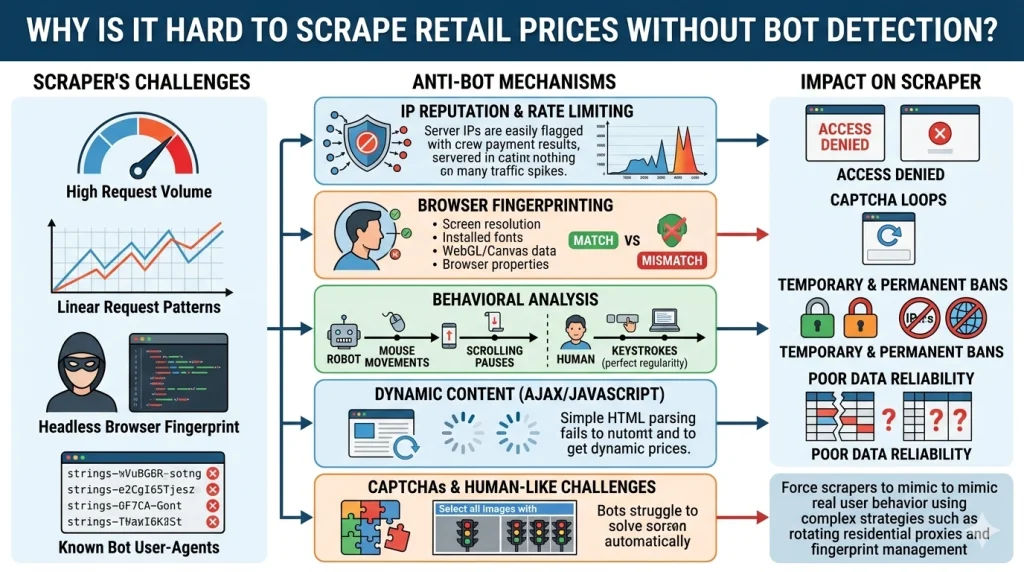
If you’ve tried to run a simple Python script against a major retailer like Amazon, Target, or eBay recently, you’ve likely been met with a “Pardon Our Interruption” screen or a persistent CAPTCHA. The reality is that modern retail websites are no longer just looking for high request volumes; they are analyzing the “DNA” of every connection.
To scrape retail prices without bot detection, you need to understand that anti-bot solutions like Akamai, Cloudflare, and DataDome now use Generative AI to identify non-human patterns. They look at your IP reputation, your TCP/IP stack, and even how your “browser” renders fonts. If any of these signals look “server-like,” you are instantly burned.
What is the best way to web scrape the price of the product in a web shop?
The most effective way is to use a headless browser (like Playwright or Puppeteer) paired with rotating residential proxies. This combination allows you to execute JavaScript (to see the actual price) while appearing as a legitimate home user from a specific geographic location.
7 Methods to Scrape Retail Prices Without Bot Detection
1. Leverage Rotating Residential Proxies
This is the single most important factor. Datacenter IPs are easily flagged because they belong to known server ranges. To scrape retail prices without bot detection, you must use IPs that belong to real Internet Service Providers (ISPs).
- How it works: ColaProxy’s rotating residential proxies route your requests through real household devices. Since these IPs are indistinguishable from actual shoppers, retailers are hesitant to block them.
- The Benefit: You can scrape at scale without worrying about your entire subnet being blacklisted.
2. Implement Browser Fingerprint Spoofing
Anti-bot systems check your “fingerprint”—a unique combination of your screen resolution, OS, battery status, and WebGL metadata.
- The Fix: Use the stealth plugin for your scraping framework. Ensure your User-Agent matches your hardware profile. If your User-Agent says “Windows,” but your fingerprint suggests “Linux,” you will trigger a “Bot Detected” screen.
3. Use Static ISP Proxies for Persistent Sessions
Sometimes, you need to log in to see “Member Only” pricing. In this case, rotating your IP every request will get your account banned.
- The Strategy: Use ColaProxy’s static ISP proxies. These provide the speed of a datacenter proxy with the high trust of a residential IP, allowing you to maintain a consistent session for hours without a change in identity.
4. Master the Art of Request Pacing and Jitter
Bots are predictable; humans are not. If you send a request exactly every 5.0 seconds, you are a bot.
- The Technique: Add “Jitter.” Set your script to wait for a random interval (e.g., between 3.4 and 9.2 seconds). This simple change makes it much harder for AI-based detectors to categorize your traffic.
5. Handle Dynamic Content with JavaScript Rendering
Many retailers use “Shadow DOM” or AJAX to load prices after the initial HTML is served.
- The Tool: Use Playwright or Selenium. While slower than raw HTTP requests, rendering the full page is often the only way to scrape retail prices without bot detection on sites built with React or Vue.
6. Rotate Mobile Proxies for High-Security Targets
For the “Final Boss” of retail sites, even residential IPs might fail.
- The Solution: Rotating mobile proxies (4G/5G). Mobile IPs carry the highest authority because hundreds of people often share a single IP address. Blocking one mobile IP could potentially block thousands of real customers, so retailers almost never do it.
7. Geo-Targeting for Accurate Data
Prices often change based on the user’s location. If you are scraping a US retailer from a UK IP, you might see “International Shipping” prices instead of local retail prices.
- ColaProxy Advantage: Our dashboard allows you to select specific cities and regions, ensuring your price monitoring is geographically accurate.
Comparing Proxy Types for Price Scraping
| Proxy Type | Trust Score | Speed | Best Use Case |
| Rotating Residential | 9/10 | Medium | General price monitoring on protected sites. |
| Static ISP | 8/10 | 10/10 | Account-based scraping and fast data pulls. |
| Rotating Mobile | 10/10 | Medium | Bypassing Akamai/Cloudflare on high-value items. |
| Datacenter | 3/10 | 10/10 | Scraping unprotected sites or sitemaps. |
How to get around high-cost scraping of heavily bot detected sites?
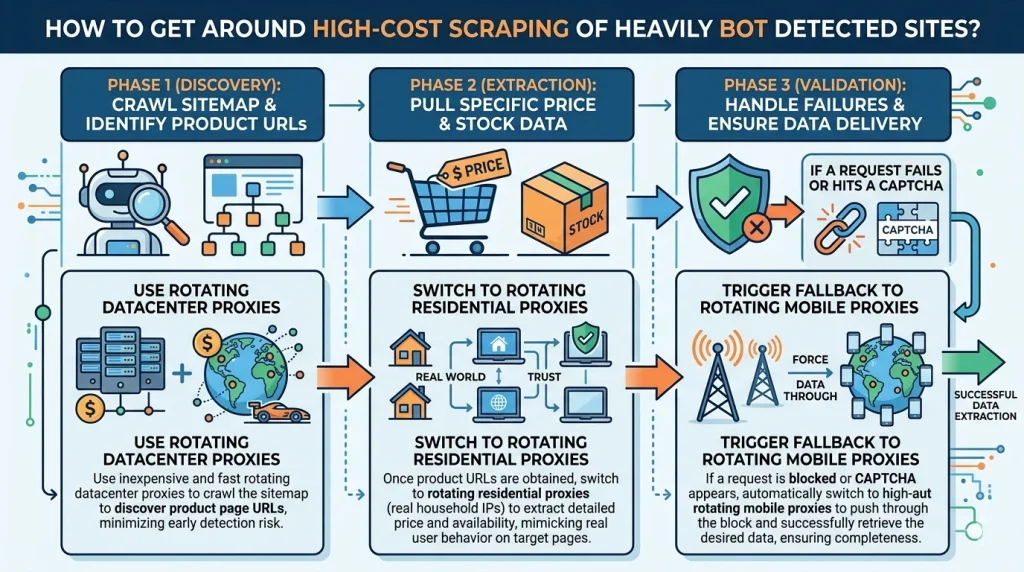
High-security scraping can get expensive if you rely solely on mobile proxies. To optimize your ROI, we recommend a Hybrid Proxy Strategy:
- Phase 1 (Discovery): Use rotating datacenter proxies to crawl the sitemap and identify product URLs. This is cheap and fast.
- Phase 2 (Extraction): Once you have the URLs, switch to rotating residential proxies to pull the specific price and stock data.
- Phase 3 (Validation): If a request fails or hits a CAPTCHA, trigger a fallback to rotating mobile proxies to “force” the data through.
This method reduces your average cost-per-successful-request while maintaining 100% data coverage.
Client Success Story: Scaling Price Intelligence
One of our clients, a Tier-1 consumer electronics aggregator, was experiencing a 40% block rate using a competitor’s residential service. Their primary struggle was with a major US retailer that frequently updated its bot-detection algorithms.
After switching to ColaProxy, we implemented a custom rotation logic:
- We assigned static ISP proxies for their daily “Price Check” on 50,000 SKUs.
- We utilized rotating mobile proxies for “Flash Sale” events where speed and undetectability were critical.
- Result: Their block rate dropped to under 1.5%, and their data refreshing speed increased by 300%.
“The ability to switch between ISP and Mobile IPs in one dashboard changed how we handle black-friday-level traffic.” — Senior Data Engineer.
Checklist: Is Your Scraper Truly “Invisible”?
Before launching your next large-scale crawl, verify these parameters to ensure you scrape retail prices without bot detection:
- IP Quality: Are you using residential IPs with a low fraud score?
- Headers: Is your Accept-Language header consistent with your proxy’s country?
- TLS Fingerprint: Does your SSL/TLS handshake match a real browser (not Python-requests)?
- Canvas Rendering: Have you disabled or spoofed Canvas/WebGL fingerprinting?
- ColaProxy Endpoint: Are you using the correct port for auto-rotation?
Frequently Asked Questions
Why do I see different prices when scraping?
Retailers often use “Dynamic Pricing.” This is based on your IP’s location, your browsing history (cookies), and even your perceived device type. Using rotating residential proxies helps you see what a “clean” local customer sees.
Is web scraping retail prices legal?
According to the landmark hiQ Labs v. LinkedIn case, scraping publicly available data is generally legal in the US. However, always check the robots.txt file and local regulations.
How do I avoid “Honey Pot” traps?
“Honey pots” are links invisible to humans but visible to bots. If your scraper clicks one, your IP is instantly banned. To avoid this, use a headless browser that only interacts with visible elements.
Final Takeaway: Build for Resilience
The key to a successful price monitoring operation is diversity. Don’t rely on one proxy type or one scraping method. As retailers get smarter, your infrastructure must be flexible. By integrating ColaProxy’s full suite—rotating residential proxies, static ISP proxies, and mobile proxies—you create a resilient system that can adapt to any anti-bot update.
Ready to bypass the blocks?
Start your trial with ColaProxy and see the difference that high-quality IP rotation makes for your e-commerce data.
Internal Learning Resources
- The ROI of Residential Proxies: How One “W” Pays for Your Monthly Sub
- 7 Proven Steps: How to Set Up a Residential Proxy Easily
- Why Data Center Proxies Fail Where Rotating Residential Proxies Win?
- How to Avoid “Ghost Checkouts” on Supreme Using Residential IPs?
- Are Residential Proxies Legal? The Ultimate 2026 Compliance Guide